

Would you like to save this?
Open your wallet right now. The way the bills are arranged, whether the receipts are folded or crumpled, even the coupon from 2019 you cannot quite throw away—none of it is random. Most of those habits were learned decades ago from people who probably never sat you down and taught you anything about money at all.
Money scripts take shape early, usually before you are old enough to have money of your own. They run in the background of adult life, quietly deciding what feels safe, what feels reckless, and what feels like something you are not allowed to want.
Here are 25 tells. See how many you recognize.
The Reason You Check Your Bank Balance Even When Nothing Has Changed

You checked it twenty minutes ago. Nothing has moved. You check again anyway. The number is the same, and somehow that is a relief.
Financial psychologists describe this as an extreme version of money vigilance: a tendency to watch, save, and plan carefully around money. Vigilance can support healthy habits, but it can also slide into anxiety when checking stops providing useful information and starts functioning as reassurance. Source
For some people, the habit traces back to a childhood in which money felt unpredictable. Research has linked unstable childhood environments with later insecurity and hoarding-related behavior, suggesting that uncertainty can shape how strongly adults monitor resources. Source
The practical move: choose one checking window each day, or even a few fixed days each week, unless you are actively tracking a transaction. The balance does not need constant supervision.
Why Your Fridge Is Full but You Still Panic-Buy Groceries

Two shelves of yogurt. Three loaves of bread in the freezer. You still walk into the grocery store for two things and leave with four bags.
Where the checking habit above is about monitoring what you already have, this one is about refusing to trust that it will stay there. Research on childhood food insecurity has associated early scarcity with lasting difficulty trusting that food will remain available, even after circumstances improve. Some adults continue stocking far beyond what they need because an empty shelf still feels like a warning. Source
That pattern can show up as a packed pantry, anxiety when a favorite item runs low, or buying foods that once felt unavailable. Source
Why Paying Full Price Feels Wrong Even When You Can Afford It

The sweater fits. The color works. You have the money. Your finger still hovers over the checkout button because it is not on sale.
Financial psychologist Brad Klontz calls inherited beliefs like these money scripts: unconscious rules about spending, saving, and worth that often take shape in childhood. Source
One belief measured in the Klontz Money Script Inventory is that a smart shopper should always try to pay less than retail. Source For some people, paying full price feels less like a neutral purchase and more like breaking a family rule.
The Receipt Habit That May Have Started in a Kitchen Drawer
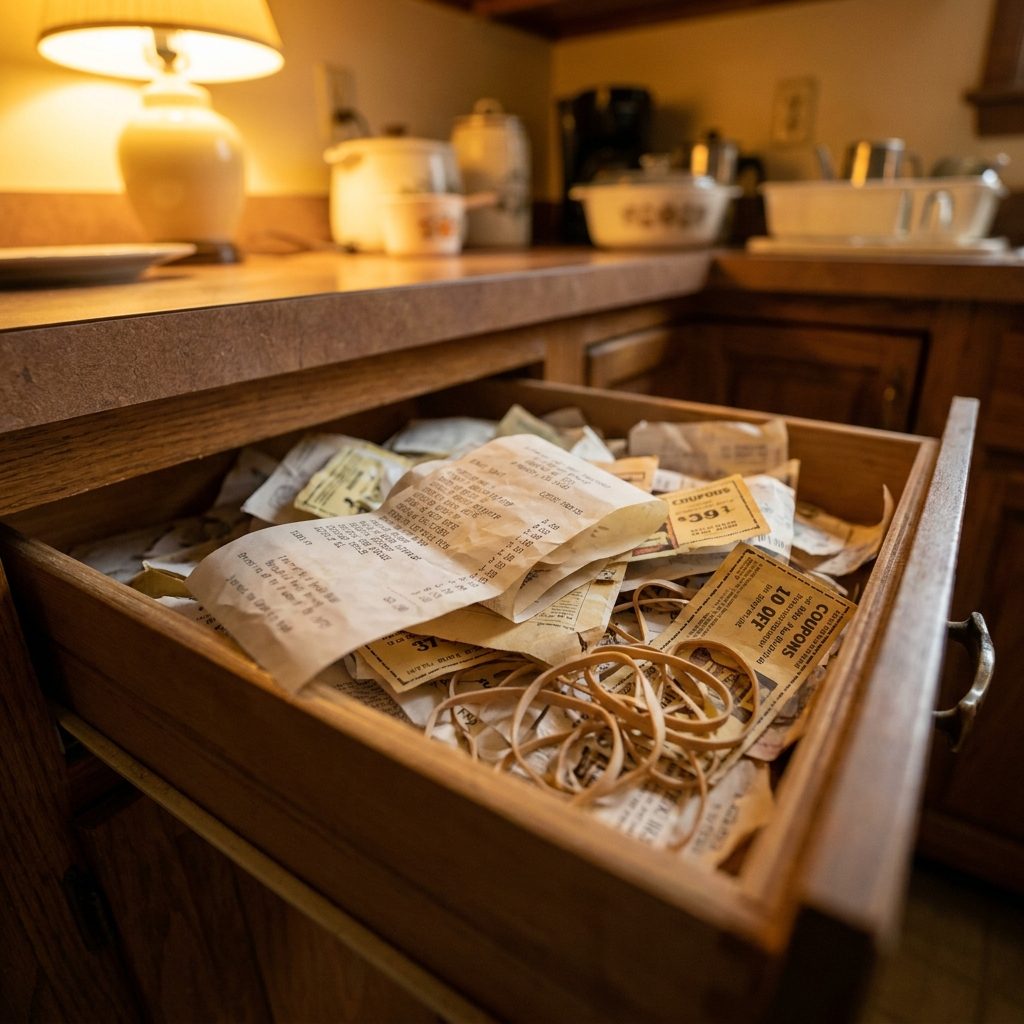
You have a drawer. Or a shoebox. Or an envelope in the glove compartment. It is full of receipts you will probably never read again.
The habit often traces back to a specific room in a specific house: a parent who saved every gas receipt, grocery slip, or warranty in case it was ever needed. You watched the ritual long before you understood what the paper meant.
Research on money scripts frames these behaviors as unconscious, learned early, and often passed from one generation to the next. Source
The receipt itself is rarely the point. It is proof that you were careful and could reconstruct the record if anyone asked. In one household, that habit may have been useful. In another, it may simply be clutter with a family history.
Why Talking About Salary Can Feel More Awkward Than Talking About Sex

You will tell a coworker about your therapist, your marriage, and the strange thing your body did last Tuesday. Ask what she earns, and the room changes.
Many Americans grow up with an unspoken rule that money is private, and that rule often carries straight into adulthood. Source
Economists describe the “salary taboo” as a privacy norm that discourages workers from revealing or asking about pay. That silence can make compensation feel like a verdict on personal worth rather than a workplace fact. Source
Pay secrecy can also preserve inequity. One Canadian study of university faculty found that public salary-disclosure laws reduced the gender pay gap by roughly 20 to 40 percent in that setting. Source
Why You Overtip Even When the Service Was Mediocre
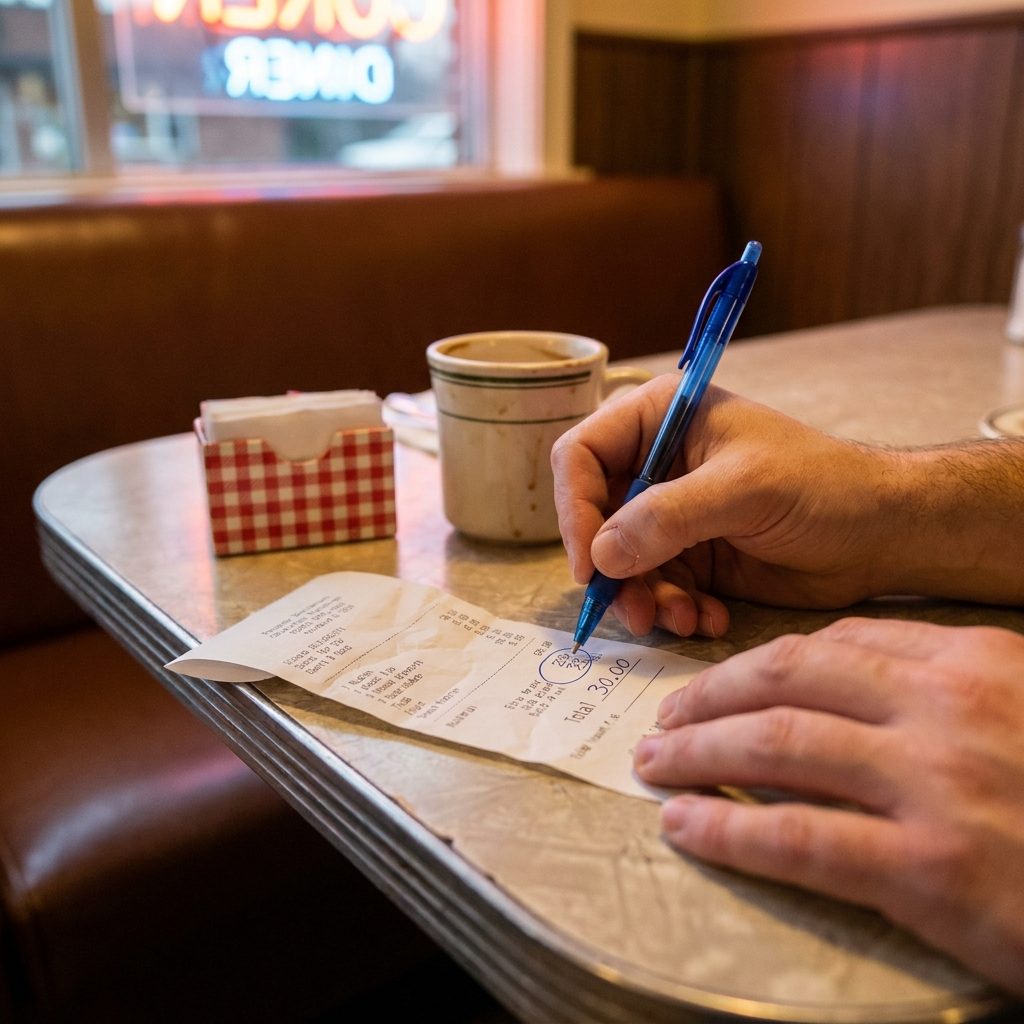
The server forgot your drink. Twice. You still hit 22 percent.
Research suggests that tip size is only weakly related to service quality. Social pressure, empathy, habit, and the desire to appear generous can matter just as much. Source
Being watched matters too. When people feel observed, they are more likely to act in socially desirable ways, which helps explain why a glowing tip screen can feel like a character test. Source
Add a childhood rule such as always tip well; they work hard, and the percentage can become part of your identity. Under-tipping no longer feels like saving three dollars. It feels like becoming the kind of person you were warned not to be.
Why Small Luxuries Feel Safe but Big Purchases Do Not

The candles are expensive. The couch is from a discount warehouse and already sagging on one side.
Small purchases can feel emotionally safe because the stakes are limited and the reward is immediate. Big purchases activate a different rule: we do not spend that kind of money on things like this. The result is a pattern of treating yourself in tiny doses while minimizing the categories that affect daily life for years.
Klontz’s work argues that money scripts often persist as partial truths, continuing to steer adult spending long after the circumstances that created them have changed. Source
The better comparison is not sticker price alone. It is cost over time, durability, repairability, and how often the item will be used.
How “Save for a Rainy Day” Can Turn Into Retirement Anxiety

Someone said save for a rainy day often enough during your childhood that you can still hear the phrase when you look at a retirement balance and wonder whether it is enough.
The Klontz Money Script Inventory includes that belief as a marker of money vigilance. Source In moderation, vigilance can support planning and restraint. Taken too far, it can make financial success difficult to enjoy.
The problem is not saving. It is that the script often has no stopping point. The target moves every time you reach it.
The practical move: define what “enough” means with real numbers, revisit the plan periodically, and let the arithmetic carry some of the weight your nervous system keeps trying to hold.
Why You Say “We Can’t Afford It” to Your Kids Even When You Can

Would you like to save this?
The words arrive before you can catch them. Your child asks for the overpriced snack at checkout, and you hear yourself say, we cannot afford it. Later, you realize you could have.
Financial psychologists call inherited beliefs like this money scripts. They often form early and can keep running long after adult circumstances change. Source
The point is not to start saying yes to everything. It is to notice when the phrase appears and ask whether it is true right now. Sometimes the honest answer is that is not what we are spending on today, which teaches a different lesson from we cannot.
Why a Sale Sticker Feels Like a Win

You walked into the store for socks. Then you saw a red tag, and suddenly the sweater in your hand felt like an opportunity.
Discounts reduce the psychological pain of spending, while scarcity messages such as only two left or today only create urgency. The broad principle is loss aversion: people tend to react more strongly to the prospect of losing an opportunity than to an equivalent gain. Source
That does not mean every sale is manipulation or every bargain is bad. It means the discount can become the product. You stop asking whether you want the sweater and start asking whether you can tolerate missing the deal.
Why You Keep Working Even When the Numbers Say You Could Stop

Your accountant says you are fine. Your spreadsheet agrees. You keep working anyway, and not because you love every minute of it.
Work can become a source of structure, identity, and emotional regulation. Dopamine is involved in motivation and reward processing, so finishing tasks and reaching goals can reinforce the urge to keep going. That does not make overwork an addiction by definition, but it helps explain why an empty Tuesday afternoon can feel strangely uncomfortable. Source
The money layer matters too. If you watched income disappear in childhood or learned that security could vanish overnight, no account balance may feel fully convincing. Some people keep working because stopping would require them to trust a safety they have never felt before. Source
The Strange Comfort of a Junk Drawer Full of Free Ketchup Packets
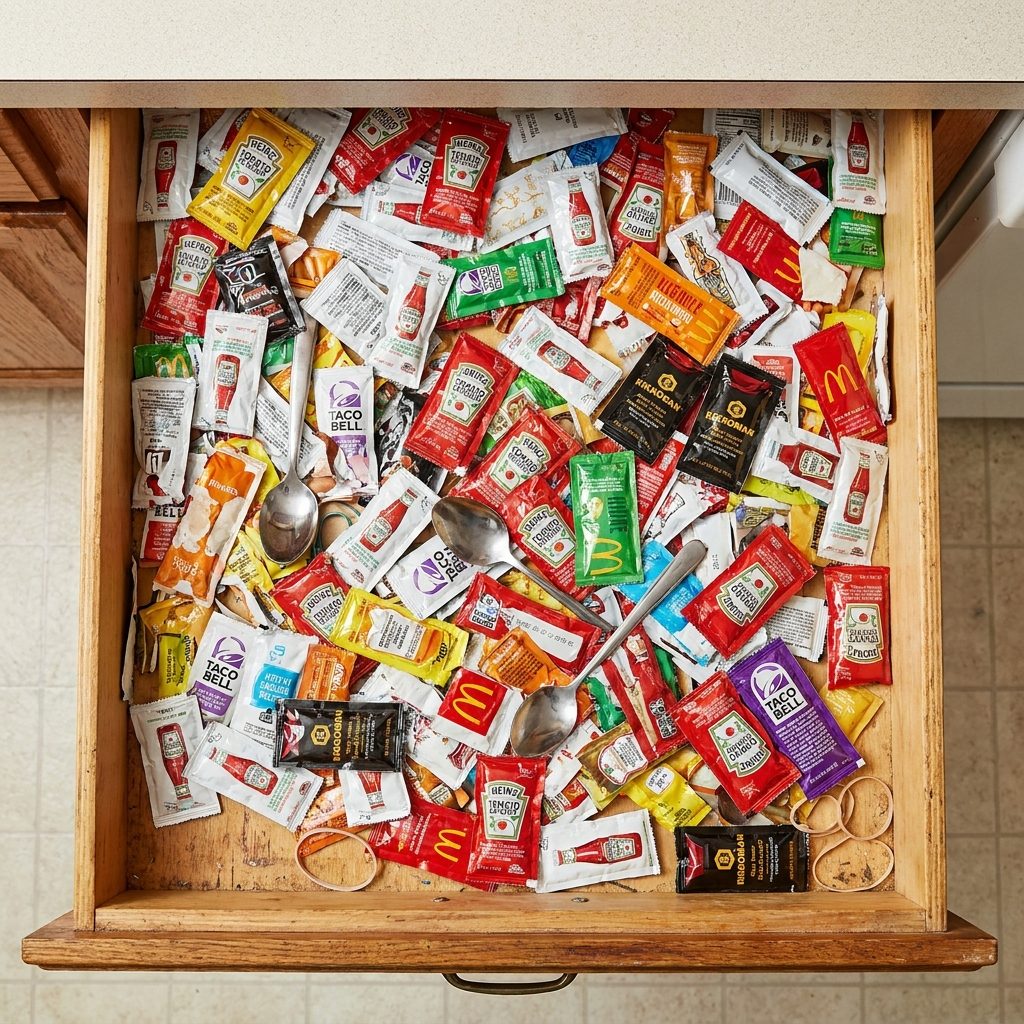
Open the drawer. Count the ketchup packets. There are more than any household could use in years.
This is a narrower habit than the pantry-stocking above. The object here is free, and throwing it away can feel like wasting value rather than protecting against future need. Money scripts built around scarcity often include the belief that resources disappear and anything free is worth saving. Source
The drawer is not doing the same job as a stocked freezer. It is not insurance against an empty shelf. It is a small monument to not having wasted anything, which is its own kind of comfort.
Nobody is saying the drawer needs an intervention. Just notice what you feel when you consider emptying it. That feeling is the tell.
Why You Loan Money to Family You Know Will Not Pay It Back

You already know how this ends. You have loaned before. You will probably be asked again. Somewhere in the transaction, you know the money is gone the moment it leaves your hand.
Financial psychologists use the term financial enabling for repeatedly giving money in ways that protect another person from consequences while harming the giver. Source Planners who work with enabling families describe the strain of trying to support two households at once. Source
Where It Often Starts
Some people grow up learning that love is expressed through rescue, or that the responsible sibling proves loyalty by fixing every crisis. The “loan” is not really a loan. It is a payment for continued belonging.
Why Someone Else Picking Up the Check Can Feel Like a Debt

Your friend reaches for the folder before you do. Your stomach drops.
For people raised in households where receiving something meant owing something, generosity can trigger an old response. Money scripts formed in one context can remain active long after the original conditions are gone.
If money in your family came with strings, hooks, or a running tally, an unpaid share of the check may feel like a debt opening rather than a kindness arriving.
One useful reframe is that accepting can also be a gift. It lets the other person be generous without forcing the moment into perfect balance. Say thank you. Let the discomfort pass without grabbing the folder back.
Why You Hide Purchases From Your Partner Even in a Happy Marriage

You love your spouse. You trust your spouse. You still slide the shopping bag into the closet before they get home.
Researchers call this financial infidelity: engaging in a financial behavior you expect a partner would disapprove of and intentionally hiding it. Both parts are required in that definition, the act and the concealment. Source
The same research found that people prone to financial infidelity preferred more secretive purchase methods, including personal cards, cash, and less conspicuous packaging.
The impulse may come from a childhood in which money conversations meant conflict or one parent policed the other’s spending. The marriage may be healthy. The old hiding reflex may still be checking the door.
Why You Are Always the One Who Buys the Round

Every group has one. You may be the one.
Your hand goes up before the bartender finishes naming the total. You would rather cover it than owe anyone, and part of the appeal may be the role itself: the generous one, the capable one, the person with enough.
Klontz identified a money script called money status, in which wealth and visible spending become tied to self-worth or social standing. Source
That does not mean everyone who buys a round is compensating for insecurity. Hospitality, income differences, and genuine generosity matter too. The useful question is whether paying feels freely chosen or necessary to secure your place in the group.
Why You Never Return Things Even When They Are Broken

The blender arrived with a cracked pitcher. You put it in the closet. That was eight months ago.
Returning something requires a small but specific kind of confidence: the belief that your inconvenience matters, that your money deserves to work, and that asking for what you paid for is not rude. People raised in homes where making a fuss was discouraged may absorb the lesson that it is easier to accept the loss.
Money avoidance can add another layer. Some people associate asking for money back with being greedy, difficult, or too focused on money. Source
Why Your First Big Paycheck Went Toward Something Symbolic

A financial adviser might have told you to contribute to a Roth IRA. You bought a watch.
Or the car. Or the leather jacket your father would have called ridiculous. Whatever it was, practicality was not the point.
The first large paycheck is often spent on a message: to yourself, to a parent, or to the version of you who watched a family struggle and wanted visible proof that life had changed. Money scripts can drive symbolic spending even when it is not the most efficient financial choice.
The behavior is not automatically a mistake. Refusing to name what the purchase meant is. Once you see that the paycheck went toward a story about yourself, you can make the next decision more deliberately.
Why Growing Up Rich Can Leave a Gap in Money Skills

Would you like to save this?
The trust-fund cliché misses the more interesting problem. When money is the water you swim in, you may never learn to notice it.
Affluent children can miss the small frictions that build practical skill: waiting, budgeting, comparing, and feeling the consequence of a low balance. Without those repetitions, spending can feel frictionless and consequences abstract.
The familiar claim that 70 percent of family wealth disappears by the second generation and 90 percent by the third is widely repeated in wealth-management circles, but its original evidence is difficult to establish and should be treated cautiously. Source
Material comfort also does not guarantee emotional security. Some therapists describe adults raised with wealth but little emotional attunement developing their own forms of vigilance, overspending, or overwork. Source
The lever is practice: wait before nonessential purchases, track cash flow for a month, and build the repetitions that abundance may have removed.
Why You Say Yes to Every Freelance Gig You Do Not Have Time For

Your calendar is a mess. Your inbox is worse. The email still arrives and your fingers type absolutely, happy to before your brain has weighed in.
Some trauma therapists use the word fawning for a people-pleasing response in which saying no feels threatening rather than merely awkward. Source
Pair that with a childhood in which money felt uncertain, and freelance work can become difficult to decline. Compliance feels safe, while turning down income can feel like inviting instability back into the room. Source
The useful distinction is not whether you are ambitious. It is whether the yes comes from choice or panic.
Why You Save Aggressively but Cannot Bring Yourself to Invest

Your savings account is padded. Your brokerage account is empty, barely open, or still holding the same small deposit from three years ago.
One belief measured in the Klontz Money Script Inventory is that investing in the stock market is not a secure way to build a future. Source If you grew up hearing that stocks are gambling, that markets are rigged, or that only cash is safe, the belief may feel like common sense rather than a script.
The next step depends on your emergency savings, debt, time horizon, tax situation, and tolerance for risk. A small automated contribution to a diversified investment may help some people, but it should fit the rest of the plan.
Why a Full Gas Tank Feels Like an Emotional Event
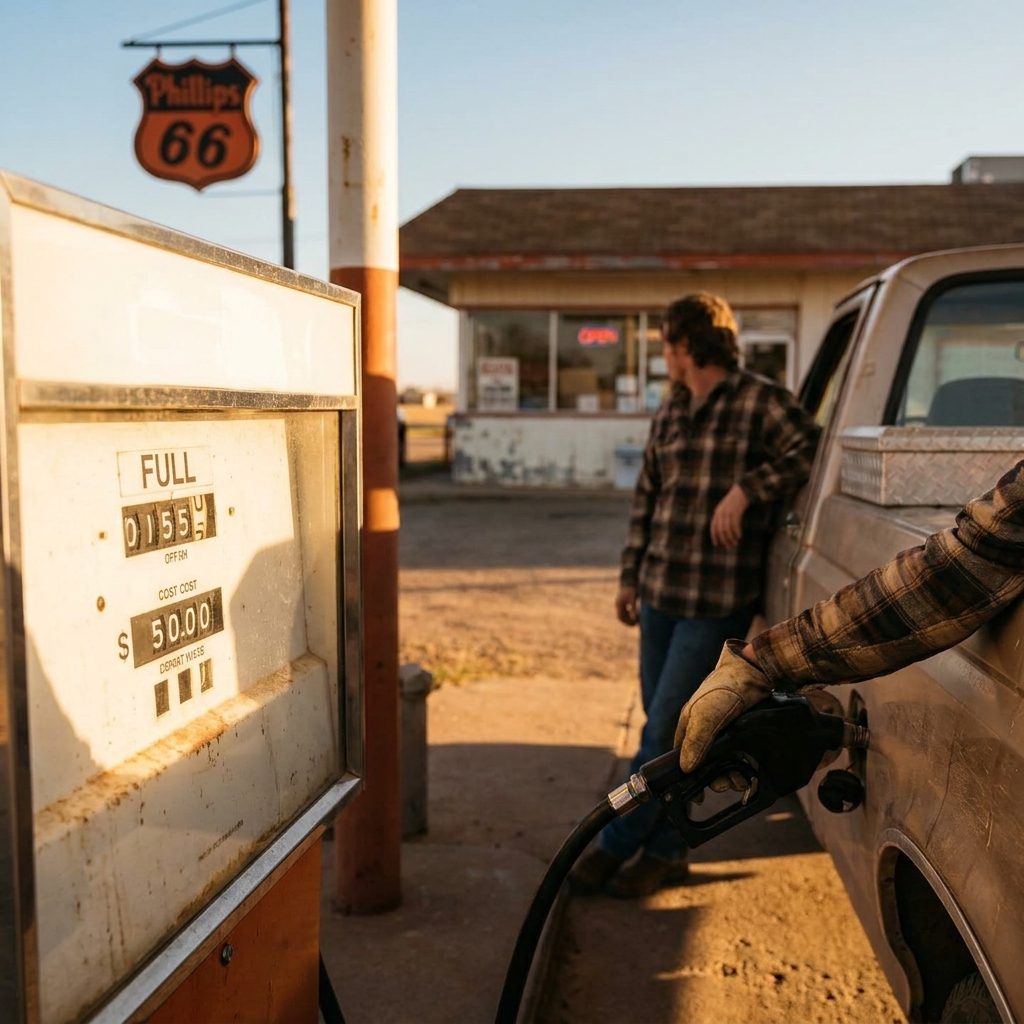
You watch the pump click to full and something in your chest loosens. It is not just fuel. It is reassurance, and it is worth asking where that particular reassurance comes from.
For some children, a full tank meant the family had made it through the week. An empty one accompanied conversations they were not supposed to overhear. The nervous system recorded both, and adults who grew up with that kind of scarcity often carry patterns that do not match their current bank balance. Researchers describe hypervigilance around money and difficulty enjoying stability even when circumstances improve. Source
Research also suggests that adults from less stable childhood environments may become more present-focused under financial threat, while those from more secure backgrounds are better able to prioritize long-term goals. Source
Notice the feeling next time it happens. Naming it is often the first step toward updating it.
Why You Give Gifts That Cost More Than You Can Afford

The card reader beeps. The number is higher than you planned. You tell yourself they are worth it.
Some money-avoidance beliefs involve discomfort with holding money, guilt about having it, or a sense that keeping too much is selfish. Source In that context, generosity can become a socially admired way of spending beyond your limits.
A scarcity childhood can create another motive. If you remember what it felt like when someone could not afford a gift, you may overspend to make sure nobody around you feels that absence now.
Why Hearing Money Fights Can Make Credit Cards Feel Dangerous

You know the fight. You were supposed to be asleep. The voices were low, then not low. It was about a bill, a balance, or something one person had not told the other.
Adults who grow up hearing repeated money conflict may learn to associate financial conversations with relationship danger. Source
For some people, that history leads not to secret spending but to avoidance: unopened statements, fear of carrying any balance, reluctance to use credit even strategically, or panic around a card that is fully under control.
The credit card is not the real issue. It is the object that became attached to the memory.
Try one small update: review the statement at a fixed time each month, with the goal of gathering information rather than solving your whole financial life in one sitting.
Why Getting Paid What You Are Worth Can Still Feel Like a Mistake

The offer arrives. It is the number you wanted. Instead of relief, you feel as though someone made a mistake.
Psychologists Pauline Clance and Suzanne Imes described impostor feelings in 1978 as a persistent sense of intellectual fraud despite evidence of competence. Later studies have reported widely varying prevalence rates, depending on the population and the way the experience is measured. Source
The financial cost is difficult to calculate precisely, but the pattern can discourage negotiation, promotion, and visible ambition.
A childhood layer may intensify it. If good things felt temporary, or praise was always followed by pressure, abundance can register as unstable.
The Bottom Line
Many money habits are not really about the transaction in front of you. They are attempts to create safety, belonging, control, or relief. Childhood is one source, but not the only one; culture, present income, debt, personality, and adult experience matter too.
The useful question is not whether a habit is irrational. It is whether the old rule still fits the life you have now. Once you can name the rule, you get to decide whether to keep it.