
Would you like to save this?
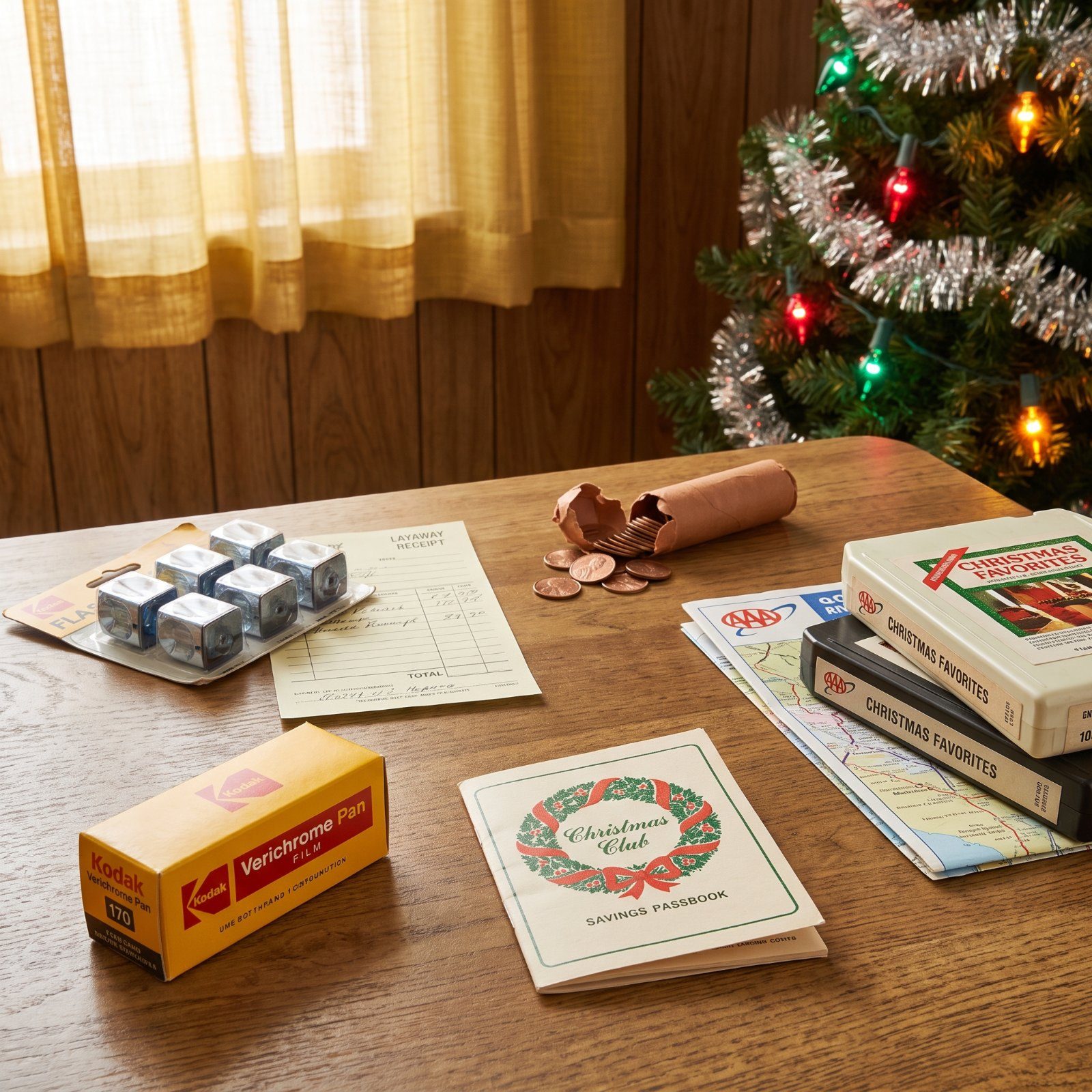
The December budget had lines on it that would baffle a kid today. Film. A club account you fed all year for one December check. A service fee just to hold a bike in the back of a store. None of it felt strange back then — it was simply what Christmas cost, and everybody paid it without blinking.
We went digging through the money habits of a 1970s holiday, the ones that quietly slipped away while nobody was watching. What follows is the paperwork, the coins, and the cartridges that used to ride shotgun with the season.
36. Kodak Film and Flashcubes for Christmas Morning
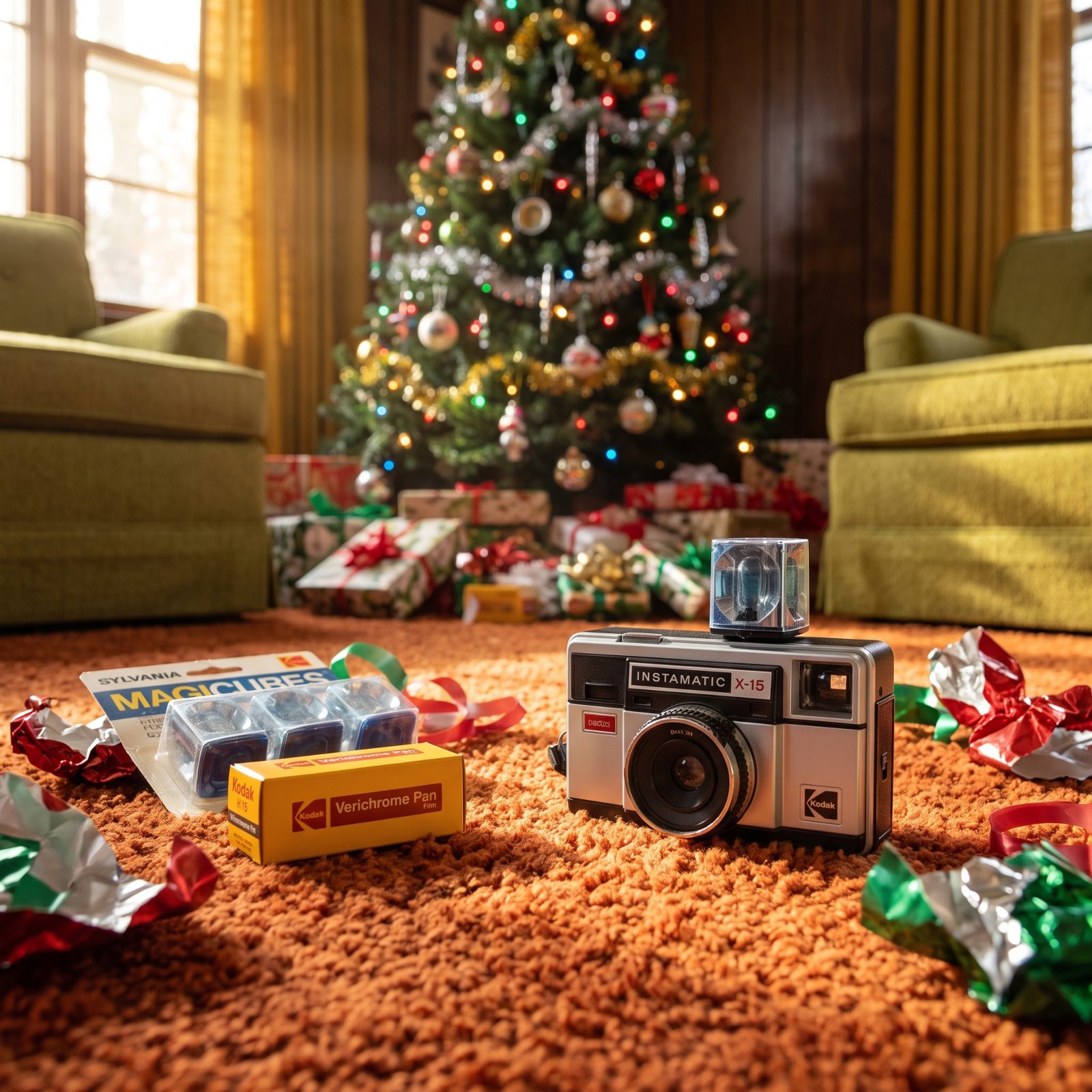
You got twenty-four shots, maybe thirty-six, and then you were done. Christmas morning ran on a strict allowance of pictures, and Dad rationed the frames like they were the last cookies in the tin.
The flashcube was the real event. Four bulbs, one per corner, each a single blinding pop and a puff of that hot-plastic smell, and the cube clicked around after every shot. Burn through all four and you snapped on a fresh one — and the good cubes cost extra.
Then the film went off to the drugstore, and a week later you learned half the pictures were blurry, someone’s eyes were shut, and the one clean shot of the tree had a thumb over the corner.
35. A Christmas Club Savings Account
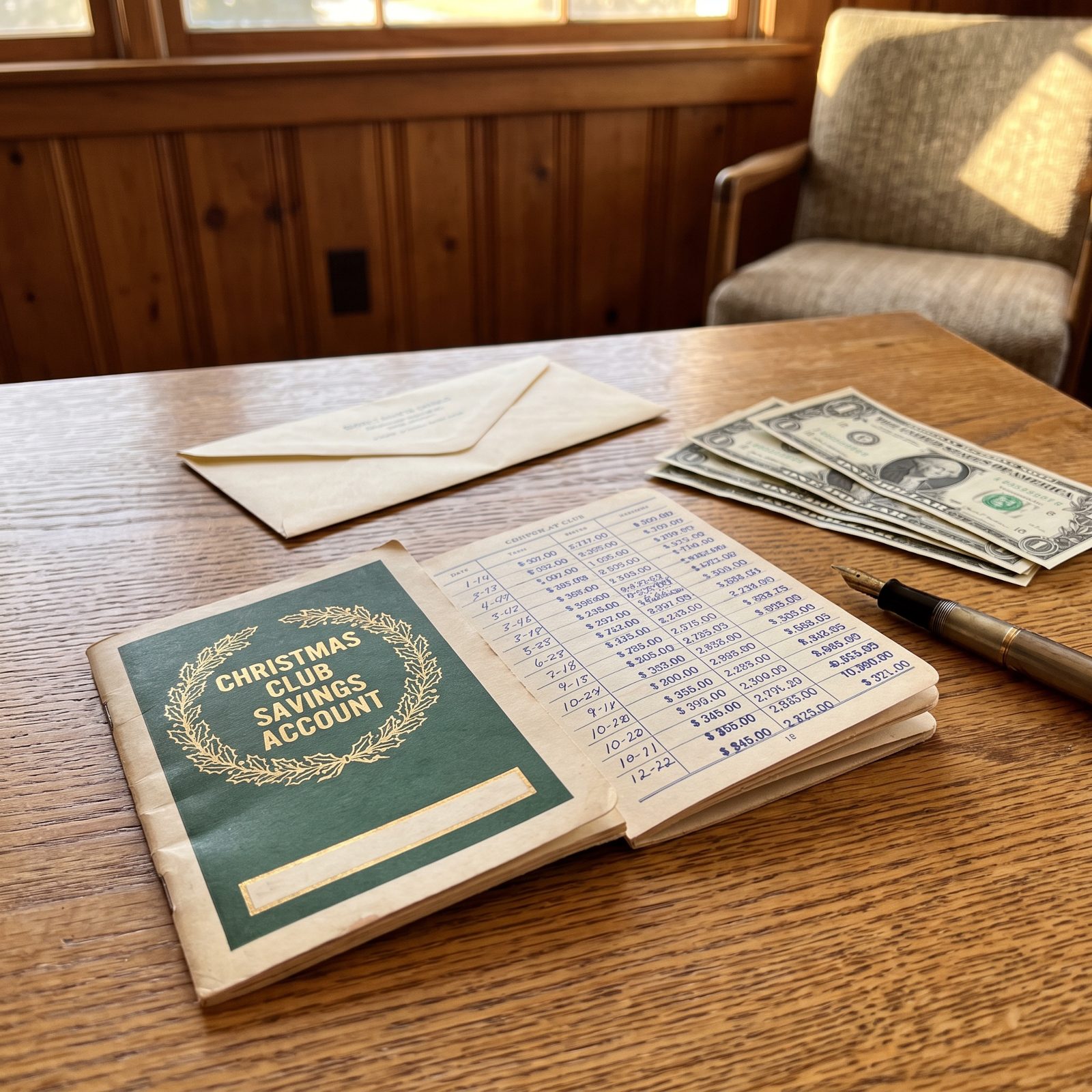
All year long you fed it. A dollar a week, maybe five, dropped at the teller window and stamped into a little booklet with a wreath on the cover. The bank paid you almost nothing in interest and you didn’t care, because the return was never the point.
The point was that check. In the second week of December, an envelope arrived with your name on it, holding exactly the money you’d need for Christmas. You’d budgeted for the holiday a full year out, one small deposit at a time, and it worked precisely because you couldn’t easily raid it.
It was forced saving dressed up as a holiday tradition, and honestly, it was smarter than most of what replaced it.
Banks phased these out as credit cards took over and people decided they’d rather owe in January than save through the fall. Bad trade, if you ask me.
34. Layaway Service Fees for Holiday Gifts
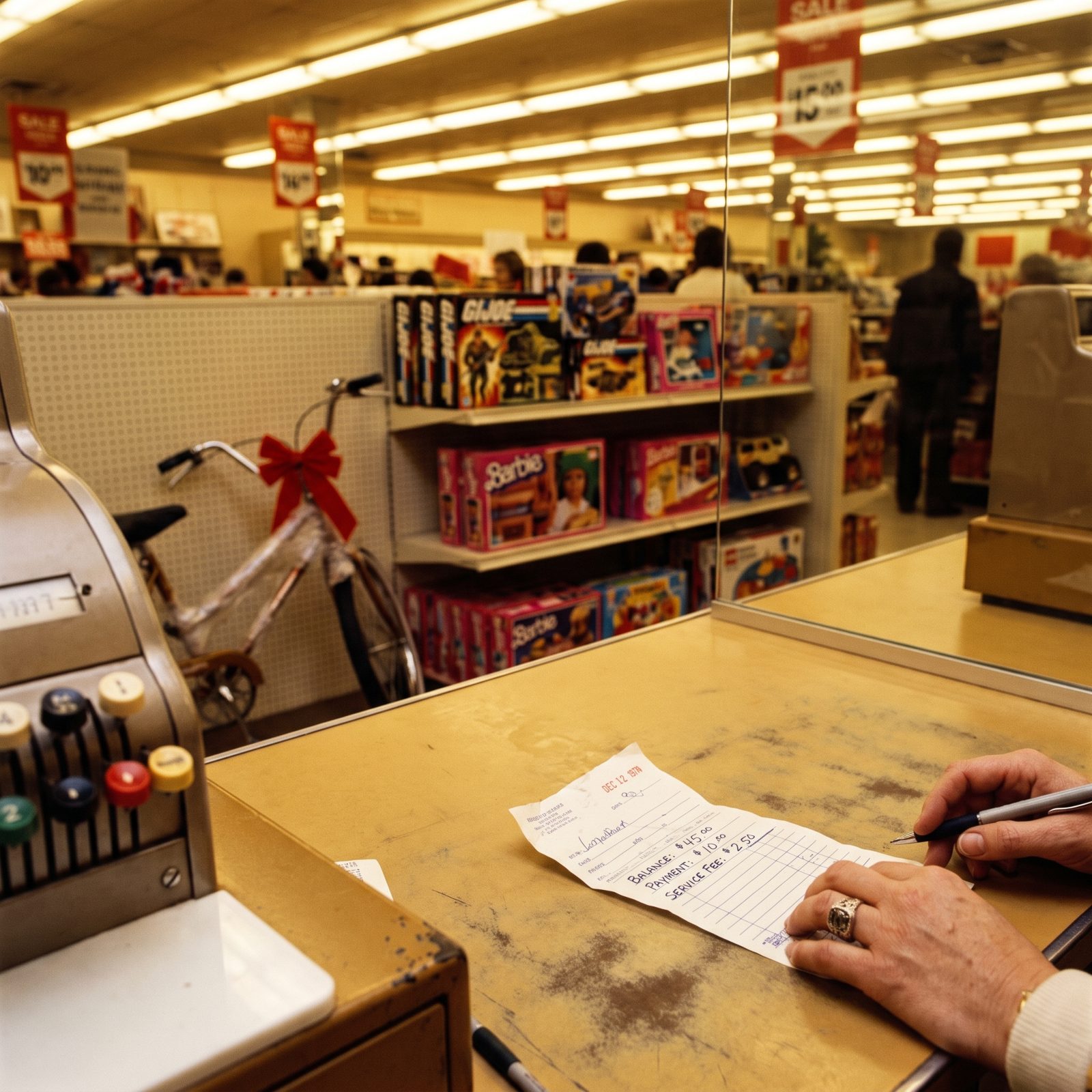
The bike sat in the back room from October, tagged with your family’s name, while you chipped away at the balance. No credit check, no interest, and for a small fee the store kept it hostage until you hit zero.
That fee was the price of not having the money yet — a dollar or two to keep the layaway ledger open, plus whatever went down as a deposit. Fridays, you’d stop by with cash, watch the clerk ink in the new balance, and walk out owning a little more of a toy you still couldn’t take home.
33. Money Orders for Catalog Purchases
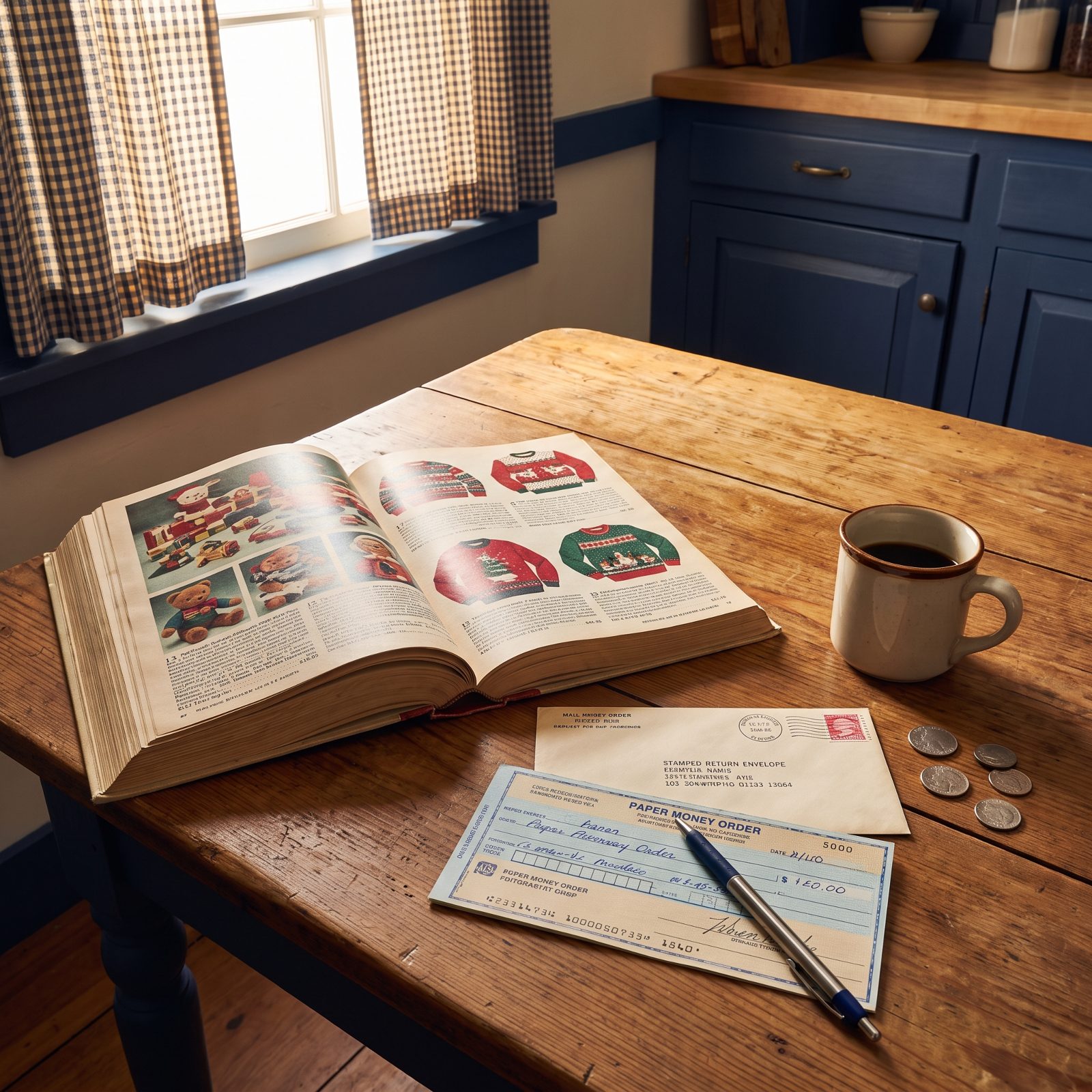
Not everyone had a checking account, and almost nobody trusted mailing cash. So you walked to the post office or the corner store, handed over the money plus a small fee, and came away with a money order made out to Sears or Montgomery Ward.
You tucked it into the order form, sealed the envelope, and mailed your Christmas away weeks early, because that’s how long the parcel took to crawl back. The fee bought you peace of mind — cash turned into something safe to send.
Debit cards and online checkout made all of it pointless. Still, there was a real satisfaction in filling out that little slip in careful handwriting, knowing your gift order was officially on its way.
32. C.O.D. Charges on Christmas Parcels
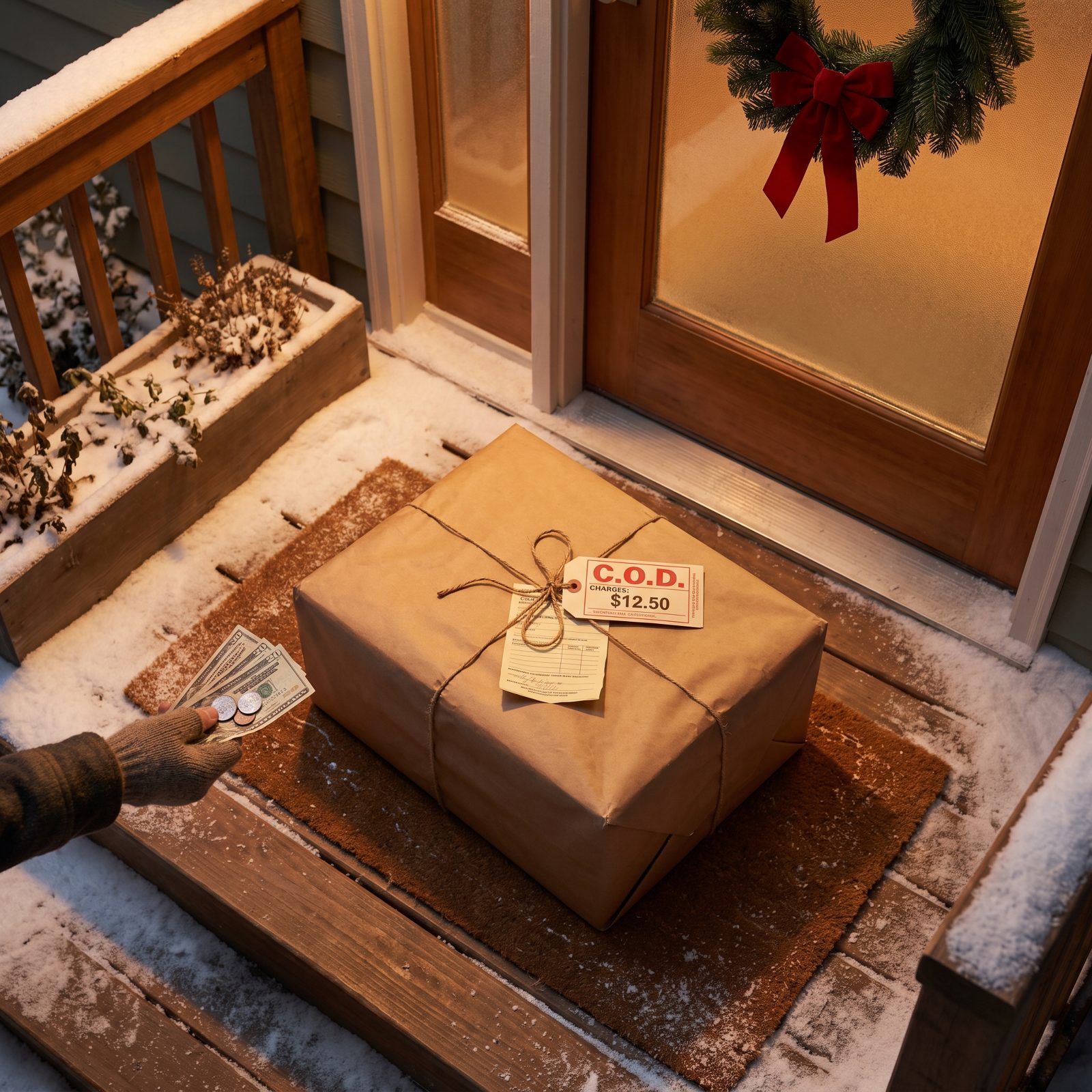
Cash on delivery meant exactly that. The parcel showed up, and you paid the driver right there at the door before he’d hand it over — gift plus shipping plus a collection fee, all due the second it arrived.
Families stashed a little cash aside in December for precisely this. You never knew which day the C.O.D. box was coming, and the driver wasn’t budging without his money. Miss the delivery? Then you’d trek to the depot and claim it yourself.
31. Traveler’s Checks for a Christmas Trip
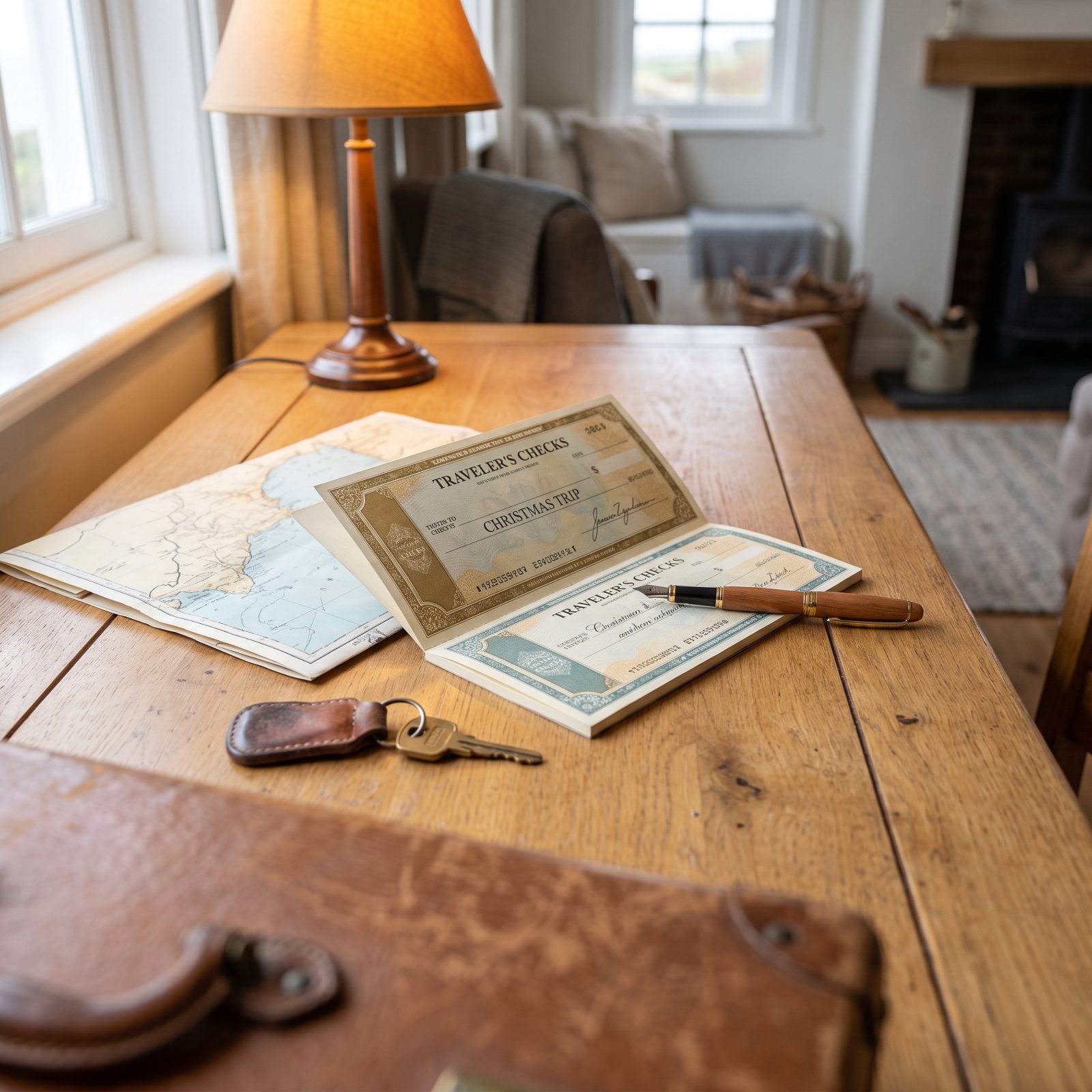
Before you loaded the wagon for the long haul to Grandma’s, you stopped at the bank and bought traveler’s checks. You paid a fee, usually a percentage, for the privilege of carrying money nobody could steal and spend on you.
The clever bit was the two signatures. You signed each one at the bank, then signed it again in front of the cashier when you spent it, and the two had to match. Lose the whole booklet and the company simply replaced them — which felt like magic in a world before you could freeze a card from your phone.
They were the safety net of the holiday road trip. Now they’re a museum piece, and good luck finding anywhere that still takes one.
30. A Roll of Coins for Holiday Tollbooths
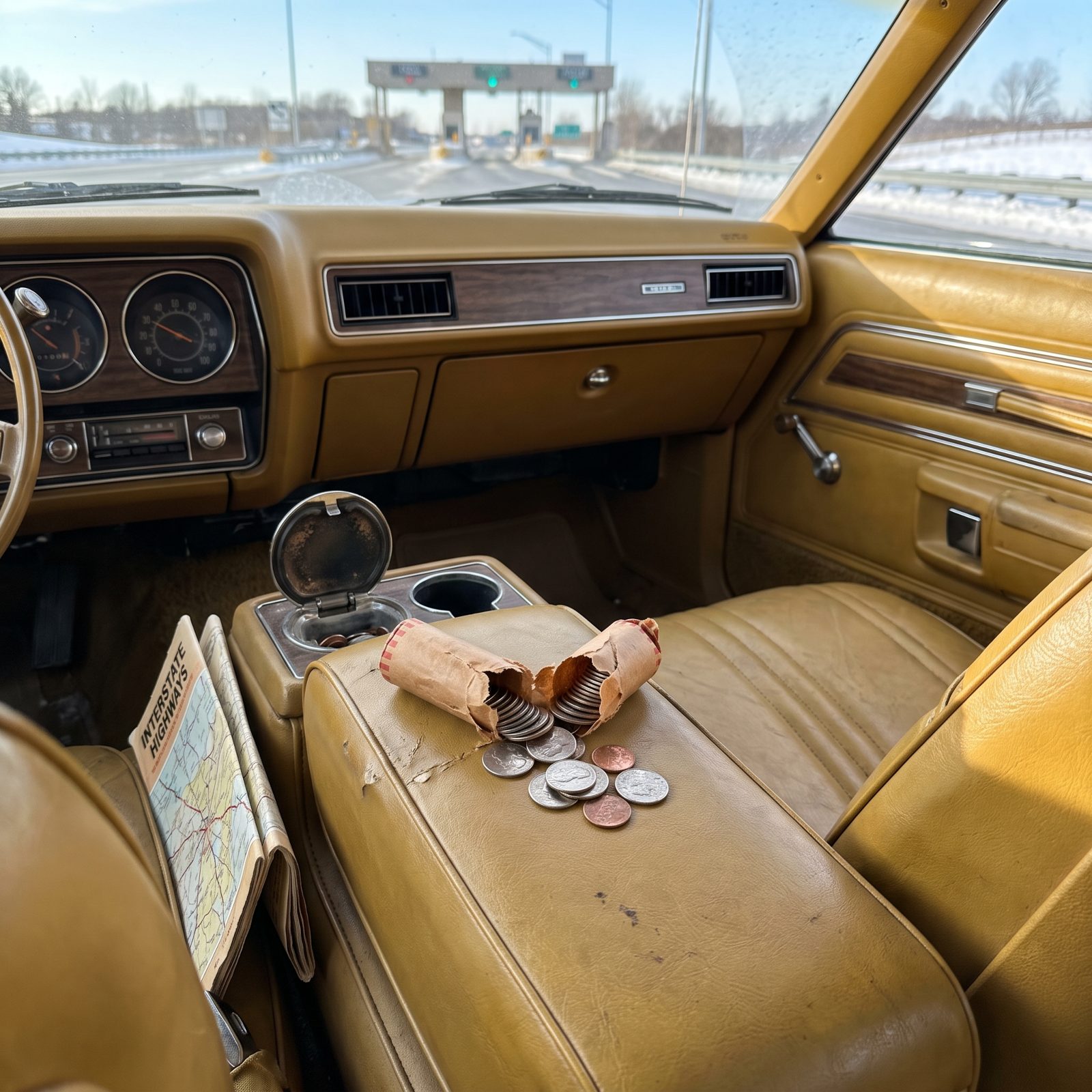
You cracked open a roll of quarters and dumped them in the ashtray before you hit the highway. Every tollbooth wanted exact change, the exact-change lane was the fast one, so the coins lived within arm’s reach of the driver the whole trip.
The rhythm stuck with you. Slow down, roll the window into the cold, drop the coins in the basket, listen for the clatter and wait for the green light — then do it all again a few dozen miles later, over and over, right up to the family gathering.
Electronic transponders wiped out the whole ritual. Nobody keeps a coin roll in the car now, and that image of an arm reaching out into the December air went with it.
29. Road Maps for Visiting Family

You grabbed a state road map free at the gas station, or splurged on a proper atlas, and the entire route to the relatives lived on paper. Somebody — usually whoever drew the passenger seat — ran it as navigator, map sprawled across their knees.
Then there was the folding. A map never went back the way it came, and by New Year’s it looked like it had survived a hurricane. But it held the whole trip: the circled exit, the penciled note about where to grab gas, the coffee ring somebody left near Toledo.
28. A CB Radio for the Christmas Road Trip
Would you like to save this?
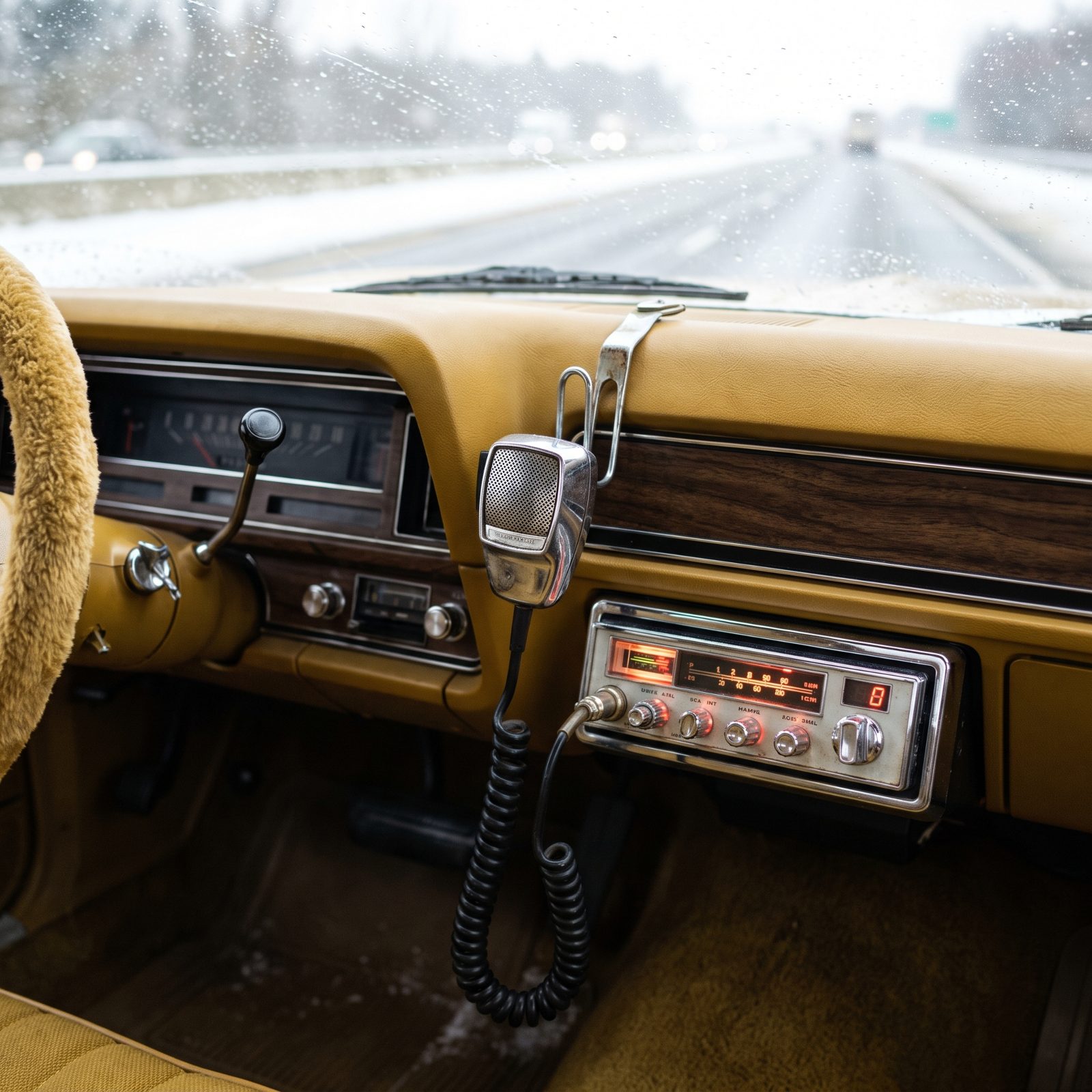
The CB radio was the group text of the interstate. Families bought them, wired them under the dash, and suddenly the long haul to relatives came with a running conversation from every truck and car within a few miles.
You picked a handle, learned the lingo, and grilled the truckers about speed traps and whether the pass ahead was iced over. On Christmas drives the chatter warmed up — strangers wishing each other safe travels across channel 19, a little community that formed and dissolved at sixty miles an hour.
27. Prerecorded Christmas Eight-Track Cartridges
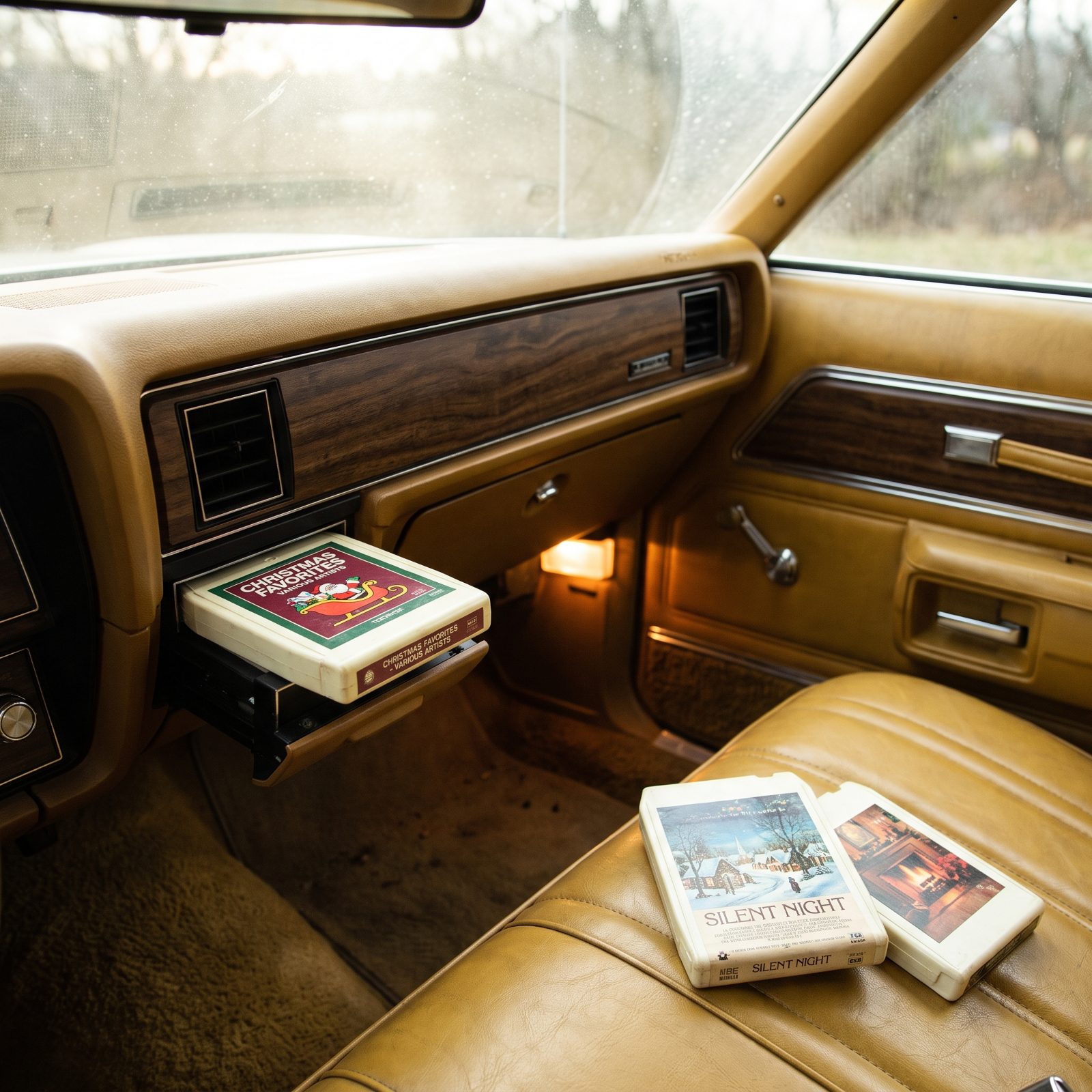
The Christmas trip had a soundtrack, and it arrived in a plastic brick you shoved into the dashboard with a satisfying clunk. Eight-track cartridges of holiday standards rode along in the glove box, ready for the drive.
They had one glorious flaw. The album was carved across four program loops, and the machine jumped between them wherever it happened to land — so a carol could fade out mid-verse with a loud ka-chunk and resurface somewhere else entirely. You learned to live with it.
Cassettes killed the eight-track fast, and CDs finished the job. But that fat cartridge of carols is pure 1970s, and the sound of it locking into the player? A December memory all by itself.
26. A Portable Cassette Recorder for Family Messages
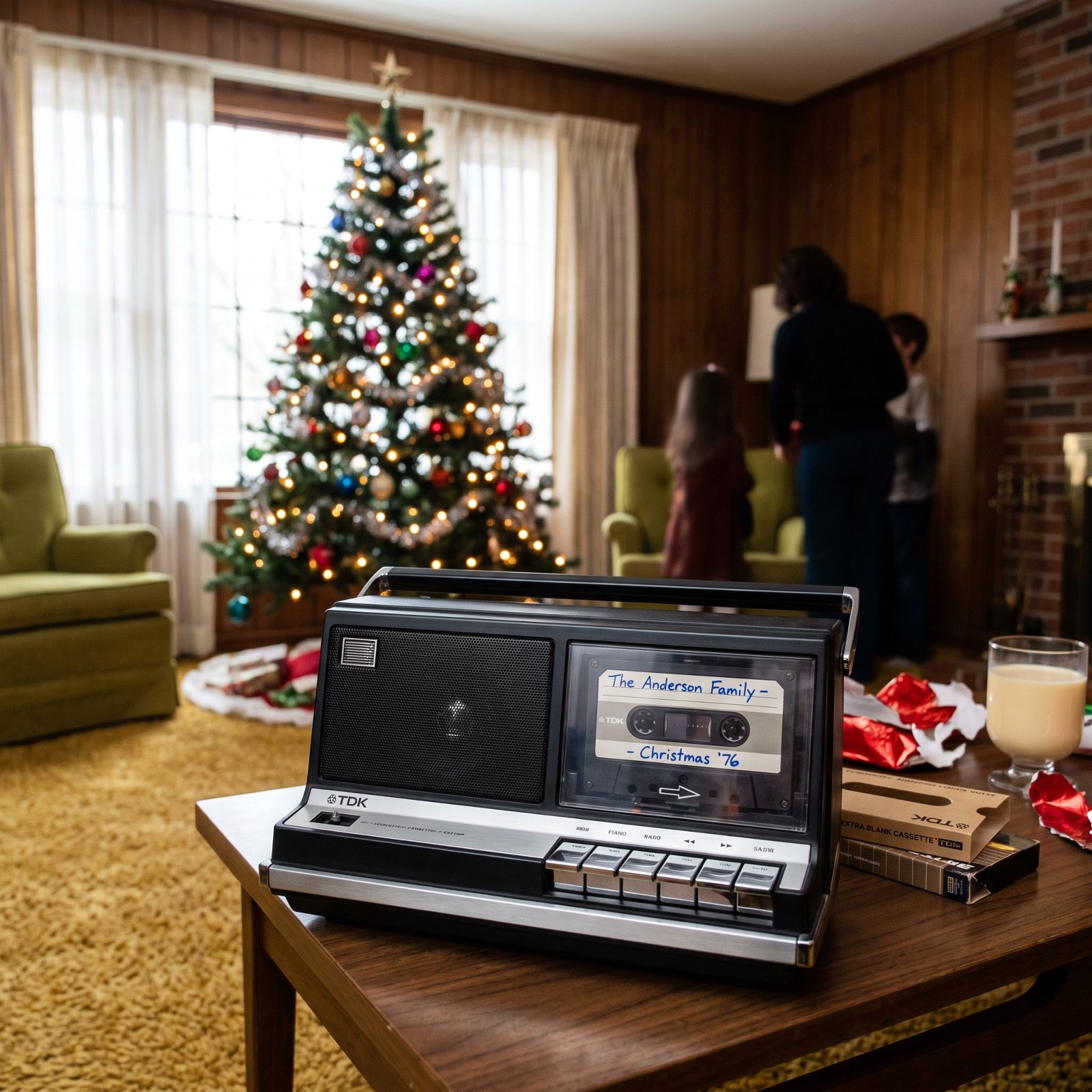
Before you could text grandma a video, you mailed her your voices. Families would gather around a portable cassette recorder, press the two clunky buttons down together, and take turns saying hello into that tinny built-in mic. Somebody always leaned in too close, somebody always laughed at exactly the wrong moment, and the tape caught all of it.
Then it got wrapped, labeled in ballpoint, and mailed off to relatives too far to visit. They’d play it back on their own machine and hear the kids screaming about what Santa brought. Clunky. And wonderful.
25. Replacement Stereo Needles for Christmas Records
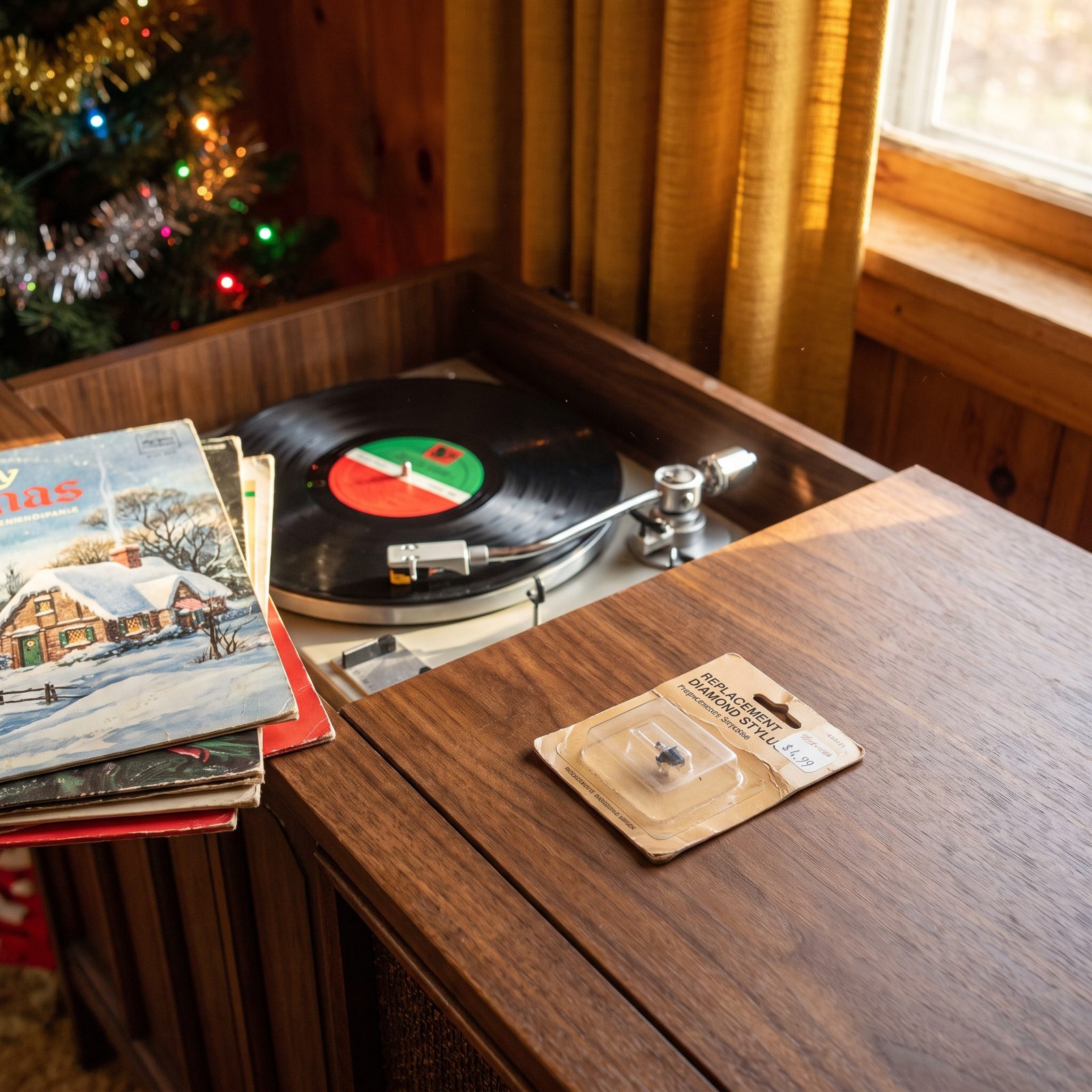
A worn needle could ruin your favorite records, and everyone knew it. By December the family Christmas albums had been dropped, scratched, and played half to death, so a trip to the record counter for a replacement stylus was practically a holiday errand, right up there with the tree.
You matched the tiny cardboard package to your cartridge model, which meant squinting at a fold-out chart taped to the counter. Grab the wrong one and it wouldn’t seat right. Grab the right one and the record sounded clean again, no hiss, no skip on the best part of the carol.
Nobody thinks about their turntable’s needle anymore because almost nobody owns a turntable. Back then it was just maintenance, same as swapping a furnace filter.
24. A Christmas Album From a Record Club
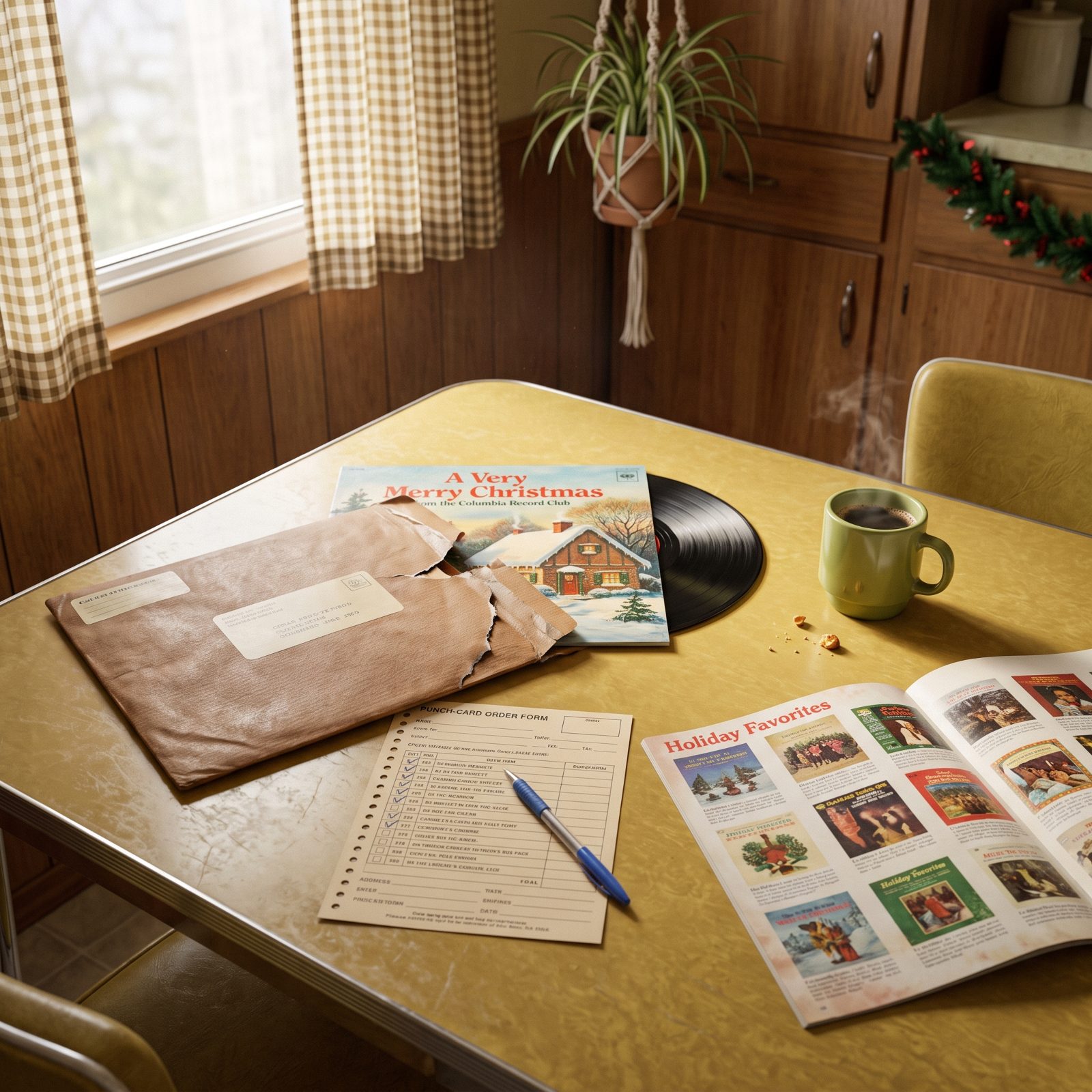
You joined for the penny. Eleven albums for a cent, the ad promised, and then you owed them a record a month for what felt like the rest of your natural life. Every household had that stack of Columbia House or RCA envelopes piling up on the counter, half of them unopened.
The Christmas album was the one selection nobody fought about. It arrived in November, right on schedule, some orchestra sawing through carols or a crooner in a cardigan on the cover. You forgot to mail the reply card back, so it showed up whether you wanted it or not.
23. A Rental Movie Projector for Holiday Home Movies
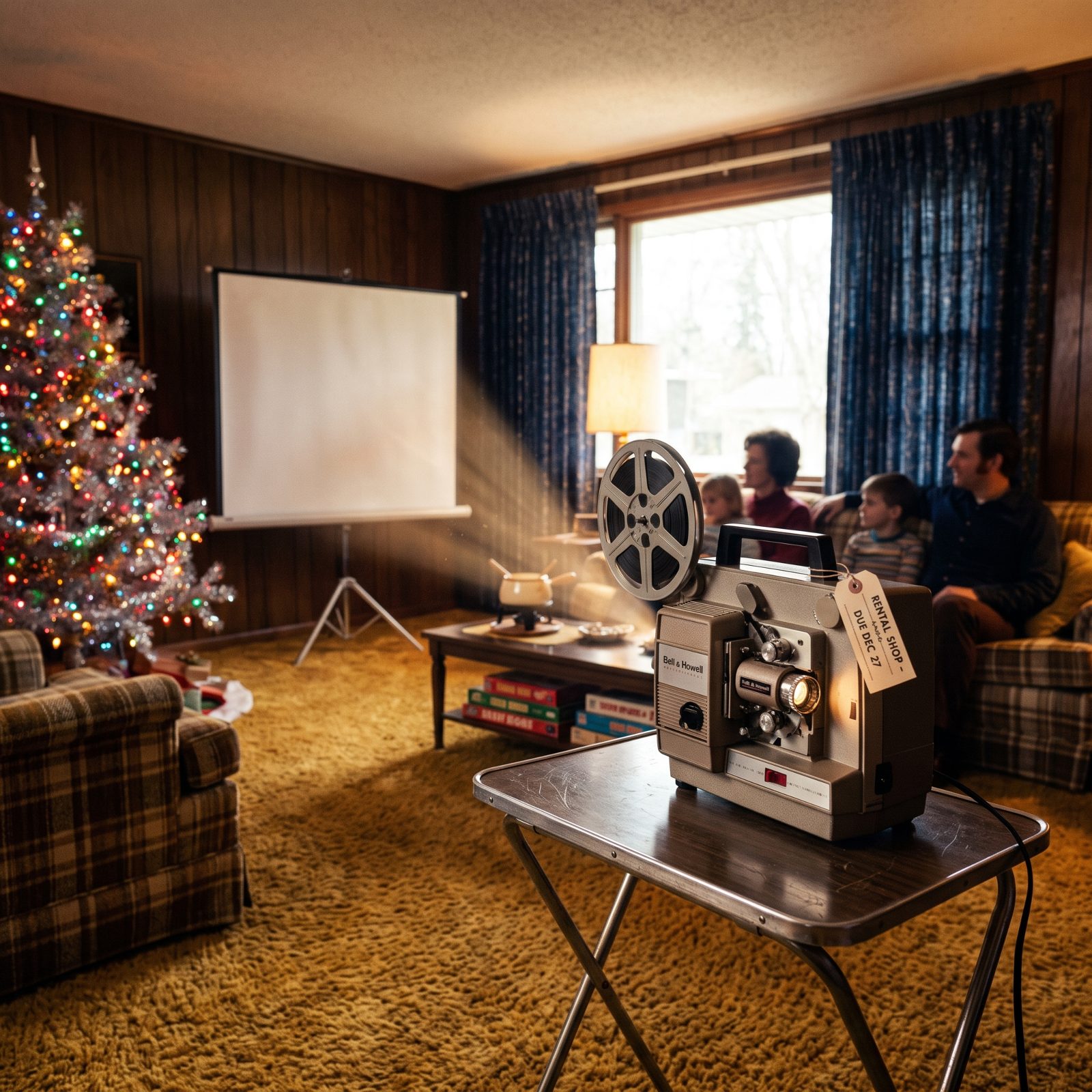
Most families didn’t own a projector. It cost too much and sat idle eleven months of the year, so you rented one, usually from the same camera shop or drugstore that developed your film, and you booked it early because everybody in town wanted one for the holidays.
Setting it up was an event all its own. Threading the film through those little sprockets while everyone crowded in to give advice, the bulb running hot enough to warm the whole room. Then the beam hit the screen and there was last summer, flickering and silent, and the family narrated it out loud over each other.
You returned it the next day, before the late fee kicked in.
22. Super 8 Film, Processing, and Splicing Supplies
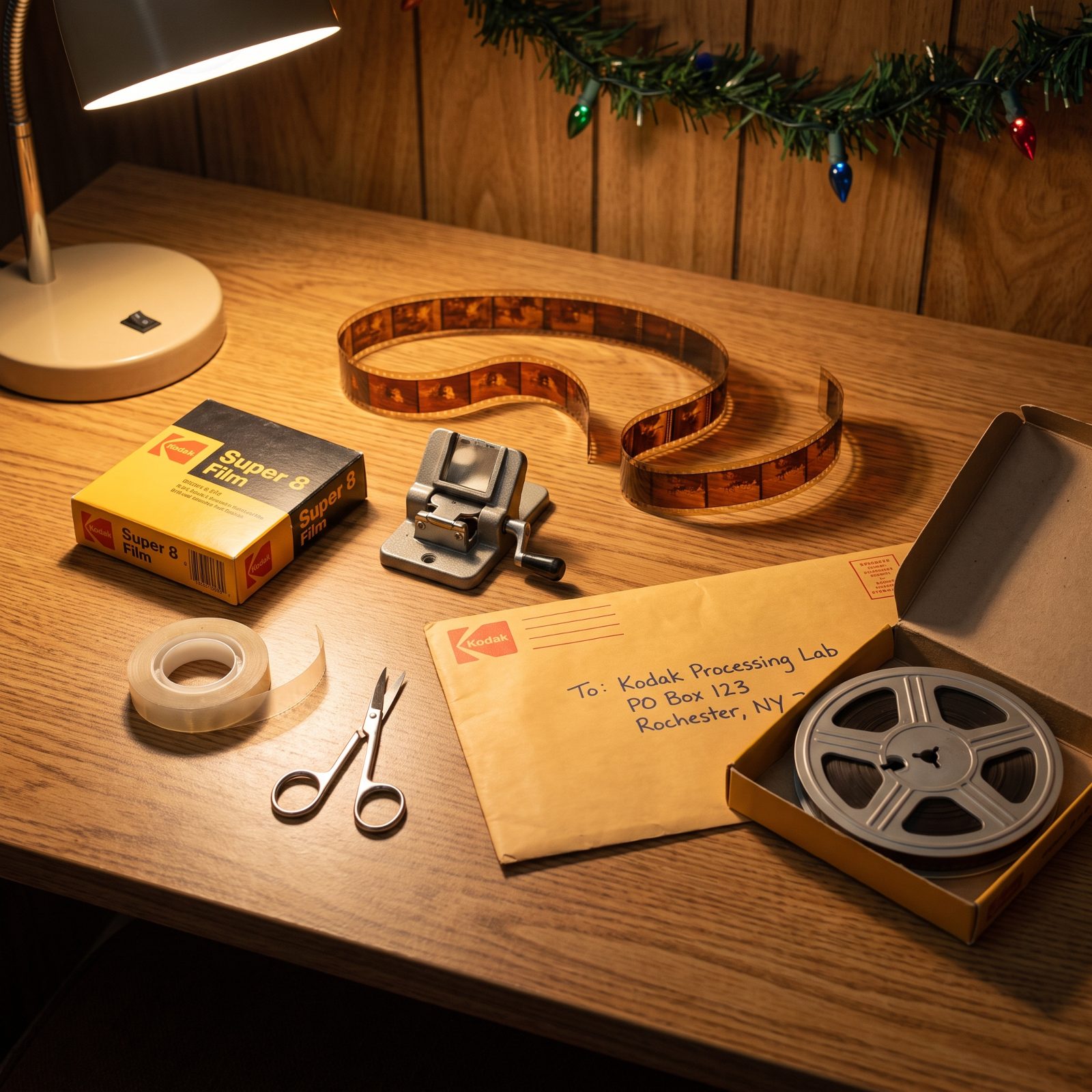
Film wasn’t free, and you felt every foot of it. A Super 8 cartridge gave you about three minutes, which is why home movies from that decade are all Christmas morning, birthday cake, and somebody waving stiffly at the lens. You didn’t waste a frame.
Then came the waiting. You dropped the cartridge in a processing mailer or handed it across the counter, and days later got back a reel of your own life. If a splice broke, you fixed it yourself with a little metal splicer and a strip of tape, hunched over the desk, cursing quietly, trying to line up sprocket holes the size of a grain of rice.
21. A Television Repair Call Before the Holiday Specials
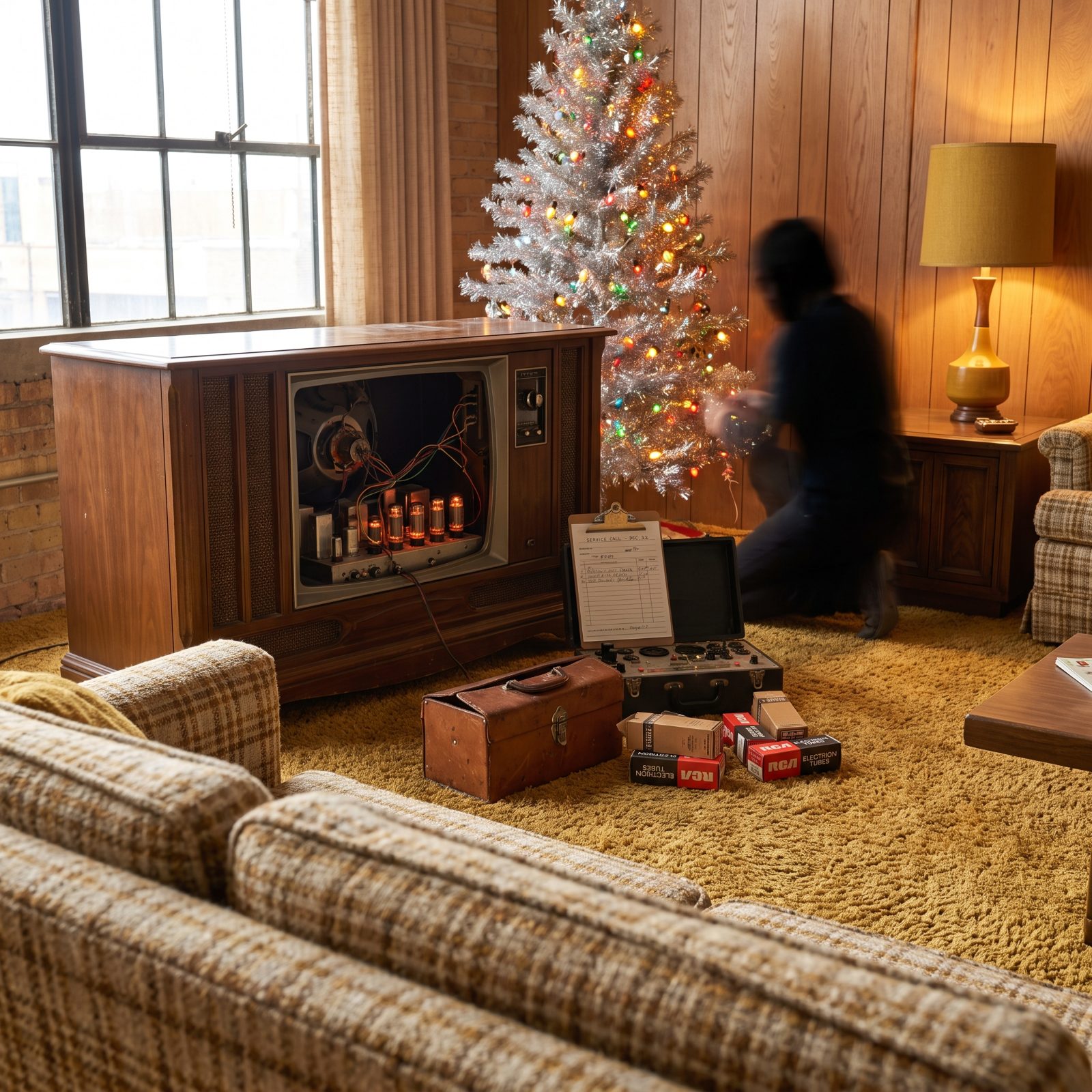
The set always died at the worst possible moment. Some Sunday in December the picture would shrink down to a bright dot in the middle of the screen, and with the Christmas specials coming, you weren’t about to wait it out. You called the TV repairman.
He’d come to the house, pull the back off the console, and start testing tubes one by one, muttering to himself the whole time. Nearly always it was a burned-out vacuum tube, a couple of dollars, and he had a spare in his kit. He’d write up the invoice, pack his case, and the picture came back before the first ad break.
House calls to fix a television. Try explaining that to anyone under forty.
20. A Printed TV Guide Christmas Issue
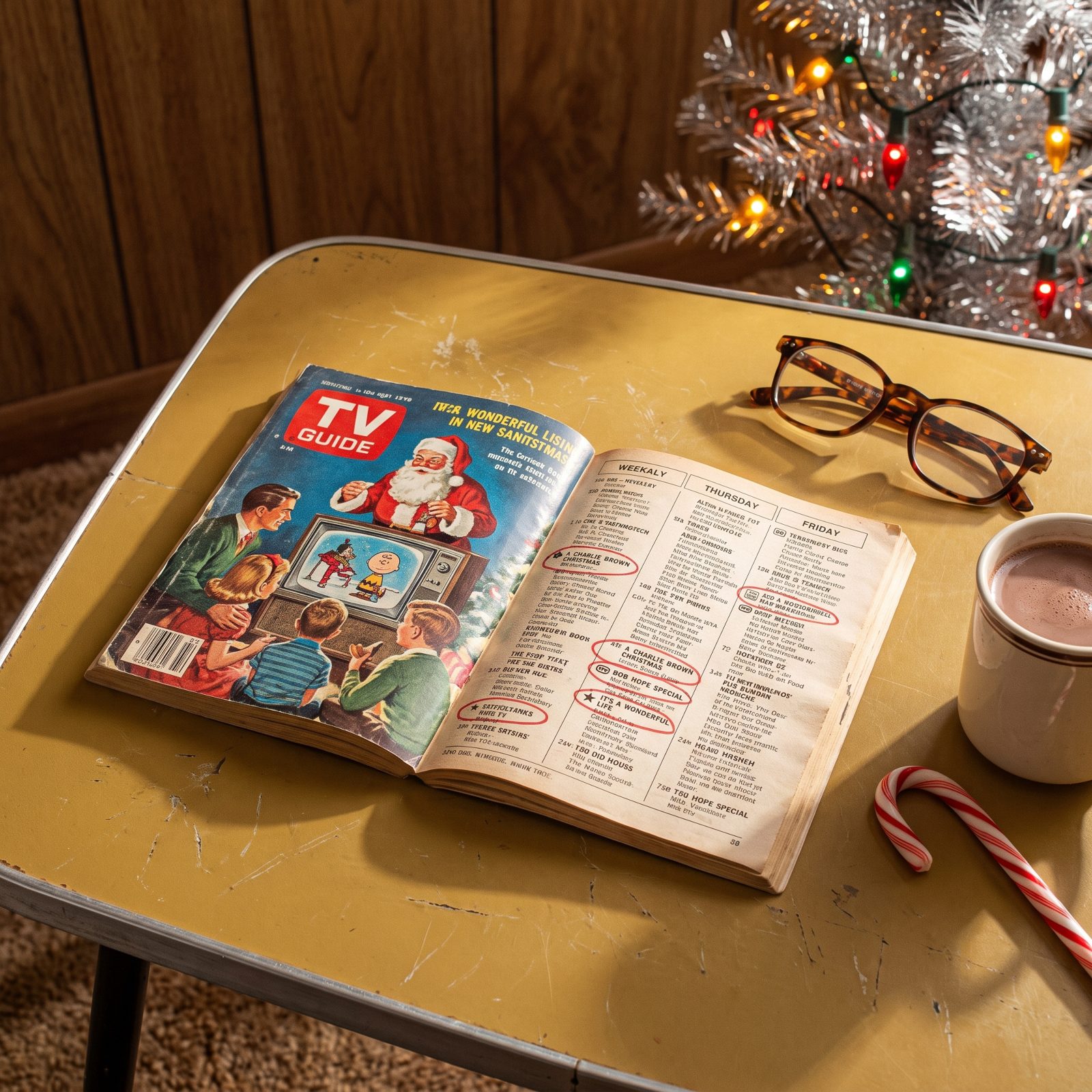
The Christmas issue was the one you kept on the coffee table all week. Thicker than usual, the special programming laid out in that tiny grid, and everyone had a pen ready to circle their shows.
You planned the whole holiday around it. Charlie Brown on Thursday, the Grinch after dinner, and somebody always circled a movie for later and then forgot, until the theme music started up from the other room and they came running.
Miss it live and you missed it, maybe for a whole year. No pause, no record, no streaming it whenever you felt like it. That printed grid was the only schedule that existed, and losing your copy under the couch cushions counted as a genuine family crisis.
19. Color-TV Rental for Christmas Week
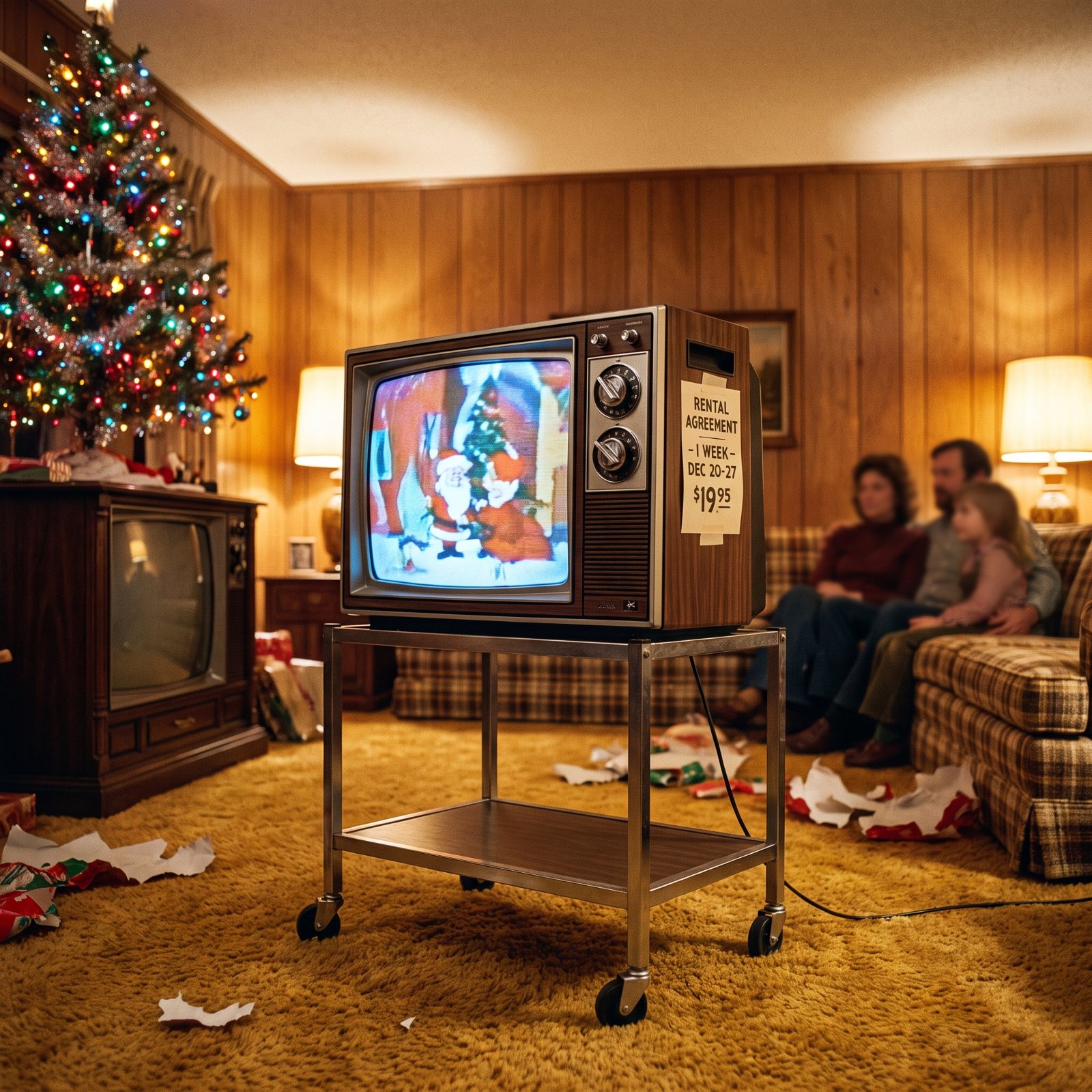
Color sets were expensive, so plenty of families still watched Christmas in black and white. But for the big week you could rent a color TV, roll it in on its little stand, and finally see Santa’s suit actually be red.
The rental shops did a booming December business. A short-term agreement, a deposit, and the good set showed up in time for the specials and the parades. Then it went back in January, and you were right back to guessing what color everything was.
18. A Mechanical Tree-Light Flasher Plug
Would you like to save this?
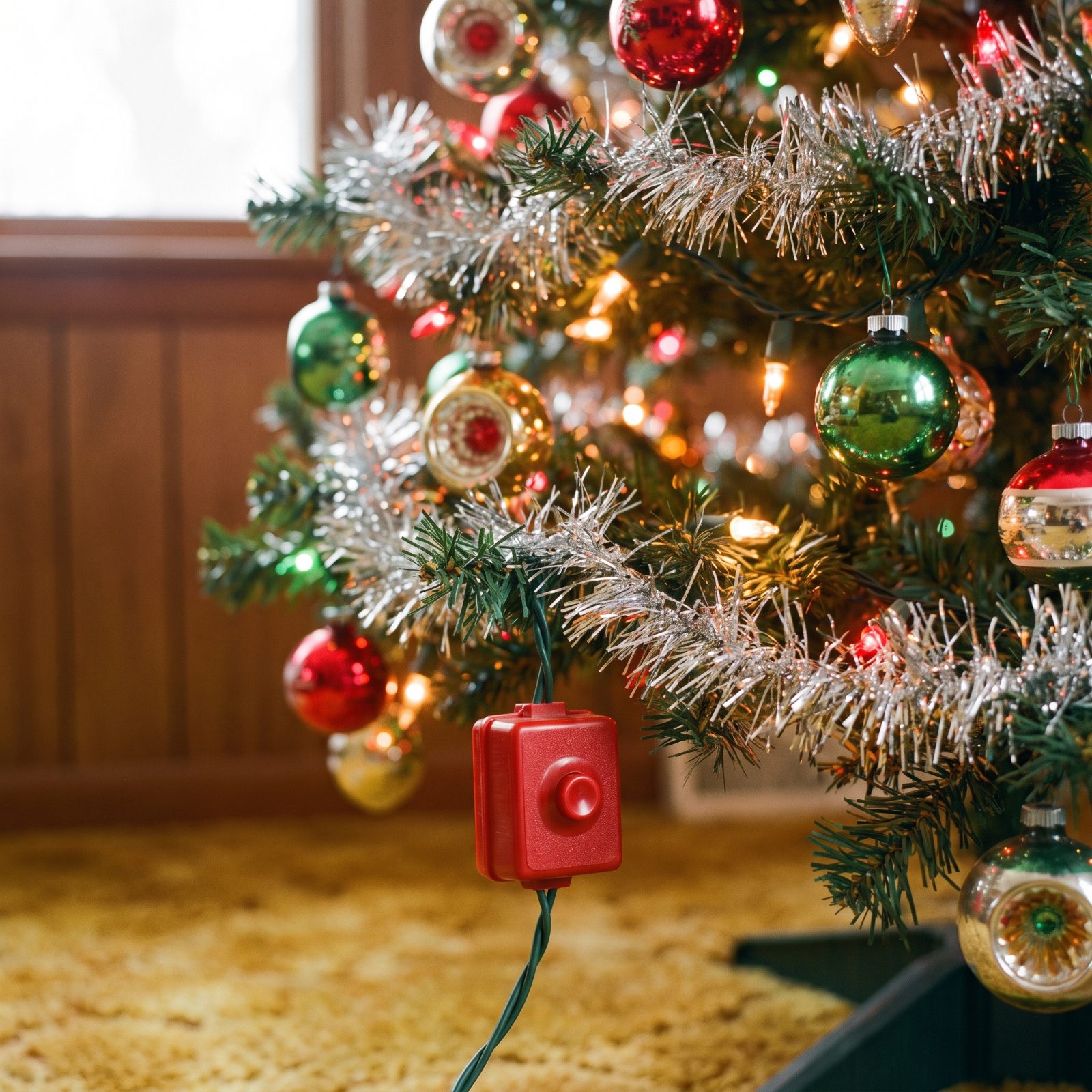
Somewhere on the light string sat a little red button plug, and inside it a strip of metal that heated up, bent, broke the circuit, cooled, and connected again. That was your flasher. That was the twinkle, back before microchips took over the job.
You bought them in a blister pack at the hardware store, screwed one bulb spot into the special socket, and the whole string blinked on its own stubborn rhythm. When it wore out the lights just stayed on steady, and back you went for another.
The good ones would sit down there clicking softly all evening. A tiny mechanical heartbeat under the tree.
17. Replacement Bulbs for Series-Wired Christmas Lights
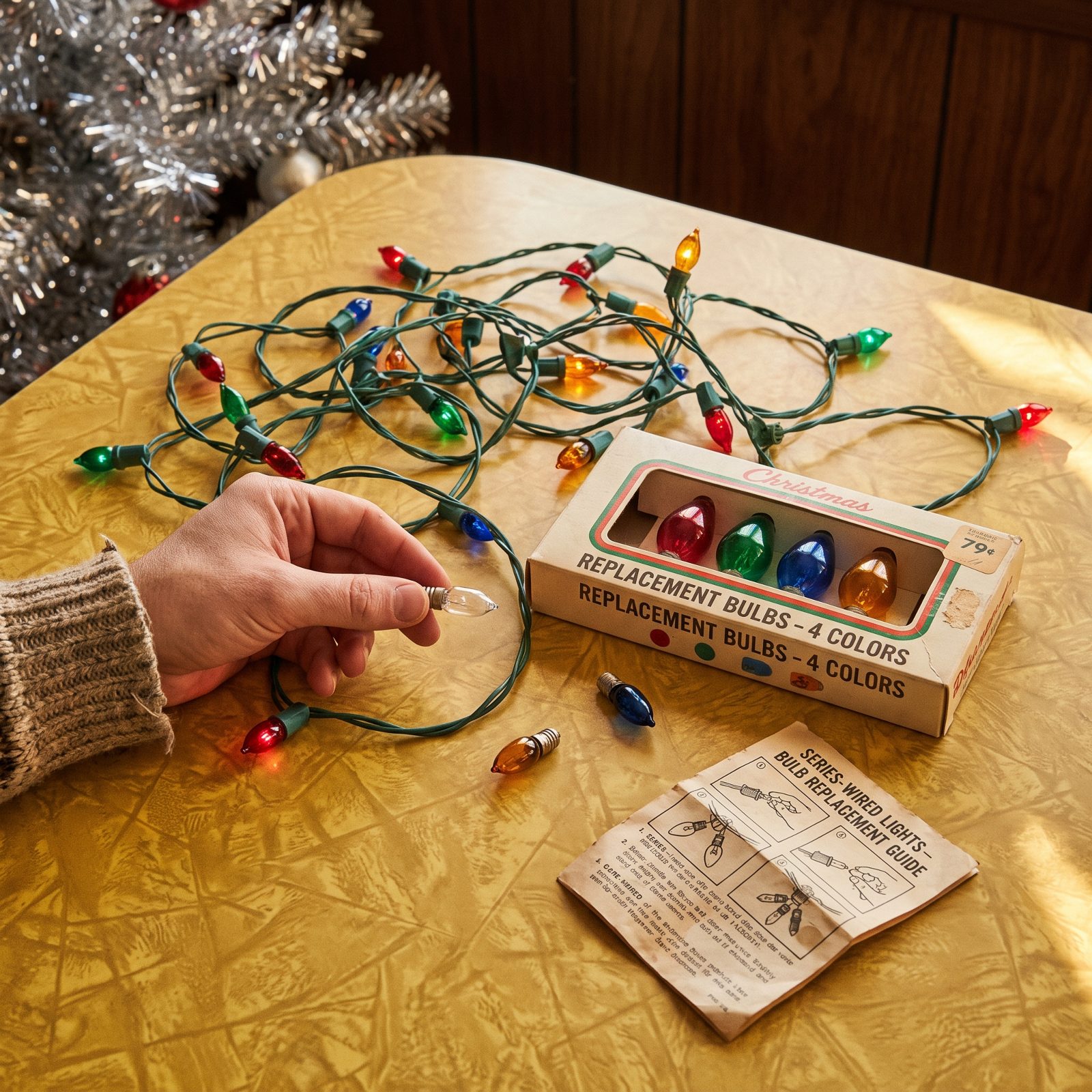
One bulb burns out and the whole string goes dark. That was the cruelty of series-wired lights. You’d finally get the tree perfect, plug it in, and half the strand sat dead because a single tiny bulb had quietly given up.
So began the ritual. Swap bulbs one at a time from a fresh box, working down the string, testing after each one, until the dead spot lit back up. It could eat an entire evening, grown adults muttering by a cold radiator, holding a bulb up to the light like a jeweler.
16. Silver Foil Icicles Sold by the Box
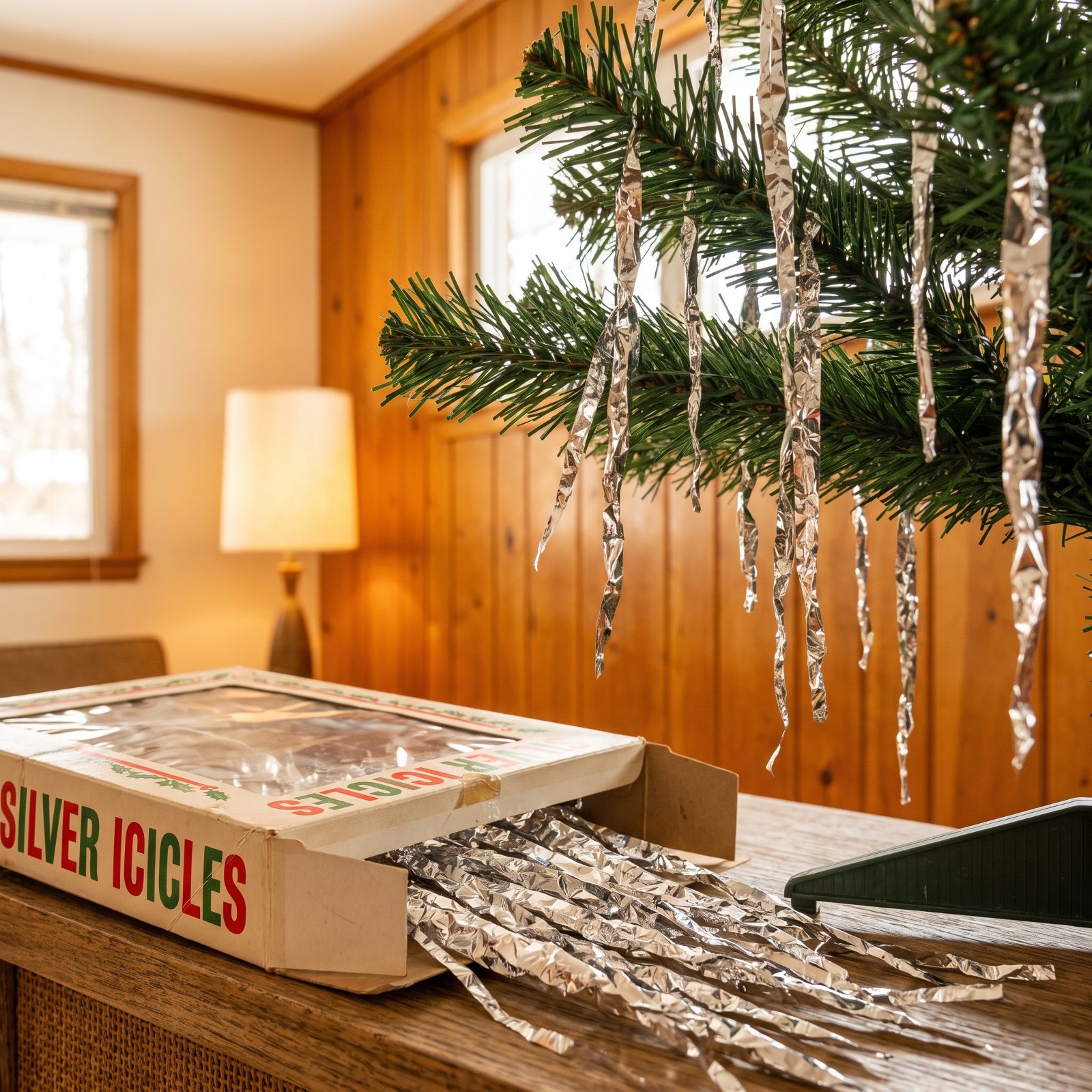
You threw them on one strand at a time if you were patient, or by the fistful if you were eight. The foil icicles came flat-packed, a few bucks a box, and they shed onto everything for months. Vacuum a strand off the carpet in July and you knew Christmas had really happened.
The early ones used lead foil, which hung dead straight and heavy — and that lead is exactly why they got pulled. The plastic replacements looked cheap next to them, so somewhere along the line families just stopped bothering.
15. A Rotating Color Wheel for an Aluminum Christmas Tree

The whole point of an aluminum tree was that you didn’t decorate it much. No lights on the branches — metal and electricity being a bad marriage — so instead you plugged in a color wheel. It was a little motorized spotlight that spun a disc of red, blue, green, and amber, washing the silver needles in shifting light.
It hummed. It got warm. Every few seconds it threw the whole tree from cool blue to hot amber and back, and on a dark December evening that was flat-out hypnotic. Both the trees and the wheels are collector items now, hunted at estate sales, but back then they were just the Sears special your parents grabbed on sale.
14. Window-Stenciling Snow and Cardboard Templates
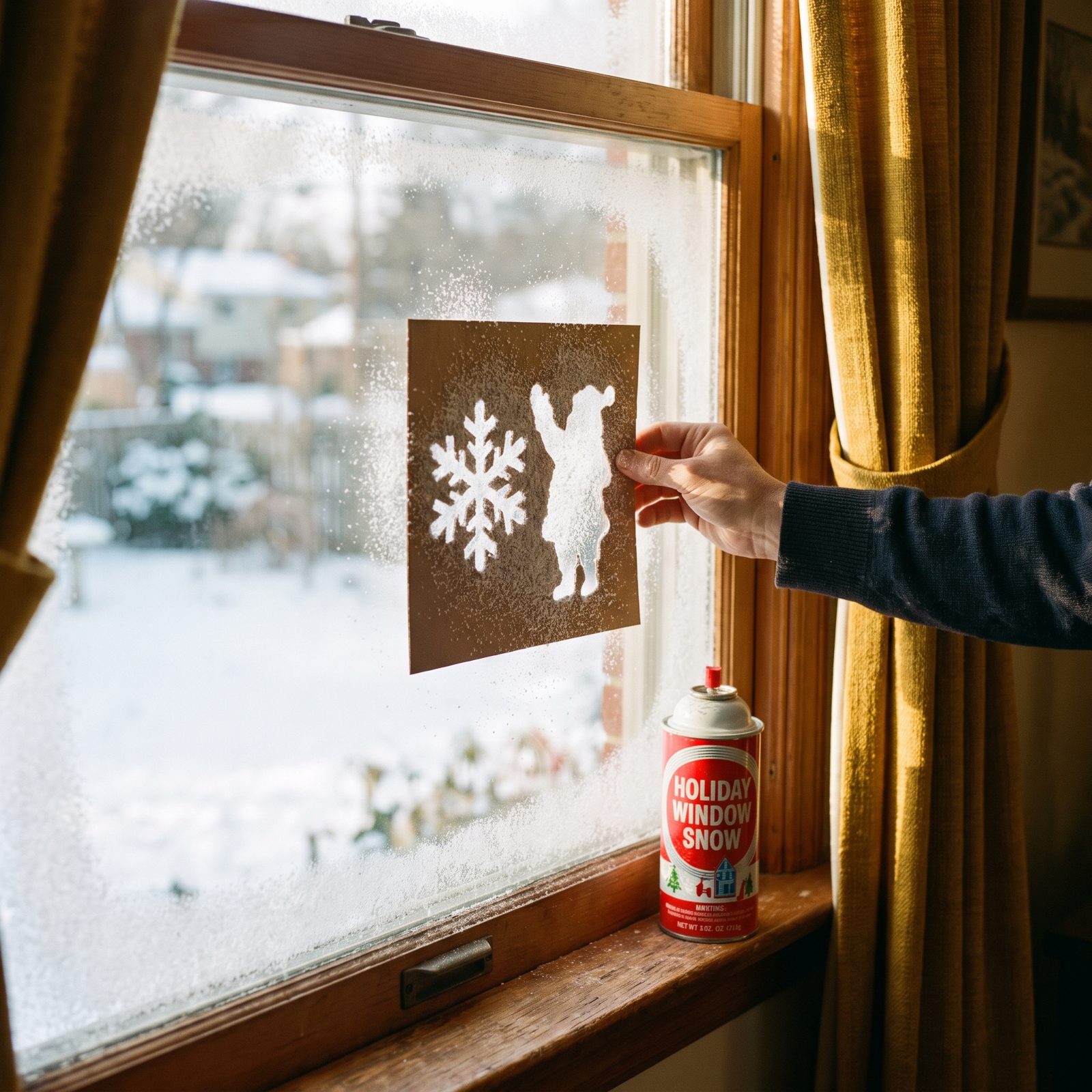
Somebody in the house always went too heavy on the spray. The window snow came in an aerosol can, you held a cardboard stencil against the glass and misted white flocking through it. Snowmen, snowflakes, a fat Santa in profile. Clean shapes in theory. A lot of drips in practice.
Scraping it off in January was its own miserable ritual — razor blade, bad attitude, half an afternoon gone. The stencils came free in the newspaper or printed on the back of the can. Nobody stencils windows anymore, and the yards look a little emptier for it.
13. Cotton Batting for a Manger-Scene Snowbank

Real snow was never the point. You pulled a wad of cotton batting apart until it was thin and wispy, then draped it under the nativity figures for a little hill of fake snow. It came from the same bag people used for quilting, which is why it lived in the sewing kit all year and got raided every December.
The problem showed up the second you plugged in the lights. Cotton batting next to hot incandescent bulbs is exactly the fire hazard it sounds like. People still do a version of this with flame-retardant fluff, and honestly? It doesn’t have the same soft, homemade look.
12. A Cardboard Fireplace Decoration

No fireplace in your house or apartment? You bought one made of cardboard. It folded out, printed with a red-brick pattern and a black hearth, sometimes with a little glowing paper log tucked inside. You stood it against the wall, hung the stockings off the printed mantel, and there you were — a chimney for Santa where there’d been a bare stretch of drywall.
They cost almost nothing and lasted about three Decembers before a corner gave out. Kids bought the story completely, no questions asked. And that was the magic of it: a working fireplace made entirely of belief and corrugated board.
11. A Motorized Santa or Angel Window Display
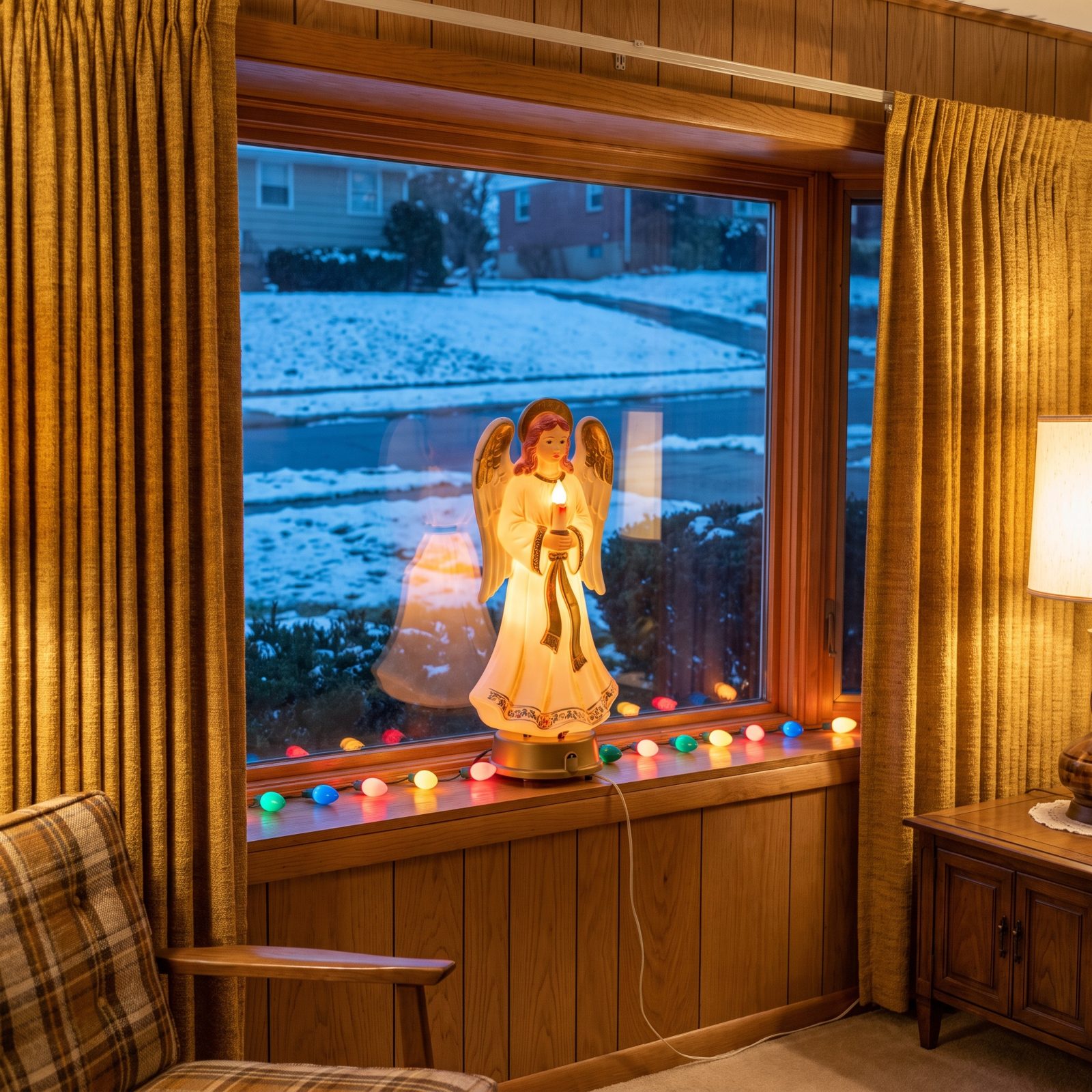
You knew which houses had them. The motorized figure in the front window — an angel raising and lowering her candle, or a Santa whose arm waved in a slow, tireless loop. Battery or plug-in, the motor ground away all evening with a faint whir you only caught if you pressed your face to the glass.
They lit from the inside, so from the street the whole thing glowed like a tiny stage. It was a small performance put on for the neighbors, who put one on right back. Inflatable lawn figures eventually took the job. Bigger, louder, and not one of them waves.
10. A Waxed-Cardboard Box of Florida Citrus Shipped North
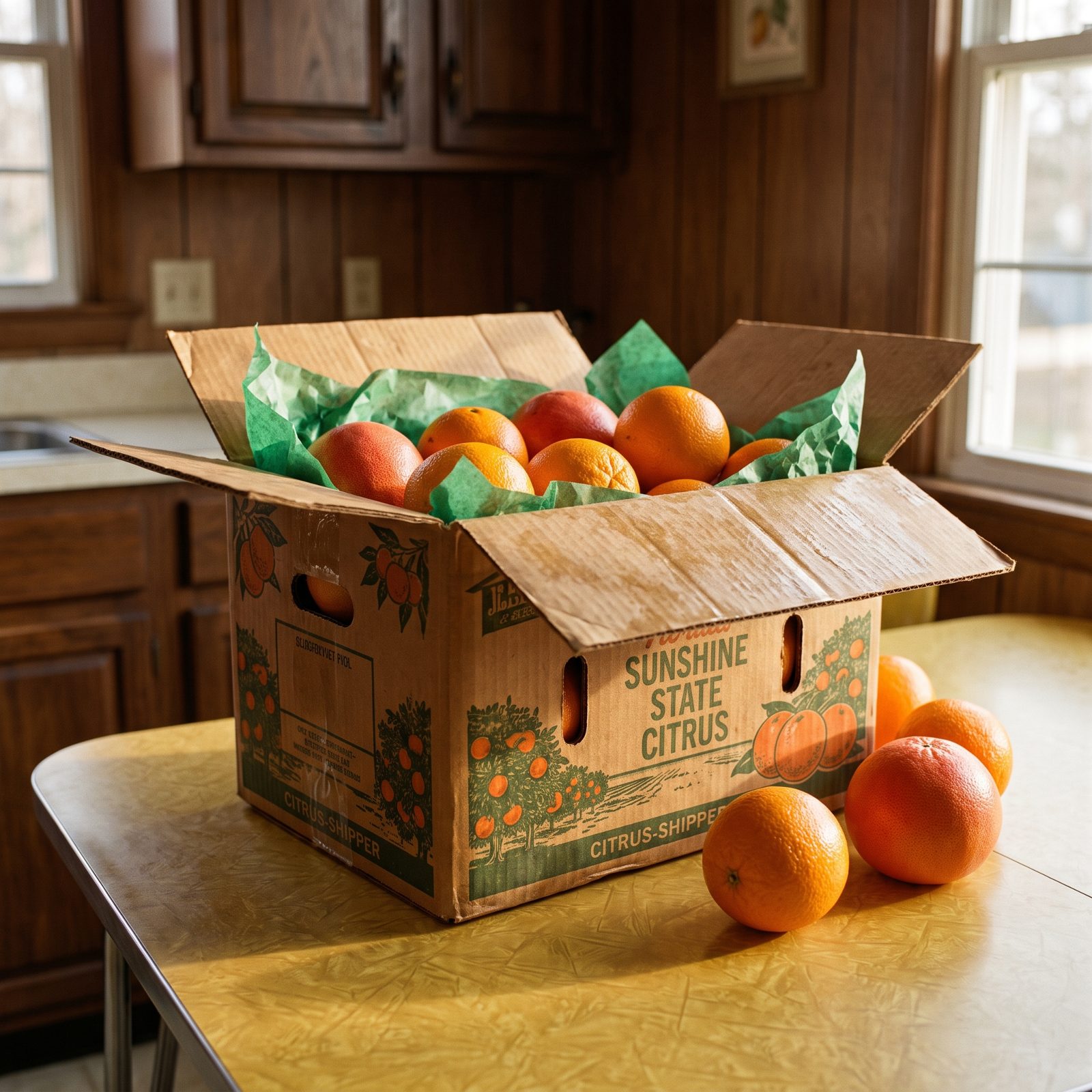
Up north in December, a crate of Florida oranges was an event. Somebody’s aunt or a mail-order shipper sent a waxed cardboard box packed with oranges and grapefruit in green tissue, and it landed on the kitchen table smelling like a place that still had sun.
The wax coating kept the fruit from soaking through on the long train or truck ride. You ate them slowly because they were a treat, not a grocery-store default. These days every store carries citrus year-round from everywhere on earth, dirt cheap, and the shipped-box tradition survives mostly as a corporate gift nobody quite gets excited about.
9. A Metal Tin of Mail-Order Fruitcake
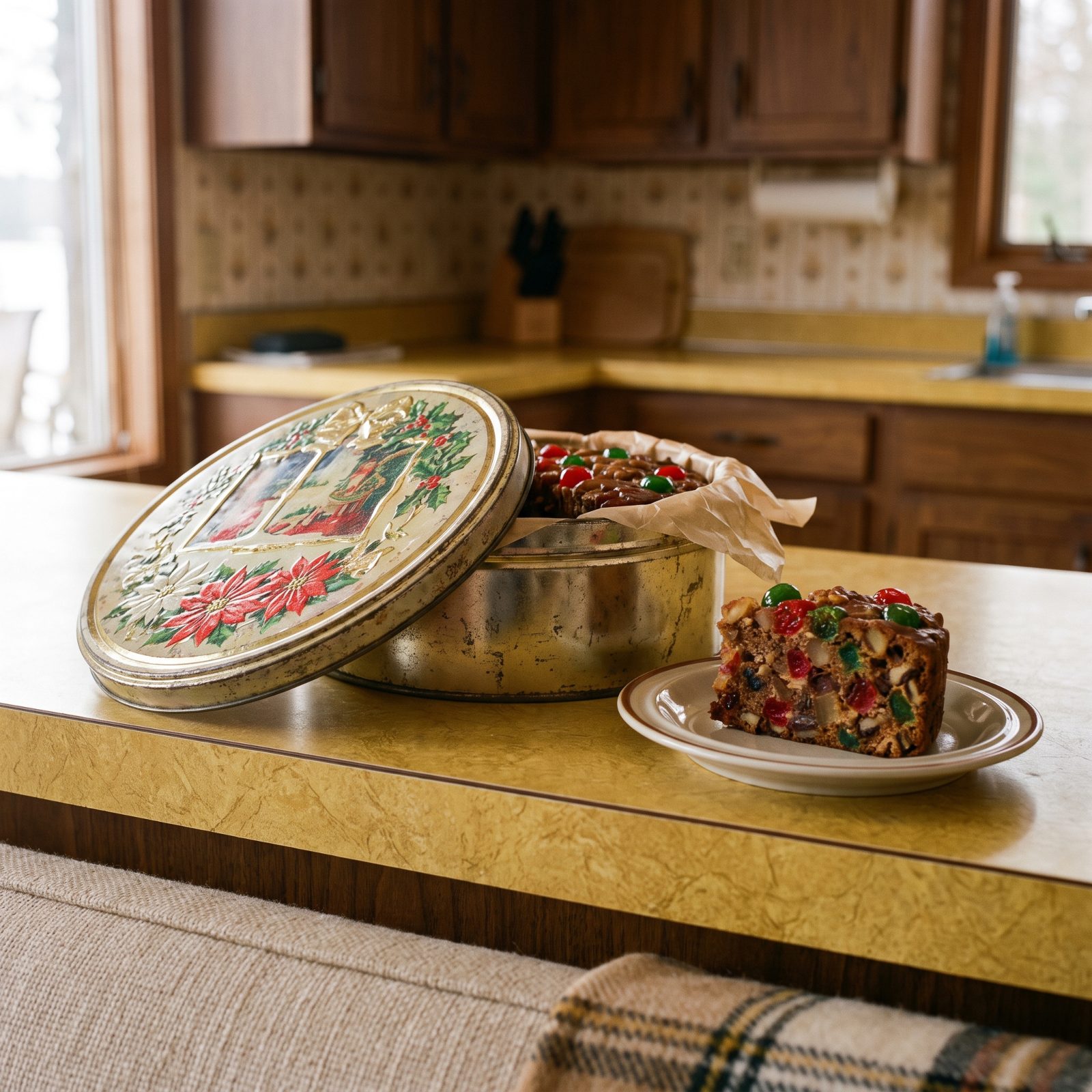
The fruitcake tin was a fixture, and yes, it was a punchline even then. It arrived by mail from Collin Street Bakery or Claxton or one of the other old catalog names, packed in a lithographed metal tin so nice you kept it for buttons long after the cake was gone.
Dense, boozy, studded with candied cherries that glowed like traffic lights — it was less a dessert than an heirloom you passed around and quietly declined. People still buy fruitcake. But the once-a-year mail-order tin as a standing budget line has mostly gone dark.
The cake got regifted. The tin got kept. That was the whole economy of the thing.
8. Mixed Nuts With a Nutcracker-and-Pick Set

Would you like to save this?
The bowl of mixed nuts in the shell sat out from Thanksgiving clear through to New Year’s, and it came with tools — a chrome nutcracker and a matching set of skinny metal picks. You’d work at a single walnut for a solid minute to earn a reward the size of a thumbnail. And the brazil nut? Defeated everyone who ever tried.
It was a slow snack, a thing to do with your hands during a long visit while the football game droned on in the other room. Now nuts come shelled in a resealable bag, faster and dull. The whole ceremony of cracking your own is basically extinct.
7. Aftershave in a Novelty Glass Bottle
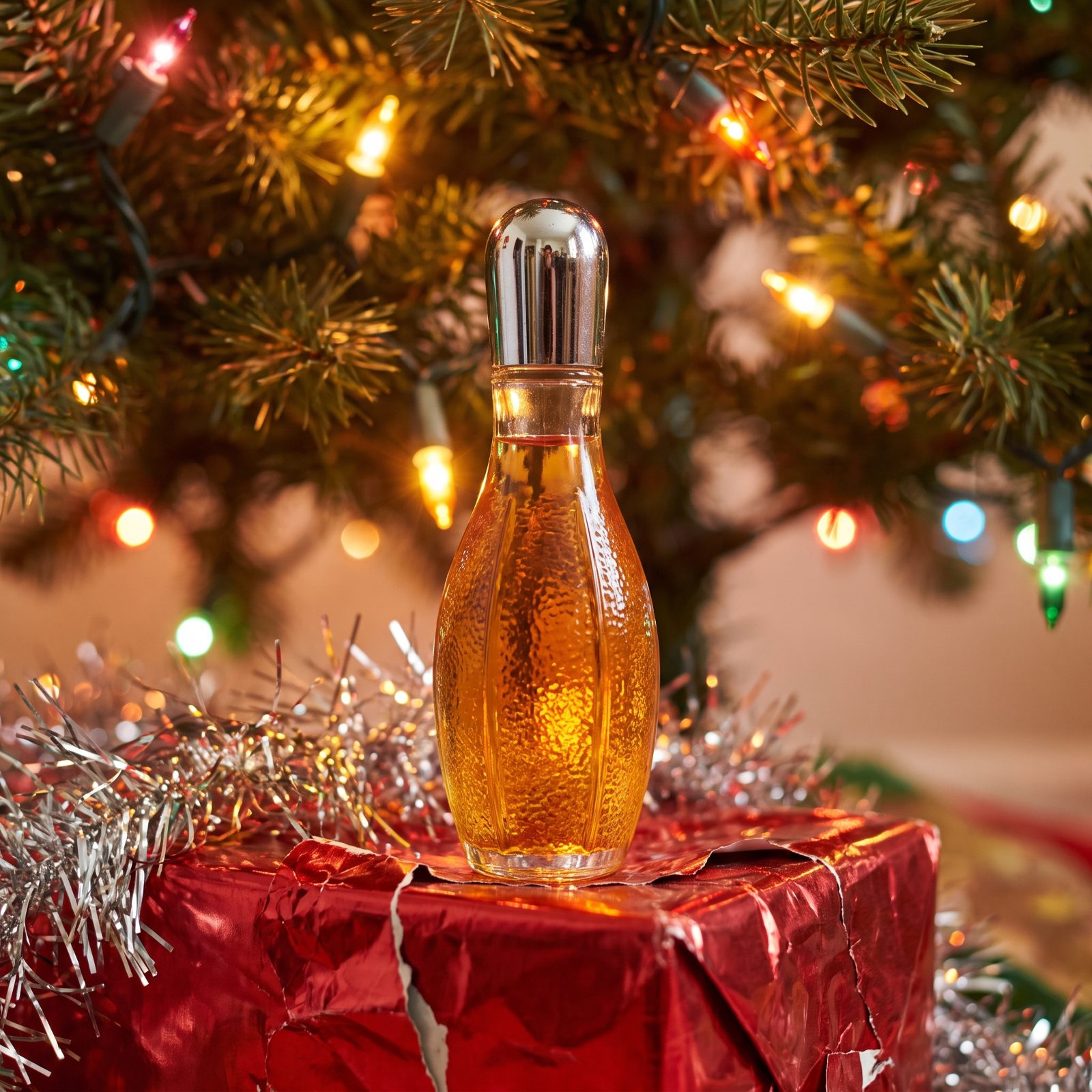
Dad got aftershave for Christmas, and the aftershave came in a bottle shaped like a car. Or a pipe. A bowling pin, a fish, a chess piece — take your pick. Avon and Old Spice turned the packaging into the actual gift, and the amber liquid inside was almost an afterthought.
The bottle stayed on the dresser long after the last splash was gone, too oddly nice to pitch. Cologne now comes in sleek anonymous glass that looks like every other cologne on the shelf, and nobody keeps it. We used to give scent, and the bottle was the memory that stuck around.
6. A Home Permanent-Wave Kit for the Holiday Party Circuit

Before a string of December get-togethers, plenty of women skipped the salon entirely and set their own curls at the kitchen sink. The kit cost a few dollars and promised a look that would ride through every office party and church social right up to New Year’s. What it actually delivered was a bathroom that smelled like a chemistry accident and rods that pinched if you rolled them too tight. Worth it, though. A fresh perm was armor for the season, and doing it yourself meant the money stayed home where it belonged.
5. Holiday Cream and Eggnog Left on the Porch by the Milkman
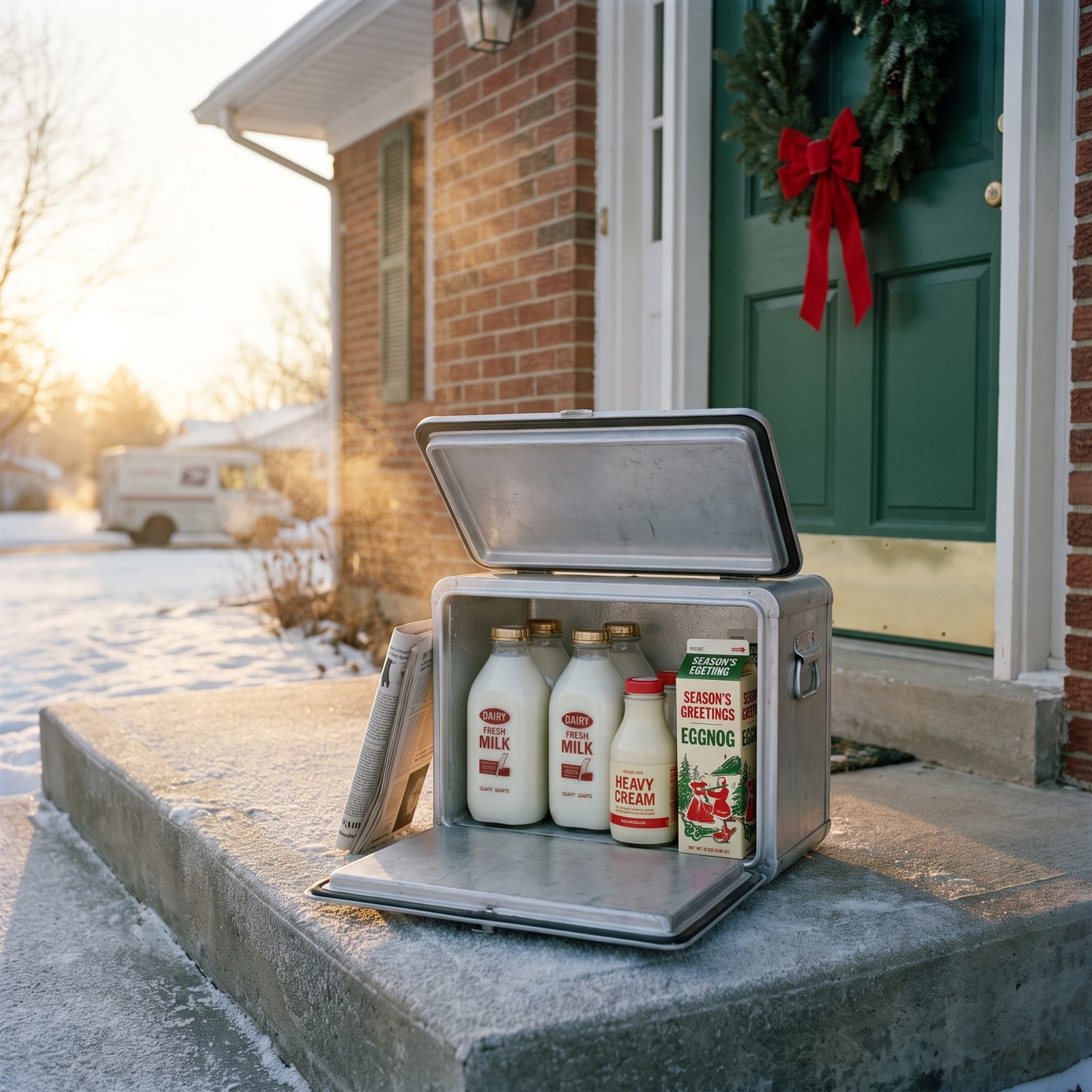
The milkman ran a quiet holiday economy of his own. You’d leave a note in the empty bottle asking for extra cream and a bottle of eggnog, and by the time you shuffled out in your slippers the next morning, there it all sat in the metal box, cold enough to have skimmed frost. No trip to the store, no fighting the parking lot. Eggnog was the splurge item, the thing you didn’t buy the rest of the year. And here’s what gets lost now: the man knew your name, knew your standing order, and probably knew you were hosting because the cream order doubled every December. That kind of service disappeared, and honestly, nobody replaced it with anything as good.
4. A Personalized Letter From Santa, Ordered Through the Newspaper
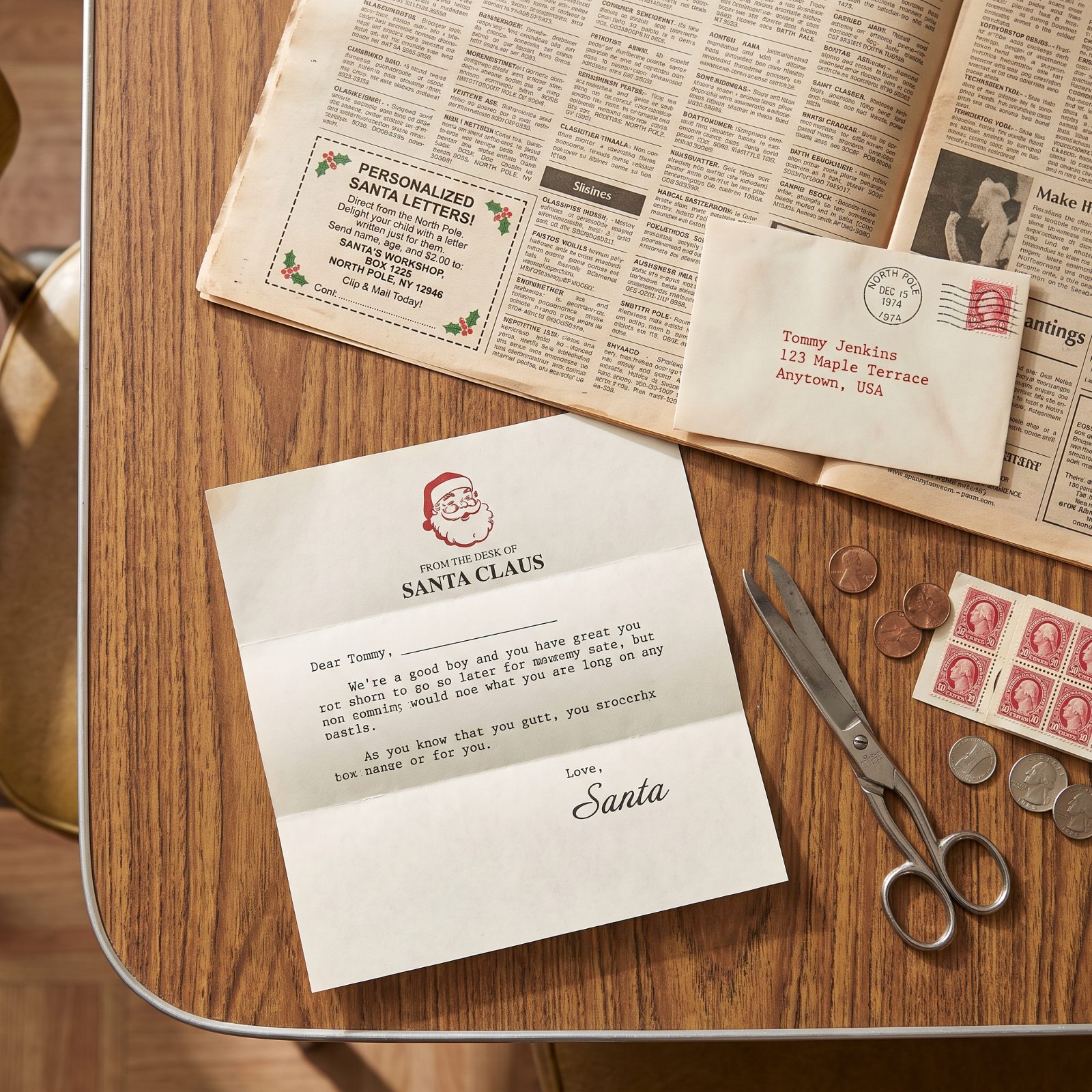
Tucked in among the classifieds, between the used-car listings and the help-wanted column, sat a little ad offering a letter from Santa mailed straight to your kid. You clipped the coupon, wrote in your child’s name, dropped a few coins and the whole thing in the mailbox, and waited. Weeks later a cream envelope showed up with a North Pole postmark and your child’s name typed right into the letter. To a six-year-old that postmark was proof of everything. The magic wasn’t free, but it was cheap, and the return on a few clipped coins was a kid who believed a little harder that year.
3. The Coin-Operated Kiddie Ride Outside the Department Store
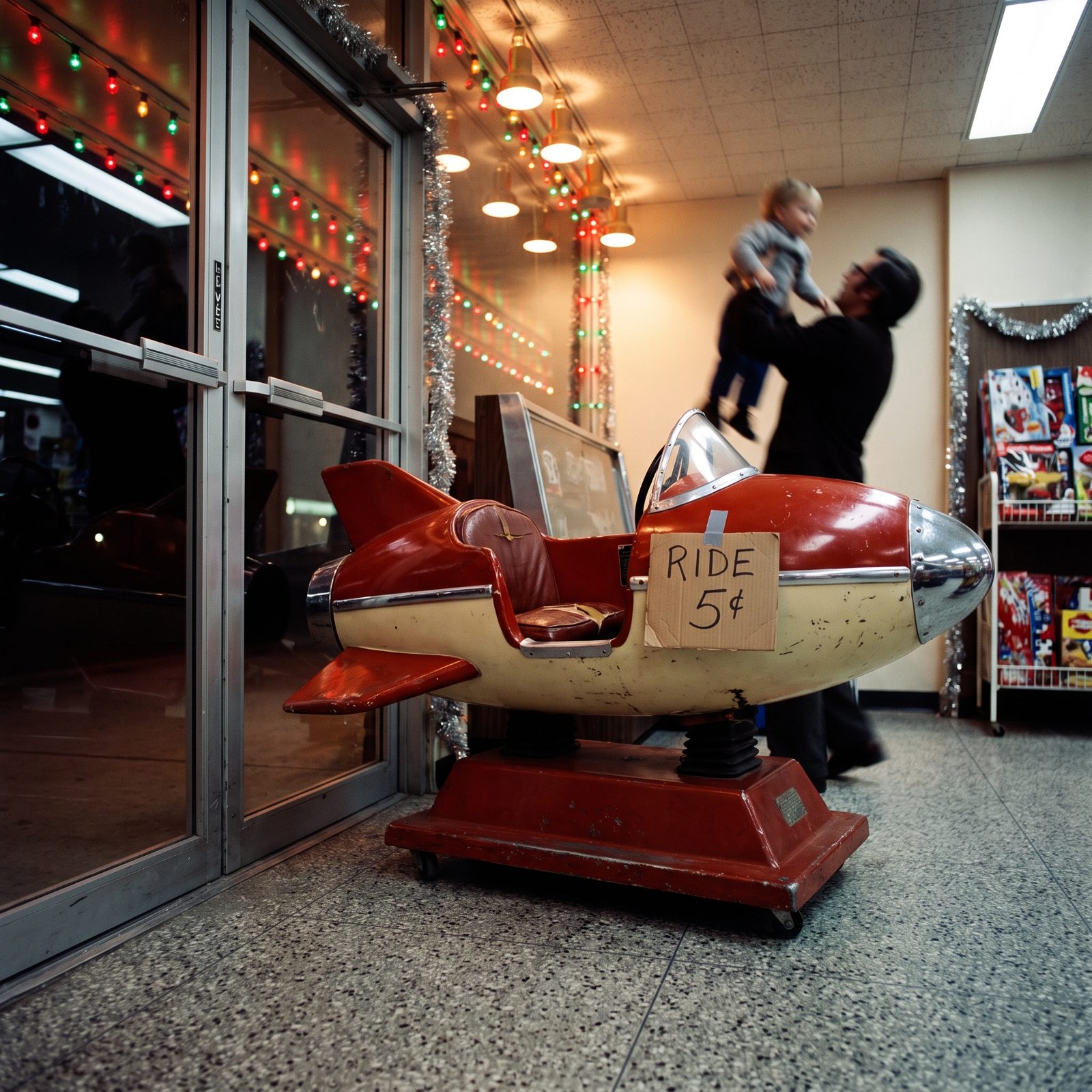
Right by the department store doors, where you couldn’t miss it and neither could your kid, sat a scuffed fiberglass horse or rocket that bucked and hummed for a coin. It didn’t do much. A gentle rock, a tinny jingle, maybe thirty seconds of glory. But it bought a parent a moment of peace during the holiday rush, and for a child it was the whole reason to tolerate a shopping trip at all. The coin was pocket change even then. That was the deal: you fed the machine one coin, and the kid stopped asking for a real pony for at least a week.
2. A Carton of Cigarettes, Gift-Wrapped and Set Under the Tree

Here’s one that stops a modern reader cold: a carton of cigarettes, wrapped in red foil with a gold bow, sitting right under the tree for Grandpa. Back then it read as thoughtful. You knew his brand, you bought the carton instead of the pack to save him money, and you handed it over like any other treat. Cheaper by the carton, a genuine gift, and completely ordinary. Nobody blinked. The ashtray on the coffee table was as much a part of the living room as the tree, and the whole scene would have looked normal in a million homes.
1. The Long-Distance Christmas Call to Relatives Three States Away
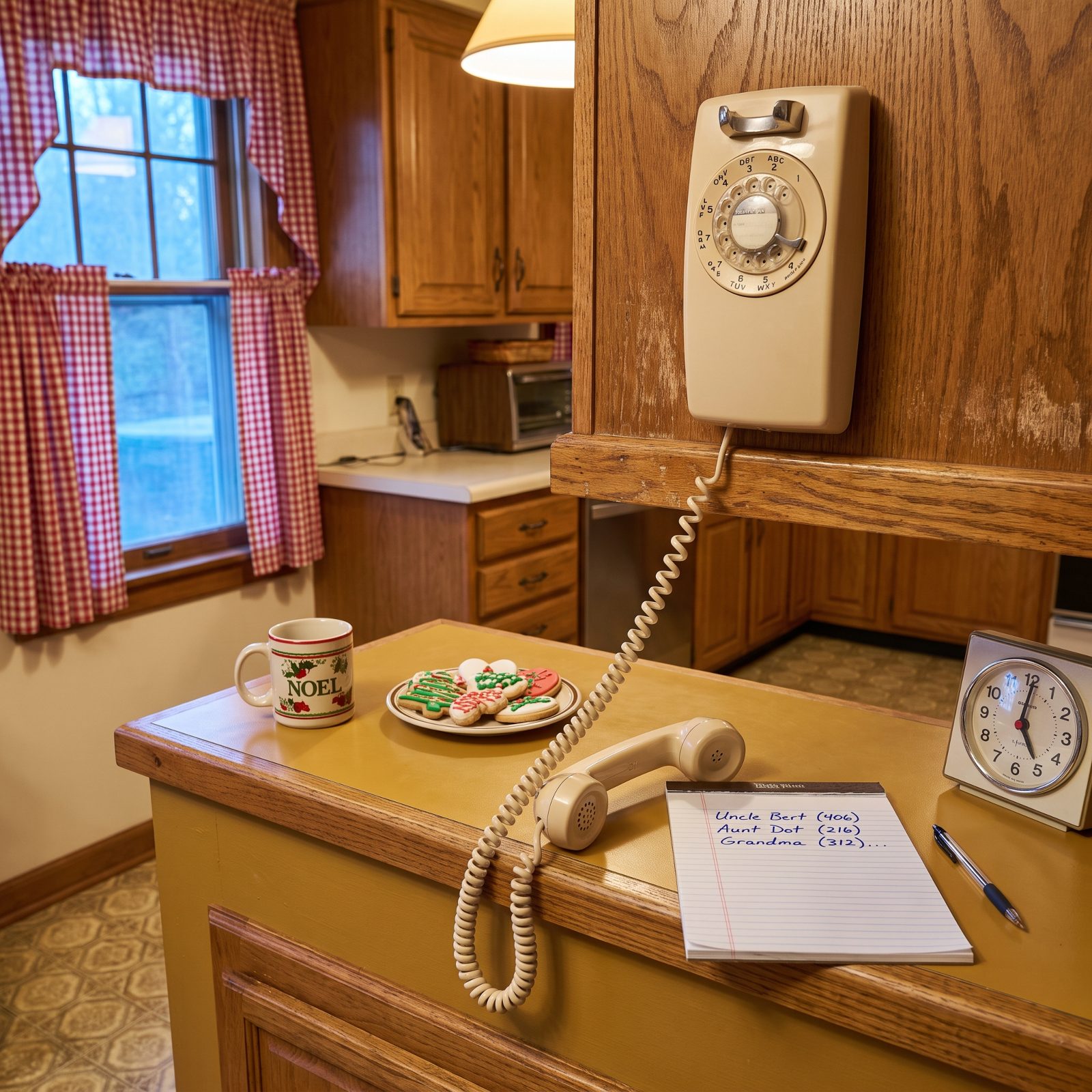
Long distance was expensive, and calling three states over on Christmas Day cost real money by the minute. So families planned it like a mission. You waited for the cheaper evening rate, kept a notepad of who to call and in what order, and rehearsed the news you wanted to share so you wouldn’t burn seconds fumbling. Then everybody crowded around the wall phone, passing the handset down the line — quick, say Merry Christmas, hand it to your brother, don’t linger. Ten minutes for the whole extended family. Somebody’s grandmother always tapped the counter when someone got chatty, the universal signal that the meter was running. And when the phone bill arrived in January, that one call had its own line, and everybody remembered it was worth every cent.