
Would you like to save this?
Your first boss is still living rent-free in your nervous system. You may have forgotten his last name, but your body hasn’t forgotten the way he sighed when you asked for a Saturday off.
Here’s the strange part. The job that paid you $4.25 an hour to fold sweaters or flip patties or answer phones did more than earn you gas money. It wired the circuitry you still run on every time you send a Slack message at 9 p.m., apologize for a lunch break, or feel a small hot shame about calling in sick with a real fever. Psychologists have a name for these deep grooves—and you’re about to recognize more of them than you expected.
The Reason You Apologize for Taking Breaks (And Whose Voice You’re Actually Hearing)

You stand up from your desk to get water and hear yourself explain, to no one in particular, that you’ll only be a minute. Nobody asked. Nobody was watching. The apology came out anyway.
That voice isn’t yours. It’s a two-hundred-year-old sermon wearing your voice as a costume. Sociologist Max Weber traced the modern compulsion to overwork back to Calvinist theology, and its secular version continues to instill the compulsion to live to work (Source), long after the religious framework fell away. Your first boss inherited it. Your parents inherited it. You inherited it from them, probably at a job where breaks were treated as evidence of weak character.
The reframe worth practicing: a break isn’t a debt you owe back in extra work. It’s a maintenance interval built into how brains actually function. You wouldn’t apologize to your car for stopping at a gas station.
Why Some People Feel Guilty Getting Paid to Sit Down

Ask anyone who started their career in a physical job. Waiting tables. Stocking shelves. Landscaping. Nursing. Then ask them how they felt the first week they took a desk job and the paycheck was bigger.
Uncomfortable. A little fraudulent. Like they were getting away with something.
That’s the residue of a very specific work ethic that equates effort with sweat and value with visible labor. Weber described the American compulsion to make work the center of one’s identity, and its modern shape rewards busyness that can be seen. Sitting doesn’t look like work, even when it is work. The Protestant work ethic is a deeply embedded cultural belief (Source) that runs deep enough to shape mental health outcomes.
The reframe: thinking is labor. Judgment is labor. Restraint is labor. The person who makes one good decision in a quiet office often prevents ten expensive mistakes downstream. Your paycheck isn’t rewarding the sitting. It’s rewarding the thing you’re doing while you sit.
The Strange Loyalty You Feel Toward Bosses Who Barely Trained You

Your first manager threw you into the deep end. Handed you responsibility you weren’t ready for. Corrected you sharply when you got it wrong. And you’d walk through fire for that person twenty years later. Meanwhile, the manager who onboarded you carefully at your last job barely registers.
Psychologists have a name for this. Effort justification. The more we suffer to earn something, the more we value it, because the brain refuses to believe it paid a high price for a low reward. Your loyalty isn’t really to the boss. It’s to the version of yourself who survived that boss, and to the skills you had to develop just to keep up.
There’s a shadow side worth naming. That same wiring is what keeps people in workplaces long past when they should have left. The chaos gets reframed as character-building. The neglect gets reframed as freedom. The reframe worth trying: gratitude for what you learned doesn’t require ongoing loyalty to the person who made learning painful. You can keep the lesson and leave the debt.
Why You Still Show Up 15 Minutes Early to Everything

Everyone else strolls in at 8:59. You’ve been in the parking lot since 8:40, reading emails on your phone, waiting for a socially acceptable moment to walk in.
Some of this is temperament. (Source). But there’s usually a first-job story underneath. A manager who made a public example of latecomers. A parent who treated tardiness as disrespect. A summer job where being ten minutes early was the unspoken cost of keeping the job.
The trait itself is fine. It signals reliability and it lowers your own stress by removing uncertainty. What’s worth examining is whether the buffer has crept from ten minutes to forty-five, and whether you feel actual dread at the thought of arriving exactly on time like a normal person. If early arrival is a preference, keep it. If it’s a survival strategy for consequences that stopped applying decades ago, the buffer can shrink without anything bad happening.
The Reason Praise From Your Manager Hits Harder Than It Should at 47

A quick email from your boss. “Great work on that presentation.” Six words. And you’re floating for the rest of the day at an age where you should, logically, be past this.
You’re not past it because your brain isn’t wired to be past it. Praise triggers a hit of dopamine, the brain’s reward chemical (Source). The catch: the effect is short. Recognition is a need that has to be met on an ongoing basis, weekly or even daily, and when expected praise doesn’t materialize, dopamine levels drop.
Add a first-job history where feedback was rare or entirely negative and the hit lands even harder. Your nervous system is still calibrated to a scarcity of approval, so the current supply feels like abundance.
The insight isn’t to want praise less. It’s to notice how much of your workweek is organized around chasing a chemical hit that lasts about ninety minutes, and to build sources of validation your manager doesn’t control.
Why You Can’t Bring Yourself to Call in Sick, Even When You’re Sick

You’re running a fever. You’ve slept four hours. Your throat feels like sandpaper. You log on anyway, camera off, apologizing in the chat for sounding rough.
Researchers call this presenteeism, and it’s not just personal grit. A University of South Florida study found workplace culture creates hidden presenteeism pressure (Source). Earlier work from Concordia University found presenteeism spikes among workers on interdependent teams and among people who feel insecure about their jobs.
The first-job piece: if your early bosses treated sick days as evidence of weak character, your body learned that being sick at work was safer than being absent from work. That calculation stuck.
Here’s what the research keeps finding. Working sick doesn’t save the company time. It costs more than absence would, in reduced output, in contagion, in the slow burn toward burnout. Taking the day off isn’t slacking. It’s math.
The Hidden Reason You Overwork After Every Small Mistake

You sent an email with a typo. Not a career-ending typo. A missing word. And now it’s 9 p.m. and you’re still at your desk, cranking through extra tasks nobody asked for, trying to balance a scale nobody else can see.
That’s overcorrection, and it’s usually rooted in a first job where mistakes were punished disproportionately. A boss who yelled. A shift lead who made you feel small in front of coworkers. A performance review at 22 that framed one misstep as a character flaw. Your nervous system learned that a mistake wasn’t a mistake. It was a debt, and the debt had to be paid loudly and visibly or the consequences would escalate.
Two decades later, the boss is gone but the accounting system runs on. The typo triggers the ledger. The overwork is you making the payment.
What actually clears it: naming the pattern out loud, closing the laptop at a reasonable hour after a small mistake, and letting the feared consequence not arrive. Do that ten times and the ledger starts to close on its own. The first job wrote the code. Nothing says you can’t rewrite it.
Why Certain Smells From a Fast-Food Kitchen Still Make Your Stomach Tighten

Fryer grease at 4pm on a Tuesday. Twenty years later, one whiff in an airport food court and your shoulders climb up around your ears before you know why. You’re not being dramatic. Your brain is doing exactly what it was built to do.
Smell is the only sense that skips the thalamus and wires straight into the amygdala and hippocampus, the brain’s twin engines for emotion and memory. Source That direct line is why odor-triggered memories tend to be more emotional than the ones set off by photos or songs, and why they often reach further back into your past. Source
So the burger grease isn’t just a smell. It’s a shortcut to the sixteen-year-old you, closing alone, counting drawers, learning that being useful was the price of being okay. The body remembers what the résumé forgot.
The Reason You Equate Being Tired With Being Valuable

Would you like to save this?
Ask an American how they’re doing. Listen to the answer. Nine times out of ten it’s some version of “busy,” said with the tiniest lift of pride, like a status update disguised as a complaint.
That’s not an accident, and it’s not just you. Researchers at Columbia and Harvard analyzed thousands of celebrity humblebrags and ran a series of studies showing that Americans now read busyness and overwork as signals of high status, competence, and scarcity in the job market. Source A century ago, Thorstein Veblen argued the opposite: visible leisure was the prestige signal, and labor was for people who had no choice. The script has flipped. Source
If your first job rewarded you for staying late, covering a shift, running yourself down to the studs, your nervous system learned the equation early. Exhausted equals valuable. Rested equals suspect. That’s a hard belief to unwrite, and pretending you don’t hold it doesn’t help.
Try this instead: catch yourself the next time you say “I’ve been slammed” out loud. Notice who you’re saying it to and what you want them to think of you. You don’t have to change the behavior yet. Just watch the reflex. The watching is where the loosening starts.
Why You Feel Weirdly Competitive With Coworkers Who Aren’t Competing

Your first job probably ranked you. Fastest drive-thru times. Most units sold. Employee of the month with a laminated photo by the register. Nobody explained that this was operant conditioning, but that’s what it was, and it stuck.
Behavioral researchers have shown that early exposure to rank-based reward systems trains the brain to look for a scoreboard even when none exists. You walk into a meeting and start counting who spoke, who got the nod, who the boss made eye contact with. It’s not insecurity. It’s a leftover scoring habit from when your paycheck actually depended on beating Kevin at the fryer.
The science of scarcity research by Harvard’s Sendhil Mullainathan (Source) shows how mindsets built under resource pressure keep running in the background long after the pressure lifts. The scoreboard is one of those mindsets. The fix isn’t to stop being competitive. It’s to notice when you’re competing against someone who never entered the race.
The Money Script You Wrote at 16 That’s Still Signing Your Contracts

You didn’t know it at the time, but that first paycheck taught you something specific about what money is. Reward. Relief. Proof. Escape. Whatever it was, it wrote itself down as a rule.
Financial psychologist Brad Klontz calls these money scripts: unconscious beliefs about money that get formed in childhood and adolescence and quietly steer adult financial behavior. Klontz’s research identifies four main patterns (avoidance, worship, status, vigilance) and finds that people who grew up around financial struggle tend to skew toward money-status behaviors later, using purchases to prove worth. If your first job was the first time you had money that was actually yours, that moment did a lot of the writing.
The exercise most people never do is trace the script backward. What did that first paycheck feel like? Freedom? Safety? Power? Whatever it felt like, you’ve been chasing that feeling in every job since, and it might explain why the raise that should have made you happy didn’t.
Why the Phrase ‘Just Doing My Job’ Was Wired Into You Before You Understood It

You heard it before you said it. A cashier saying it to a customer. A manager saying it about a layoff. Your first shift lead saying it while handing you a task nobody wanted.
Then you started saying it yourself, usually as a shield. It’s the phrase you reach for when someone asks you to do something you don’t want to do and you don’t want to look like the person refusing. Sociologist Arlie Hochschild’s work on emotional labor shows that service workers learn early to separate themselves from the role, performing an expected emotion for pay, and the ones who segregate the self from the job most cleanly avoid burnout but risk estrangement from their own feelings.
That’s the trade. Say “just doing my job” often enough and eventually you’re not sure which parts of the job are you and which parts are the costume. Worth asking, decades in: how much of your current work personality is actually you, and how much is a coping strategy from a job you left in 1994.
Why the Way You Felt About Your First Paycheck Still Runs Your Salary Negotiations
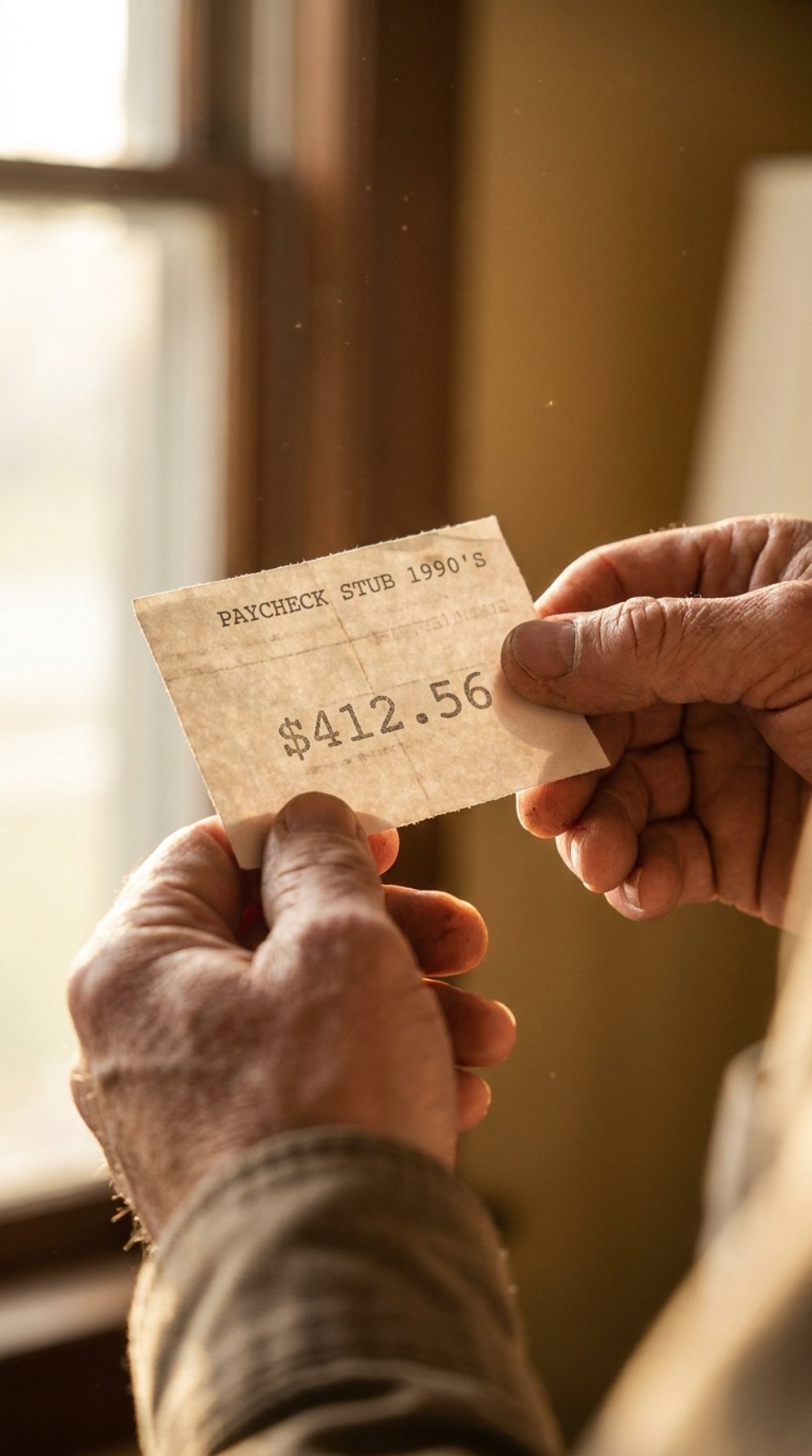
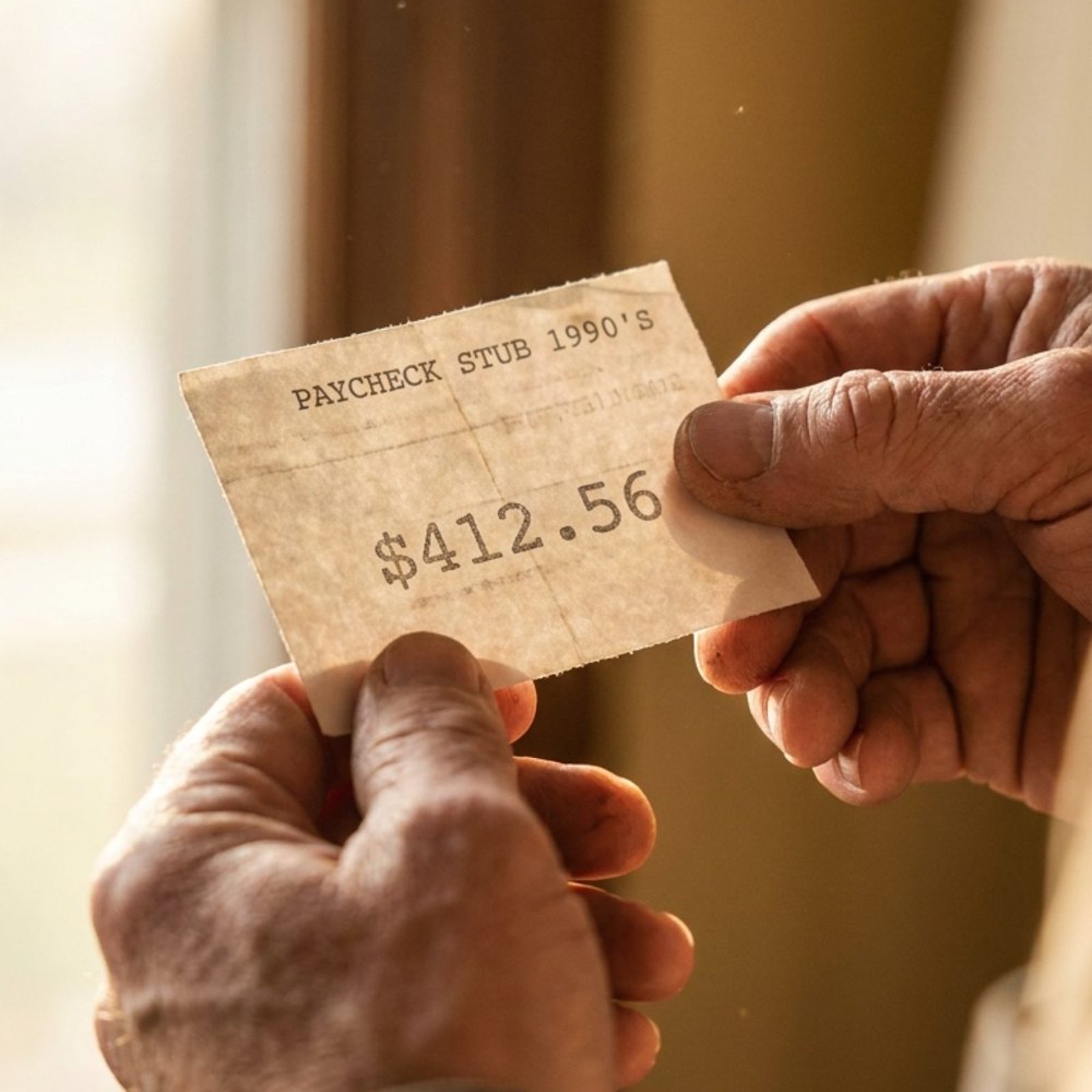
You remember the number on that first stub. Maybe $4.25 an hour. Maybe a $22,000 salary that felt like winning. Whatever it was, your brain filed it away as the baseline for what your work is worth, and it’s been quietly running the math ever since.
Behavioral economists call this anchoring. The first number in any negotiation becomes the psychological center of gravity, and every counteroffer gets calculated in proximity to it, even when the anchor is arbitrary or outdated. We even fixate on anchors that are clearly irrelevant to the negotiation (Source). The problem is that your original anchor wasn’t the market rate. It was whatever a manager at your first job decided to pay a nervous 19-year-old.
Try this before your next negotiation: research the market rate first, write it down, and stare at it for ten minutes before you say a number out loud. You’re not lowballing yourself on purpose. You’re using a twenty-year-old anchor that no longer applies.
The Reason Your First Uniform Still Affects How You Dress for Work

The polo with the embroidered logo. The apron. The visor. The name tag that always pinched.
Whatever you wore first for money changed something. Researchers Hajo Adam and Adam Galinsky coined the term enclothed cognition in 2012 to describe how clothing systematically influences the wearer’s thoughts, feelings, and behavior through symbolic meaning. Later work has found that professional attire promotes more abstract, big-picture thinking, while uniforms can amplify traits like empathy, deference, or competitive drive depending on what they symbolize.
If your first uniform meant “be quick, be polite, don’t sit down,” your body learned that posture in the fabric. Decades later you might still overdress for meetings that don’t require it, or underdress in rebellion, or feel physically wrong on days you don’t “look the part.” None of that is vanity. It’s a nervous system that learned to associate certain clothes with being competent and paid.
Why You Can’t Enjoy a Day Off Until Everything Is Done

Sit down. Feet up. And then, immediately, the list starts.
You know this loop. The couch is right there, the coffee is fresh, and your brain refuses to let you enjoy either until you’ve dealt with the laundry, the email, the errand you swore you’d do Tuesday. First jobs teach this. Hourly work rewards visible motion. If you looked idle, you got tasked. Sitting was suspicious. Standing with a rag in your hand was virtue.
That reflex doesn’t retire when you do. You still associate rest with permission you haven’t earned yet, which is why a Saturday morning can feel like a test you’re failing. The reframe is small but it matters: rest that comes after everything is done isn’t rest, it’s collapse. Actual rest happens before you’ve finished, on purpose, as a decision.
Try sitting down with things still undone. Not forever. Just twenty minutes. See what your body does. That flinch is the old job talking.
The Odd Comfort of Being the One Who Stays Late

The office empties out. The overhead lights click off in sections. You’re still there.
Some people find this stressful. You find it, if you’re honest, a little satisfying. There’s a specific pleasure in being the last one, and it doesn’t come from productivity. It comes from an old belief that being seen working late is safer than being seen leaving on time.
First jobs teach hierarchy through visibility. The kid who closed the store got trusted. The one who left when their shift ended got labeled. That teenage lesson doesn’t leave, even when you’re now the person who could set the policy. Being the last one out feels like insurance against a fear you can’t quite name.
Why You Distrust Jobs That Feel Too Easy

The offer comes in. Good money. Reasonable hours. A boss who seems like a real person. And your first thought, before you can stop it, is: what’s wrong with it.
Something in you is looking for the catch. That’s the residue of a first job that made you earn everything twice. When your entry point into the working world was hard, hot, boring, or humbling, you learned to associate discomfort with legitimacy. A job without pain must be fake, precarious, or about to end.
Behavioral economists Sendhil Mullainathan and Eldar Shafir found in their scarcity research that early experience with scarcity keeps shaping decisions long after the scarcity is gone. Applied to work: if your first jobs required you to earn every dollar through visible suffering, ease will feel wrong forever. Not because it is wrong. Because it doesn’t match the deal you learned to make.
Sit with the easier job a minute before you sabotage it.
The Reason You Take Customer Rudeness Personally, Decades Later

Somebody cuts in front of you at the grocery store. A stranger snaps at a barista in earshot. And your body flushes with a heat that seems out of proportion to what just happened.
It isn’t out of proportion. It’s memory. If your first job put you on the receiving end of the public’s worst moods, your nervous system logged every one of them. Arlie Hochschild’s foundational work on emotional labor documented what service workers already knew: managing your face while someone unloads on you costs the body something real, and surface acting (faking the smile) is measurably more harmful to health than deep acting (trying to actually feel calm).
Those costs don’t get refunded when you leave the job. The vigilance stays. You watch how strangers treat cashiers because you were the cashier, and every rude customer since 1987 is standing in that line with you.
Why Your First Tip Jar Taught You More About Money Than College Did

Would you like to save this?
The first time you counted a wad of singles at the end of a shift, something rewired in your head. That money had a face on it. Someone’s mood, someone’s generosity, someone’s decision to leave you an extra dollar because you refilled their iced tea without asking. You learned in one shift what a semester of economics never quite delivers: income is a relationship, not a number.
Tipping is one of the most studied and least logical behaviors in consumer psychology. Researchers have spent five decades trying to explain it, and the honest answer is that people tip for a tangle of reasons: social norms, gratitude, guilt, the wish to be seen as generous Source. Servers who came up on tips tend to over-tip for the rest of their lives, because they know exactly what a bad table costs Source.
What you took from that jar wasn’t a wage. It was a lesson in reading people, hustling for the last twenty percent, and understanding that effort and reward are only loosely connected. That belief still runs your budget.
The Strange Way a Bad First Boss Becomes the Voice in Your Head

Decades later, you can still hear him. The manager who sighed when you asked a question. The shift lead who said “figure it out” without looking up. The one who made you cry in the walk-in cooler and then acted surprised when you quit.
Object relations psychologists have a name for this. When we’re repeatedly criticized by someone whose approval we need, we don’t just remember them, we install them. The inner critic is often an internalized version of a rejecting authority figure, and it keeps talking long after the person is gone Source. That voice tells you you’re behind, you’re lazy, you should already know this, who do you think you are asking for a raise Source.
Research on self-criticism suggests it develops through the experience of harsh external criticism, then keeps running on its own even when the original critic is nowhere near you Source. That first bad boss didn’t just teach you how to work. He taught you how to talk to yourself while you work.
The good news: you can notice the voice without obeying it. When you catch yourself panicking over a small mistake, ask whose tone that actually is. It’s rarely yours.
Why You Still Feel Like You’re Getting Away With Something on Salary

Payday hits your account. You did nothing dramatic to earn it this pay period. Maybe you sat in three meetings that could’ve been emails and answered a Slack thread from your couch. And still, some quiet corner of your brain flinches, like the money showed up by mistake.
That flinch usually belongs to your first job. If you started out clocking in, punching out, and watching the minutes add up on a timecard, you learned that money is what you trade specific hours for. Research published in Personality and Social Psychology Bulletin found hourly workers show a stronger link between income and happiness than salaried workers, because the connection between time and money is emotionally direct. Source
Salary breaks that math. You get paid whether you crushed it Tuesday or coasted Thursday. Salaried workers also put in an average of 9.2 hours of unpaid overtime a week, which the guilty brain quietly uses as evidence it hasn’t stolen anything. Source
Try tracking your actual working hours for two weeks. Not to justify yourself. Just to let the accountant in your head see the receipts.
The Reason ‘A Job Well Done’ Feels Like Love to You

You handed in the report. Your boss said good work. And something inside you, older than the report and older than the boss, lit up like a porch light.
That warmth has a longer memory than the job. A meta-analysis across 31 samples linked conditional parental regard, love that swelled when you succeeded and cooled when you didn’t, with contingent self-esteem and a specific way of chasing approval that never quite lets you rest. Source Kids who grew up reading the emotional weather of a parent’s approval get very, very good at reading rooms. They also grow up to work in them.
Your first job was where that reading skill met a paycheck. A shift manager said you were reliable, and it felt like being seen. A regular customer asked for you by name, and it felt like belonging. The system had already been installed. The job just gave it something to run on.
The competence is genuine. The cost of how it was acquired is another conversation entirely.
Research on adolescents found that parental conditional positive regard, the kind that shows up as extra warmth after a win, was linked to a self-esteem that swings between grandiosity after praise and shame after setbacks. Source Which is a fair description of most performance reviews, if you’re honest.
Notice when praise at work lands harder than it should. That’s information. It’s telling you where the wiring runs.
Why the Work Ethic You’re Most Proud Of May Also Be Costing You

You brag about it. The double shifts you pulled at nineteen. The summer you worked seven days straight and thought it built you. Some of it did.
Here’s the part nobody puts on a resume. A longitudinal study on healthcare workers found that workaholism at baseline predicted higher mental distress a full year later, and in a subsample with medical data, it was positively linked with systolic blood pressure. Source The body keeps a ledger the mind refuses to open.
A more recent longitudinal study in the Spanish Journal of Psychology mapped workaholism and overcommitment as progressive stages of a work-addiction process, with job satisfaction actually strengthening the pathway toward burnout, not protecting against it. Source Loving your job can be the thing that lets the machine run hotter for longer before you notice the smoke.
The habit that got you hired at seventeen was survival. At fifty, it might be sabotage wearing a name tag that says ‘reliable.’ Same behavior. Different price tag. Ask yourself which one you’re still paying.
The Bottom Line
Your first job wasn’t just a job, it was the template your nervous system used to define what work is, what workers deserve, and what your body owes an employer. That’s why it’s still running the show three decades later: you didn’t learn a job, you learned a survival script, and scripts don’t expire until you consciously rewrite them. The next time you catch yourself apologizing for a break or bracing at a manager’s tone, ask whose voice you’re actually obeying, and whether that person still deserves a say in your life.