

Would you like to save this?
The checking account refills every two weeks and somehow it’s still tight. You’ve had a solid year—earned more than you ever imagined—and the savings number hasn’t budged in any direction you’d want printed on a billboard. These aren’t budgeting failures in the usual sense. They’re structural mistakes woven into a high-income life, the kind that feel completely reasonable while they’re happening. Here are some of the most quietly devastating ones, and what actually fixes them.
Please note that some of the images in this article were created with the assistance of AI.
Financing Luxury SUVs, Boats, and Recreational Toys Simultaneously Because Each Monthly Payment ‘Doesn’t Seem That Bad’

The Tahoe payment. The boat slip and loan. The side-by-side. Insurance on all of it. Each one passed the gut check on its own. Together they might run north of $2,500 a month in payments for things that lose value while you sleep. I did a version of this with cars alone in my late thirties, and it took an embarrassingly long time to see I was financing depreciation at scale.
The fix isn’t austerity—it’s sequencing. Buy the truck. Pay it off. Then buy the boat. That psychological trick of isolating each monthly payment is exactly what keeps high earners asset-poor and liability-rich. Try this: add up every single recreational vehicle payment, insurance premium, storage fee, and maintenance cost into one number and write it on a sticky note. Stick it on your bathroom mirror. If the number doesn’t make you flinch, great, carry on. But most people have genuinely never done the addition.
Letting Private School Tuition Quietly Expand into Elite Sports, Travel Teams, and Luxury Camps That Cost More Than College Savings

Tuition felt like the big commitment. But then your daughter made the travel soccer team—fees, tournament travel, gear, private coaching—and suddenly the extracurricular bill rivaled the tuition itself. Your son tried fencing, which led to an eye-wateringly expensive summer program in Vermont. Nobody sat you down and totaled any of this.
You approved each thing in isolation because your kid is talented and you could technically afford it. But “technically afford it” and “this is a wise use of capital” are sentences from different planets. Track every child-related enrichment expense in one spreadsheet for six months. The number will jar you, and it’ll clarify which activities your family genuinely values versus which ones you greenlit because saying no felt like a parental failure.
Buying into Wealthy Neighborhoods Where Every Casual Dinner, Fundraiser, and Kids’ Birthday Party Becomes a Spending Competition

Your zip code is the most expensive subscription you never knew you signed up for.
Move into a neighborhood where the median household income dwarfs yours and see what happens. The school auction expects four-figure donations. The block party is catered. A “casual” Saturday dinner invitation means a restaurant tab that stings. Your ten-year-old comes home from a birthday party that featured a DJ, a photo booth, and personalized gift bags that cost more than your own wedding favors. None of this is mandatory, obviously—but social pressure has its own gravitational pull, and it tugs harder than most people’s discipline. The real price tag on an affluent zip code isn’t the mortgage. It’s the invisible lifestyle surcharge on everything surrounding it, the thousand small yeses you didn’t plan for when you signed the deed.
Treating Business-Class Flights as ‘Non-Negotiable’ Long Before True Financial Independence Is Secured

Look, I get it. Economy is miserable if you’re tall or old enough to remember when flying wasn’t a punishment. But there’s a canyon between “I can charge this to my card” and “this expenditure makes sense given where I actually stand financially.” A family of four flying business class to Europe twice a year can easily burn through what would fully fund two Roth IRAs with room to spare.
The Honest Math
If you’re earning well into six figures but your net worth hasn’t crossed seven, business class is a luxury you’re borrowing from your future self. Fly premium economy. Deploy credit card points with some strategy. Save the lie-flat seat for the trip after you’ve hit your number—not the trip where you’re performing as though you already have.
Keeping Massive Emergency Funds in Low-Interest Accounts While Carrying Enormous Lifestyle Overhead Every Month

Sitting on a massive cash pile in a savings account earning next to nothing feels safe—and safety matters. But when your monthly overhead is enormous and you’re carrying a mortgage at a rate that hurts to think about, that parking strategy costs you real money in opportunity and interest differential every single month. The emergency fund isn’t the problem. Its size relative to your liability structure is.
Keep three months of genuine bare-bones expenses liquid. Move the rest into a high-yield savings account or short-term treasuries. Better yet, aim some of that excess cash at whatever debt carries the steepest interest rate. An emergency fund should be a life raft, not a vacation home for money with no job to do.
Outsourcing Every Single Inconvenience Until Basic Life Maintenance Costs Thousands Per Month

Lawn service. House cleaning twice a week. Meal delivery kits. Laundry pickup. Mobile car detailing. Grocery delivery. Dog walking. Personal training. A monthly massage “for recovery.” Each one runs a few hundred bucks a month and each one is individually defensible—together they can quietly consume thousands in monthly convenience spending, a figure that tends to grow because once you’ve outsourced something, reclaiming it feels like a demotion.
I’m not suggesting you mow your own lawn to prove a philosophical point. But audit the full list once a year. You’ll find services you forgot you were paying for, and a couple more where the ROI on your time doesn’t actually hold up the way it did when you first signed up. That “my time is worth $200 an hour” argument? Only works if you’d genuinely be earning during that hour. Most of the time, you’d be scrolling on the couch.
Assuming a $500K Household Income Automatically Means Wealth While Carrying Seven-Figure Liabilities

Half a million dollars a year sounds like a lot of money because it is a lot of money. But after federal and state taxes in a high-cost state, take-home shrinks fast. Subtract the mortgage, car notes, private school tuition, insurance premiums, and baseline retirement contributions, and you’ve committed an enormous chunk before anyone eats dinner or flips a light switch.
What’s left sounds comfortable until you layer in property taxes, home maintenance, utilities, groceries for a family, and every flavor of lifestyle creep we’ve been talking about. Suddenly that half-million income is running a surprisingly tight operation. Here’s how I think about it: income is the speedometer. Net worth is the fuel gauge. One tells you how fast you’re moving. The other tells you whether you’ll actually arrive anywhere.
Building a Lifestyle That Requires Peak Earning Years to Continue Indefinitely Without a Single Interruption

This is the one that keeps people staring at the ceiling at 2 a.m. You’ve constructed a life that costs a staggering sum every month to operate, and every dollar of it assumes next month’s paycheck arrives on schedule—and the one after that, and every one for the next twenty years. No layoff. No health crisis. No industry downturn. No burnout that makes you want to torch your laptop. Not a single interruption from now until 65.
The most dangerous financial plan is the one that requires everything to go right.
Stress-test your lifestyle against a serious income drop lasting twelve months. If that scenario would force you to sell the house, yank kids from school, or raid retirement accounts, what you’ve built isn’t a sustainable life. It’s a wager. Reduce fixed obligations until a bad year is uncomfortable but survivable—painful, sure, but not catastrophic. That single shift buys more peace of mind than any raise ever will.
Confusing High Income with High Net Worth and Never Closing the Gap

Would you like to save this?
A quiet truth that nobody at the country club will volunteer: plenty of people pulling down several hundred thousand a year carry a net worth that would embarrass them if it were tattooed on their foreheads. Meanwhile, a couple earning far less in a medium-cost city, driving paid-off Camrys and steadily maxing out their 401(k)s, might be worth double.
Income is a tool. Wealth is what the tool builds. And that gap only closes when you deliberately funnel surplus income toward assets that appreciate, accounts that compound, and debts that vanish. Without that intention, a big paycheck just means high throughput—money flows in, money flows out, and you end up sixty years old with a nice house, a catalog of great memories, and not much else to show for it. Which, honestly, some people are fine with. But most aren’t, and they don’t realize the gap exists until it’s very late to close it.
Constantly Renovating Perfectly Functional Homes Because Social Media Keeps Resetting Your Expectations

The kitchen works. The counters are solid, the appliances heat up, the drawers close. But someone on Instagram just posted their fluted plaster range hood with unlacquered brass hardware, and suddenly your two-year-old renovation feels like a relic. So you rip it out. Again.
I’ve watched friends do this three times in six years. Each round costs $40,000 to $120,000, and by the time the grout dries, the trend has already shifted. The real cost isn’t just financial. It’s the months of dust, the displaced dinners, the decision fatigue that eats your weekends.
Here’s what actually works: set a renovation moratorium. Five years minimum before you touch anything structural or cosmetic that still functions. If something genuinely breaks, fix it. If you’re just bored, swap out hardware or light fixtures for under $500. That scratch-the-itch budget keeps your hands busy without gutting your equity.
Accumulating Luxury Subscriptions, Memberships, and Retainers Nobody Fully Uses Anymore

$47 here. $199 there. $350 for that thing you used once in February. High earners collect subscriptions the way other people collect takeout menus. The wine club, the concierge doctor retainer, the boutique gym across town you haven’t visited since the free-trial period, the meal kit that arrives every Thursday and goes straight into the compost.
Each one felt reasonable at sign-up. Collectively, they can run $2,000 to $5,000 a month, which over a year is a down payment on a rental property or a fully funded 529 contribution. The sneaky part: because each charge is small relative to your monthly cash flow, none of them ever triggers a review.
Block off 45 minutes this Saturday. Pull up your last three credit card statements. Highlight every recurring charge. Cancel anything you haven’t actively used in the last 30 days. You can always re-subscribe later. You almost certainly won’t.
Buying Vacation Homes That Quietly Become Second Jobs With Taxes, Repairs, Furnishing, and Management Costs

The dream is always the same: a place by the water, long weekends, kids running through the screen door. Nobody ever dreams about the $14,000 property tax bill, the burst pipe in January when you’re 400 miles away, or the week you spend furnishing it instead of actually relaxing in it.
The Hidden Math Nobody Shows You
Mortgage payment, insurance, property taxes, HOA or lake association dues, property management fees if you’re renting it out, cleaning between guests, landscaping, winterization, furniture replacement, and the constant low-grade guilt that you’re “not using it enough to justify the cost.” I say this as someone who spent two years crunching numbers on a cabin purchase before admitting the math only worked if I lied to myself about maintenance costs.
Rent first. Rent the same place for three consecutive years. If you still want it after year three, and you can pay cash or put 50% down without touching retirement accounts, then buy.
Refusing to Downsize Any Expense Because Every One Feels “Small Relative to Income”

“It’s only $200 a month.” That phrase has probably cost high earners more cumulative wealth than any single bad investment. The premium car wash membership, the organic grocery markup, the first-class upgrade, the extra bedroom in the rental, the nicer hotel, the better bottle of wine. Each one passes the sniff test individually. Together, they form a lifestyle that costs two or three times what it needs to.
This is the financial equivalent of death by a thousand paper cuts, except every cut feels like a tiny luxury. Nobody ever sits down and totals up all the “small” expenses because doing so would require admitting that small times fifty equals enormous. Try it anyway. You’ll find $1,500 to $3,000 in monthly spending that adds zero measurable happiness to your life.
Normalizing $1,000 Weekends Because Everyone in the Social Circle Spends Similarly

Friday night dinner with another couple: $380. Saturday morning boutique fitness class plus smoothies: $85. Afternoon at the wine bar while the kids are with a sitter (who costs $25/hour): $220. Sunday brunch because nobody felt like cooking: $160. Groceries for the week because you still need those: $300. That’s over $1,100, and nothing about it felt extravagant in the moment.
The problem isn’t any single expense. It’s that your spending baseline has been set by the people you spend time with, and they’re all doing the same thing. Behavioral economists call this “reference group spending,” and it’s one of the most powerful forces in personal finance. Your brain literally cannot register $380 dinners as expensive when everyone at the table orders the same way.
I’m not suggesting you ditch your friends. But try tracking total weekend spending for four consecutive weekends. Write the number down. Don’t judge it yet. Just look at it. The awareness alone tends to shave 20 to 30 percent off without any actual sacrifice.
Overleveraging Into Real Estate Assuming Future Income Growth Will Solve Everything

Buy the bigger house. Then the rental property. Then maybe a small commercial building. The logic always sounds airtight: “Real estate only goes up, and my income is going to keep climbing.” Until a recession flattens bonuses. Or a business has a bad quarter. Or interest rates jump and refinancing evaporates.
Overleveraged real estate is the most common way I’ve seen high earners go from comfortable to panicked in under 18 months. The properties themselves might be fine investments on paper, but when 70% of your net worth is illiquid and your monthly debt service requires every dollar of your current income, you’ve built a house of cards that happens to be made of actual houses.
A useful guardrail: total real estate debt payments, including your primary residence, should stay below 28% of gross income. And no single property should require more than one income source to service comfortably.
Paying Enormous Tax Bills Simply Because Financial Planning Was Delayed Year After Year

This one makes me genuinely sad. I’ve talked to people earning $400,000 who write six-figure checks to the IRS every April and just accept it as the cost of doing well. It isn’t. A significant portion of that bill is the cost of not planning.
Maxing out pre-tax retirement accounts, funding HSAs, timing capital gains, harvesting losses, making quarterly estimated payments to avoid underpayment penalties, structuring charitable giving through donor-advised funds, electing S-corp status for business income where appropriate. None of this is exotic. It’s all available to anyone earning in the mid-to-high six figures. But it requires working with a CPA and a financial planner before December 31, not scrambling in April.
If you don’t have a tax planning meeting on your calendar for October or November of this year, book one this week. The cost of the meeting will almost certainly be less than the cost of one more year of overpaying.
Using “Rewarding Ourselves” to Justify Almost Every Major Purchase

“We earned it.” Three words that have funded more lifestyle inflation than any marketing campaign ever could. The new car after a big quarter. The vacation upgrade after a stressful month. The kitchen appliance after surviving the holidays. The handbag after… Tuesday.
Here’s the thing: you did earn it. That’s not the issue. The issue is that the reward mechanism has no off switch. When every stressor and every win both trigger spending, spending becomes the emotional regulation tool rather than an actual financial decision. And that pattern doesn’t scale well, because stress and wins both increase as income rises.
If you need a reward for earning the money, and the reward costs the money, you haven’t actually rewarded yourself. You’ve just run in a circle.
Build rewards that don’t compound. A walk, a day off, a long bath, a phone call with someone you love. Save the spending for purchases you’d make even on a boring, emotionally neutral Wednesday.
Building a Lifestyle Around Appearances That Secretly Requires Constant Financial Anxiety to Sustain

From the outside, everything looks dialed in. The house, the cars, the schools, the neighborhood, the vacations that photograph well. From the inside, there’s a knot in the stomach that never fully loosens. The checking account dips lower than it should every month. The credit card balance lingers. The conversation about money with a partner always carries a slight edge.
This is the most corrosive mistake on this list because it’s invisible. Nobody talks about it at dinner parties. Nobody admits it at school pickup. But a surprising number of households earning $300,000 to $700,000 are operating with less than two months of liquid savings, because every dollar is committed before it arrives.
Dismantling this takes honesty first, math second. Sit down, ideally with a partner, and answer one question: if income dropped 40% tomorrow, what would you cut? If the answer is “almost nothing without major pain,” you’ve built a lifestyle that owns you rather than the other way around. Start building a gap between income and spending. Even 10% creates breathing room that changes everything about how money feels.
Having High Incomes but Almost No Liquidity Because Everything Is Tied Up in Homes, Cars, Businesses, and Investments

Would you like to save this?
Net worth on paper: impressive. Cash available to handle an emergency, pivot on an opportunity, or simply sleep well: almost nothing. This is the quiet crisis of high-income households, and it’s more common than anyone admits.
The house has equity but you can’t spend equity at the grocery store. The 401(k) is growing but you’re 20 years from touching it without penalties. The business is worth something but only if someone buys it. The cars are depreciating daily. And the brokerage account, if it exists, is invested aggressively because “long-term horizon.”
What Liquid Actually Means
Cash or near-cash that you can access within 48 hours without selling an asset at a loss, triggering a tax event, or borrowing against something. High earners should hold three to six months of actual spending in a high-yield savings account. Not invested. Not optimized. Just sitting there, boring and available.
Yes, it feels inefficient. Yes, you’ll earn less on it than the market. And yes, it’s the single most important financial asset you can own, because it turns every crisis from an emergency into an inconvenience. I will die on this hill.
Keeping Children in Expensive Activities Largely Because of Parental Identity and Status Signaling

Your kid tried travel soccer for one season three years ago and mentioned wanting to quit twice. But here you are, writing another $4,200 check for spring club fees, buying new cleats every ten weeks, and spending every Saturday driving to tournaments two states away. The activity stopped being about your child somewhere around month four. It became about you: the parent who “invests in their kid’s development,” the family with the travel team bumper sticker, the dinner-party story about regionals.
Kids pick up on this. They feel the weight of your financial and emotional investment and stop telling you the truth about whether they even like it anymore. Meanwhile, the exposed cost isn’t just the fees. It’s the travel, the gear, the tournament hotels, the restaurant meals on the road, and the opportunity cost of a childhood spent specializing instead of exploring.
Ask your kid, privately, with zero pressure: “If this activity disappeared tomorrow, would you be relieved or sad?” And then actually listen. A $40 art class at the community center might make them happier than a $6,000 annual club membership ever did.
Mistaking Expensive Convenience for Actual Happiness or Quality of Life

Convenience is the quiet wealth tax nobody talks about. The $22 salad delivered to your desk. The $180-per-month laundry service. The car service instead of the ten-minute walk. Each individual purchase feels reasonable because your hourly rate makes it “logical” to outsource everything. But stack them up and you’re spending $2,000 to $4,000 a month on friction-removal services that mostly exist because your life has too much friction in the first place.
Here’s what I got wrong for years: I confused the absence of annoyance with the presence of happiness. They’re not the same thing. Folding your own laundry on a Sunday afternoon while listening to a podcast isn’t a failure of optimization. It might actually be the most relaxing hour of your week, if you let it.
Audit three months of convenience spending. Pick the three services that genuinely give you back meaningful time. Cancel everything else for 60 days and see what you actually miss.
Ignoring Burnout Because the Income Still Looks Impressive on Paper

I will die on this hill: the most expensive mistake on this entire list isn’t a purchase. It’s the decision to keep grinding at a pace that’s visibly breaking you, because the direct deposit still hits every two weeks and the number is large enough to make complaints feel ungrateful.
The math nobody does
A $350,000 salary that requires 70-hour weeks, three medications to manage stress-related conditions, and a therapist you see twice monthly isn’t actually a $350,000 lifestyle. Subtract the medical costs, the stress-spending (retail therapy, expensive dinners because you “deserve it,” the vacations you need just to function), and the eventual career implosion when your body finally forces the issue. The net number is a lot less impressive.
Burnout doesn’t announce itself with a banner. It shows up as a third glass of wine on a Tuesday, snapping at your partner over nothing, or realizing you can’t remember the last Saturday you didn’t think about work. If three or more of those ring true, the salary is not worth what it’s costing you. Talk to a fee-only financial planner about what a 20% income reduction would actually look like. The answer is usually less catastrophic than your anxiety insists.
Living in Cities or Neighborhoods Where Even Wealthy Households Quietly Feel Behind

Geography is a financial decision most people make once and never revisit. And in certain zip codes, even a household pulling $400,000 can feel middle-class. Not because $400,000 isn’t a lot of money (it is, by any national measure), but because the neighbor just renovated their kitchen for the third time, every kid on the block goes to the same $45,000-a-year private school, and the default dinner reservation is somewhere with a $200-per-person tasting menu.
Comparison isn’t a character flaw. It’s a neurological reality. Your brain calibrates “normal” based on what it sees most frequently, and if what it sees most frequently is extreme affluence, your own substantial income starts feeling inadequate. This is why someone earning $150,000 in Raleigh often feels wealthier than someone earning $450,000 in Greenwich. The second person isn’t bad with money. They’re just swimming in a pool where the water line keeps rising.
Turning Every Hobby into an Expensive Gear-Collecting Exercise

You decided to try fly fishing. Reasonable. Within six weeks you owned $3,800 worth of rods, waders, a vest with seventeen pockets, and a subscription to a magazine you’ve never opened. You’ve been on the river twice.
High earners do this with everything. Cycling becomes a $9,000 carbon-frame situation. Photography becomes a lens collection. Cooking becomes a kitchen full of copper pans that mostly sit in a cabinet looking handsome. The hobby itself, the actual doing of the thing, gets buried under the acquisition phase, which is where the dopamine really lives. Buying gear feels like progress. It feels like commitment. But it’s mostly just shopping wearing a costume.
Next time curiosity strikes, rent or borrow the equipment for three months. Go five times using mediocre gear. If you’re still showing up on the fifth outing with a borrowed rod and someone else’s waders, then you’ve found a hobby worth investing in. If you lost interest by outing three, you just saved yourself thousands.
Allowing Fixed Monthly Obligations to Grow So Large That Even High Earners Feel Trapped at Jobs They No Longer Enjoy
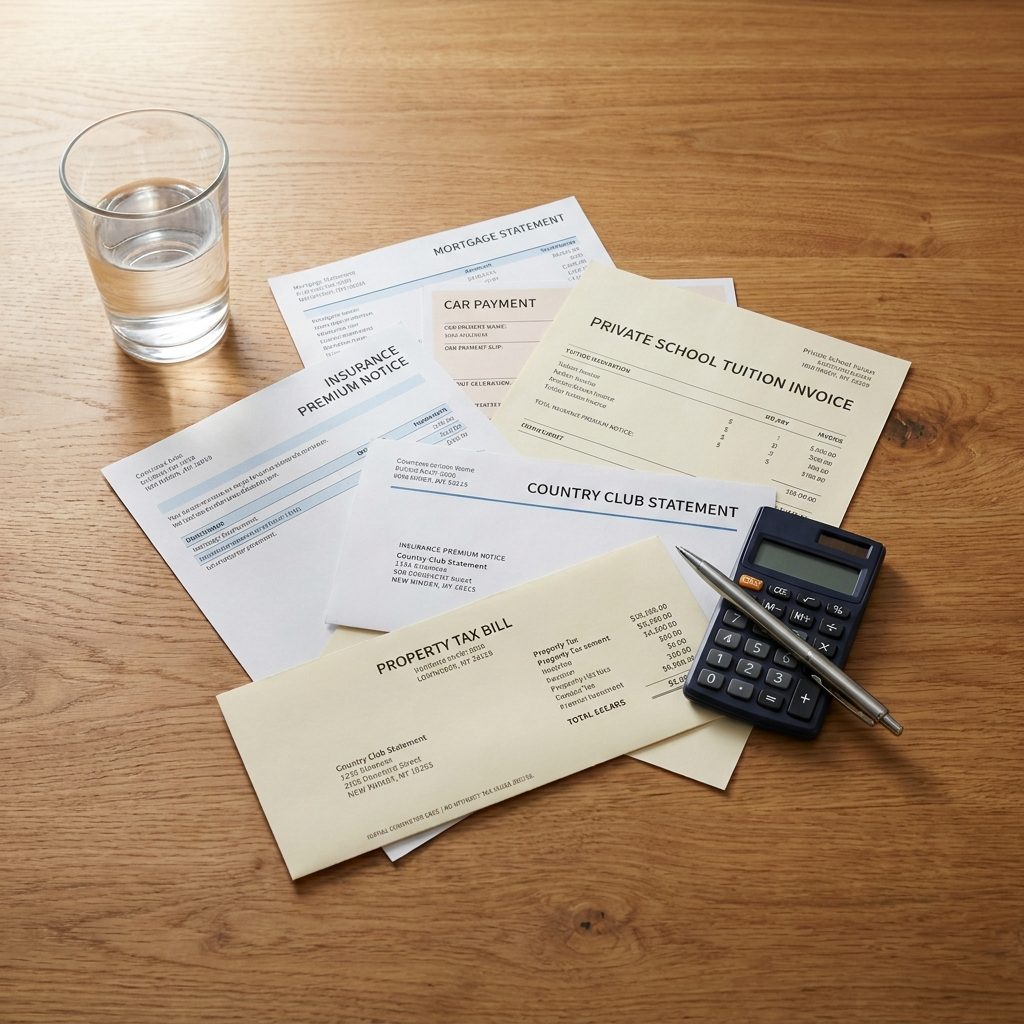
The golden handcuffs aren’t golden. They’re just handcuffs.
Mortgage: $5,200. Two car leases: $1,900. Private school for two kids: $6,500. Nanny: $4,000. Insurance bundle: $1,800. That’s $19,400 before you’ve eaten a meal, bought a gallon of gas, or put a dollar toward retirement. At $30,000 per month take-home, you’ve already committed 65% of your income to obligations you can’t pause, reduce, or renegotiate without significant life disruption.
This is how a household earning $500,000 ends up feeling financially identical to a household earning $80,000: the fixed-cost floor rises to meet the income ceiling, and the space between them, the part that’s actually yours, shrinks to almost nothing. You can’t take a sabbatical. You can’t switch to a lower-paying job you’d actually enjoy. You can’t even negotiate aggressively at your current job because the risk of losing it is existential.
The fix isn’t dramatic. It’s mathematical. Write down every single recurring monthly charge. Circle the ones you could theoretically eliminate within 90 days. If that circled number isn’t at least 20% of your take-home, your lifestyle has more control over you than you have over it.
Building Friend Groups Entirely Around Expensive Lifestyles That Become Financially Impossible to Step Away From

Your social circle costs more than you think. Not because your friends are bad people, but because the default settings of the group, the restaurants, the trips, the wine, the neighborhoods you all live in, establish a spending floor that nobody explicitly chose but everyone quietly maintains.
Try suggesting the cheaper restaurant. Feel the slight pause. Notice how quickly someone says, “Oh, let’s just go to the usual place.” That pause is the sound of a social norm enforcing itself. And it adds up: if your friend group’s default weekend involves $300 dinners, $150 concert tickets, and ski trips that cost $4,000 per family, you’re spending $30,000 to $50,000 a year just maintaining friendships. That’s not friendship. That’s a subscription with an emotional penalty for cancellation.
The most expensive thing in your life might not be your mortgage. It might be your social calendar.
You don’t need to dump your friends. But you do need at least two or three friendships that cost essentially nothing to maintain. People you’d see for a walk, a beer on a porch, a backyard cookout. If every relationship in your life requires a credit card, something has gone sideways.
Assuming Future Bonuses, Commissions, or Stock Grants Are Already “Basically Earned”

You’ve gotten a bonus every March for six years. So you’ve started spending it by January. The kitchen renovation is already underway, the deposit on the summer rental is paid, and you mentally filed that $45,000 under “incoming” even though it hasn’t arrived yet. This is how high earners end up in consumer debt that makes no sense on paper.
Variable compensation is variable. That word is doing real work. Companies restructure bonus pools. Commissions get recalculated. RSU grants vest into a stock price that moved 30% in the wrong direction. I know someone who spent two years’ worth of expected bonuses on a boat, then watched the company freeze discretionary comp during a downturn. The boat payment didn’t freeze.
Only spend money that has already cleared your bank account. If the bonus lands, great. Decide what to do with it then. If it doesn’t land, you’re not scrambling. This one rule, applied consistently, is worth more than any budgeting app you’ll ever download.
Upgrading Houses Every Few Years and Restarting the 30-Year Mortgage Clock Each Time

You bought the starter home at 32, sold it at 35 for something in a better school district, and traded up again at 39 because you could finally swing the neighborhood you actually wanted. Each time, you celebrated the new purchase. Each time, you quietly restarted a 30-year amortization schedule—meaning you spent a decade mostly paying interest and building almost no equity.
The math is brutal. Those first seven to ten years of a mortgage are heavily front-loaded with interest, so reset that clock three times and you’ve basically rented from a bank for fifteen years while telling yourself you were building wealth. If you’re going to move, refinance into a 15-year loan on the next place, or make extra principal payments starting month one. The goal isn’t to never move. Just stop treating your primary residence like a revolving credit line dressed up in granite countertops.
Spending Heavily on Luxury Wellness, Optimization, and Productivity Systems That Mainly Exist to Sustain Overwork

Would you like to save this?
The $200-per-month supplement stack. The $350 infrared sauna sessions. The $5,000 executive health screening. The sleep optimization mattress, the nootropics, the red-light panel bolted to your bathroom wall. You’re not spending this money because you’re healthy. You’re spending it because you’re not, and instead of addressing the root cause (you work too much, sleep too little, and haven’t had an unscheduled Saturday in four months), you’re buying products that help you sustain the very lifestyle that’s breaking you down.
This is the wellness-industrial complex, and it loves high earners. It sells you recovery from a problem it never asks you to solve. A $12 magnesium supplement and eight hours of sleep will outperform a $15,000 annual biohacking budget every single time. But sleep requires you to stop working, and stopping working requires confronting why you can’t.
Becoming Trapped by Country Club, Golf, Ski Club, or Social Memberships Nobody Fully Enjoys Anymore but Feel Socially Impossible to Quit

The initiation fee was $35,000. Annual dues run $12,000. You go maybe six times a year, and at least two of those visits involve sitting through a dinner you didn’t want to attend with people you’d describe as “fine.” But quitting feels loaded. It feels like announcing to your community that you can’t afford it, or that you’re withdrawing socially, or that you’re somehow less committed to the neighborhood’s invisible social contract.
So you keep paying. Year after year. And the math gets worse over time, not better, because the sunk cost of that initiation fee makes every additional year feel like you “should” stay to get your money’s worth. This is the sunk cost fallacy wearing a polo shirt and boat shoes.
Here’s something nobody tells you: most clubs are quietly full of members who feel exactly the same way. You’re all trapped in a polite standoff, each assuming everyone else is having a great time. Resign. Take the social hit, which will be smaller and shorter than you imagine. Use the $12,000 to do something you actually want to do. And if the friendships were real, they’ll survive the loss of a shared monthly bill.
Accumulating “Small Luxuries” Everywhere Until Your Fixed Monthly Spending Becomes Quietly Absurd

None of these feel like a splurge — and that’s precisely the problem. The $280 monthly gym with eucalyptus towels, the $14 cold-pressed juice three times a week, first-class upgrades on domestic flights, organic grocery delivery with a convenience fee you stopped noticing in February. Private swim lessons for the kids, a golf coach for you, a Pilates reformer membership for your partner. Each one is perfectly reasonable on a six-figure income. Stack them together and they form a shadow budget that can swallow thousands a month before you’ve paid a single actual bill.
I got this wrong for years. I’d scan the big line items, see nothing alarming, and wonder why the checking account felt tight by the 20th. The fix isn’t deprivation — it’s a quarterly audit where you list every single recurring “small” charge and total them. Seeing it all on one page hits differently than approving each charge on its own.
Mistaking Home Equity Appreciation for True Financial Flexibility

Your house went up $400,000 in value and you feel rich. You’re not. You live there. Unless you’re willing to sell, downsize, or borrow against it, that number is a psychological comfort blanket — not liquidity. I’ve watched friends use their Zillow estimate as justification for delaying retirement contributions, skipping an emergency reserve, or financing a kitchen reno at brutal interest rates.
Home equity is real wealth on paper, sure. But it’s locked behind a transaction most high earners never plan to make. A couple sitting on seven figures of home value with $40,000 in accessible savings? More financially fragile than they’d ever admit over drinks. Build your confidence around assets you can actually reach without selling your address.
Assuming Dual High Incomes Are Permanent and Building Every Obligation Around Both Salaries Indefinitely

The Two-Income Trap at $400K
When both partners earn $150K or more, the math feels bulletproof — so you buy the house that requires both incomes, commit to private school tuition that requires both incomes, lease two cars, max out two retirement accounts, hire a nanny, and build a life whose operating cost sits at roughly 85% of combined take-home pay.
Then one person gets laid off. Or burns out. Or wants to try something new. Or has to care for an aging parent. And the household discovers its entire framework was engineered for a condition — dual high income — that was always more fragile than it appeared.
The smartest high-earning couples I know structure fixed obligations around one salary and treat the second as fuel for savings, investments, and flexibility. It feels conservative. It is conservative. That’s what makes it work.
Turning Every Vacation Into a Five-Figure Production You Need a Vacation to Recover From

The family trip to Italy that started as “let’s just go for a week” somehow becomes business-class flights, a villa in Tuscany, a private cooking class, a day trip to Cinque Terre with a hired driver, and a shopping afternoon in Florence where everyone gets “one nice thing.” Final damage: five figures for seven days. And honestly? The kids mostly remember the gelato and the pool.
I will die on this hill: the best trips I’ve taken cost a fraction of the most expensive ones. A rented cabin, a cooler full of good cheese and bread, a lake. Done. The inflation happens because high earners start benchmarking vacations against what their peers post rather than against what actually recharges them. Before booking the next trip, ask a genuinely uncomfortable question — who is this vacation for, and what would a version at 40% less actually sacrifice?
Feeling Unable to Take Career Risks Because the Household Overhead Became a Cage

This one’s quiet and corrosive. You’ve got the skills, the network, maybe even an idea that keeps you up at night — but the mortgage is enormous, the kids’ school costs a fortune, the cars have payments, and the whole machine requires your current salary to keep humming. So you stay. You take the calls on Sunday. You absorb the reorg. You watch someone with half your talent but lower overhead go build the thing you wanted to build.
Golden handcuffs get discussed plenty in the context of stock vesting and bonuses. But for most high earners, the real constraint is the lifestyle commitments they locked in during peak earning years. The overhead became the boss.
Living in Constant Comparison Mode Where Upper-Middle-Class Success Starts Feeling Average

Nobody warns you about this when your income crosses a certain threshold: your reference group shifts. Suddenly you’re surrounded by people earning far more — at the neighborhood barbecue, in the school pickup line, at the club. Everyone around you has more, or appears to. Your household income, which statistically puts you near the top nationally, starts feeling like you’re barely treading water.
“Wealth is relative, and the neighborhood you can finally afford is the one that makes you feel poor again.”
Hedonic recalibration at its most vicious. The problem isn’t your income — it’s your comparison set. Social media compressed this effect into something almost inescapable, too, which is fun. The antidote isn’t gratitude journaling. It’s deliberately maintaining friendships and community ties outside your income bracket so your sense of “normal” doesn’t drift into the stratosphere without your permission.
Realizing That Many Luxury Purchases Mainly Exist to Impress People Equally Trapped in the Same Cycle

The watch. The car. The kitchen renovation. The bag. At some point — if you’re honest with yourself — you notice a pattern: the audience for most of these purchases is a tiny group of people who own the exact same things. You’re performing for each other. The luxury SUV impresses the other parents in the school pickup line who also drive luxury SUVs. The kitchen with the imported range impresses the dinner guests who have the same range. Closed loop.
I’m not above this, by the way. I’ve bought things specifically because I knew a certain person would notice. That’s human. But recognizing the loop matters — it’s how you start spending on what genuinely moves you rather than what signals correctly to your peer group. Some of the most financially secure high earners I know drive deeply boring cars and spend lavishly on things nobody else ever sees: their kids’ college funds, rental properties in unglamorous markets, experiences that don’t photograph well at all.