
Would you like to save this?
Nobody pulled you aside and told you the camera thing was a problem. No one flagged that your Slack response time was sending a message you didn’t intend. That’s the trouble with remote work mistakes: they don’t announce themselves. They just compound, quietly, until a promotion cycle passes and your name isn’t on the list. These 38 habits aren’t dramatic failures. They’re subtle signals, and most of them are fixable by Friday.
38. Keeping Your Camera Off So Often That Coworkers Forget What You Look Like

That black square with your initials isn’t neutral. It’s a signal. When your camera stays off meeting after meeting, you stop being a colleague and start being a notification sound. People remember faces. They advocate for faces. A gray tile with “JM” on it doesn’t get mentioned when someone asks, “Who should lead this project?”
The fix isn’t turning your camera on for every standup. It’s strategic. Turn it on for the meetings where decisions happen, where leadership is present, where your input matters most. Three to four camera-on meetings per week changes how people think about you entirely. And yes, the messy bookshelf behind you is fine. Nobody cares.
37. Becoming Known as the Person Who Replies Quickly but Rarely Contributes Ideas

Speed is not the same as value. Responding to every thread within ninety seconds makes you look available. It does not make you look strategic. Managers notice the difference between someone who keeps the gears moving and someone who shapes where the machine goes. Both matter, but only one gets promoted.
Next time a problem lands in a group chat, resist the fast reply. Take ten minutes. Come back with a suggestion, a question nobody asked yet, or a framework that reframes the issue. One thoughtful message per week carries more weight than two hundred thumbs-up reactions.
36. Logging Off Exactly at Quitting Time While Everyone Else Stays Visible During Crunch Periods

I want to be careful here because boundaries matter and burning out helps nobody. But there’s a difference between protecting your time consistently and vanishing at 5:00 PM sharp during the one week your team is scrambling to hit a deadline. Leadership doesn’t expect you to work every evening. They do notice patterns during high-stakes moments.
The Quiet Fix
During normal weeks, log off whenever you want. During the two or three genuine crunch periods per quarter, stay visible for an extra thirty minutes. Send a message. Offer help. You don’t have to do more work. You just have to show you’re aware the ship is taking on water.
35. Skipping Optional Meetings That Senior Leaders Quietly Pay Attention To

“Optional” on a calendar invite is one of the most misleading words in corporate life. The all-hands Q&A. The cross-team showcase. The brown-bag lunch with the VP who just joined. These are labeled optional because HR said they had to be. They are not actually optional for anyone who wants to be remembered.
You don’t need to attend every one. But skipping all of them puts you in a category: the people who only show up when required. And that category never overlaps with the people who get tapped for stretch assignments. Pick one optional meeting per month that puts you in a room, even a virtual one, with someone two levels above you. Just be there. Ask one question. That’s it.
34. Speaking Only When Called on Instead of Volunteering Insights

Waiting to be called on worked in school. In a meeting with eight remote participants and a VP scanning for future leaders, silence reads as disengagement. Or worse, as having nothing to say.
The people who get promoted aren’t necessarily the loudest. They’re the ones who volunteer a perspective at one key moment. Practice this: in your next meeting, identify the single most important question being discussed and prepare a two-sentence take before you even join the call. Then say it in the first fifteen minutes, before the conversation moves on and your window closes. Two sentences. That’s all it takes to shift from attendee to contributor.
33. Treating Slack Like Email and Responding Hours Later

Slack is synchronous. That’s the whole point. When someone asks a quick question and your reply arrives three hours later, you’ve just told your team you’re either overwhelmed, checked out, or working on something you consider more important than them. None of those impressions help you.
I got this wrong for years, by the way. I’d batch my Slack responses like email because it felt “efficient.” It wasn’t. It just made me invisible during the hours when decisions were actually being made. The fix: check Slack every 45 minutes during core hours. You don’t need to respond to everything instantly. But a quick “seeing this, will circle back in an hour” buys you all the time you need without the silence.
32. Never Turning Small Talk Into Relationship-Building Conversations

“How was your weekend?” “Good, yours?” “Good.” Conversation over. Connection: zero.
Remote work stripped away the hallway chats, the lunch runs, the accidental two-minute conversations that used to build real relationships. And most of us never replaced them with anything. We just let the small talk stay small.
Here’s what works: ask one follow-up question. That’s the entire technique. Someone mentions their kid’s soccer game, ask how the season’s going. Someone says they tried a new restaurant, ask if it’s worth the drive. One follow-up question turns a pleasantry into a memory. And people advocate for people they actually know, not polite strangers who say “good, yours” every Monday morning.
31. Doing Great Work That Nobody Outside Your Immediate Team Ever Hears About

Visibility is not vanity. I will die on this hill. The instinct to let good work speak for itself is noble and completely wrong in a remote environment. Your director can’t walk past your desk and notice the whiteboard covered in your brilliant process redesign. Your skip-level manager can’t overhear you troubleshooting something complex on a call. None of that ambient awareness exists anymore.
In a remote setting, work that isn’t narrated is work that doesn’t exist to anyone beyond your immediate team.
Send a brief monthly recap to your manager. Not a brag email. A two-paragraph update: here’s what shipped, here’s what I learned, here’s what I’m tackling next. Give your manager the language they need to advocate for you in rooms you’re not in. That’s not self-promotion. That’s basic professional communication.
30. Avoiding Cross-Functional Projects Because They Create Extra Meetings

Would you like to save this?
Cross-functional projects are annoying. More calendar invites, more stakeholders who don’t understand your constraints, more Slack channels with names like #project-phoenix-v2-final. I get it. But those projects are exactly where promotions are decided, because they’re where senior leaders see you operate outside your comfort zone.
Staying inside your team’s lane feels safe and productive. It is productive. But it also makes you invisible to the broader organization, and it signals that you’re comfortable where you are. One cross-functional project per quarter is enough. Pick one that aligns with a skill you want to be known for, and volunteer before you’re assigned.
29. Letting Your Manager Discover Your Accomplishments From Someone Else

Your manager should never learn about your wins from a peer, a Slack thread, or a quarterly review written by someone else. When that happens, two things register: one, you did something good, and two, you didn’t think it was worth mentioning. The second impression cancels out the first almost entirely.
This isn’t about bragging. It’s about giving your manager the information they need to go to bat for you. They have six or eight direct reports. They’re in back-to-back meetings. They are not tracking your contributions with the detail you assume they are. Nobody is.
Build a simple habit: at the end of each week, send your manager a three-line Friday note. What you shipped. What’s in progress. One thing you’re proud of. Takes two minutes to write. Changes everything about how your name comes up during calibration conversations.
28. Being Reliable but Invisible: The Trap of Getting Everything Done Without Anyone Noticing

You hit every deadline. Your error rate is basically zero. And somehow, when the promotion list circulates, your name isn’t on it. What happened? You became furniture — reliable, load-bearing, always present, never demanding attention. Managers don’t promote furniture. They promote people whose contributions they can actually describe to their own bosses in a sentence or two.
The fix isn’t bragging. It’s narration. When you finish a project, shoot your manager a two-sentence summary with the outcome and one decision you made that shaped it. Something like: “Wrapped up the Q3 vendor analysis — ended up restructuring the comparison framework because the old one was burying a real cost gap.” That gives your manager context they need and probably want.
27. Multitasking So Aggressively During Meetings That You Miss Opportunities to Contribute

I did this for two straight years, convinced I was being efficient. Camera off, muted, triaging Slack messages while the meeting hummed in the background. Then my VP asked me directly what I thought about a proposed restructure and I had to say “Could you repeat the question?” in front of fourteen people. Mortifying. But clarifying — because that’s when I realized meetings aren’t really about the content. They’re auditions.
Every meeting with leadership present is a chance to say something sharp. Not long. Not rehearsed. One good question, one observation proving you tracked the actual conversation. You cannot do that while simultaneously answering emails. Close the other tabs. Just for the meetings that count — you know which ones they are.
26. Never Asking Thoughtful Questions in Town Halls or Team Discussions

Town halls feel like spectator events. Someone presents slides, leadership says encouraging things, and then comes the Q&A where the same three eager people always raise their hands. You stay quiet because your question feels too small, too obvious, or you worry about looking performative.
What nobody tells you: senior leaders remember people who ask good questions — not sycophantic ones, not “gotcha” ambushes, but questions revealing thought beyond your immediate role. Something like “How does this initiative connect to the client retention trends from last quarter?” signals strategic range. Costs you thirty seconds of mild discomfort. Buys visibility you genuinely cannot manufacture any other way.
25. Keeping Your Status Permanently Set to ‘Busy’ When You Think It Signals Productivity
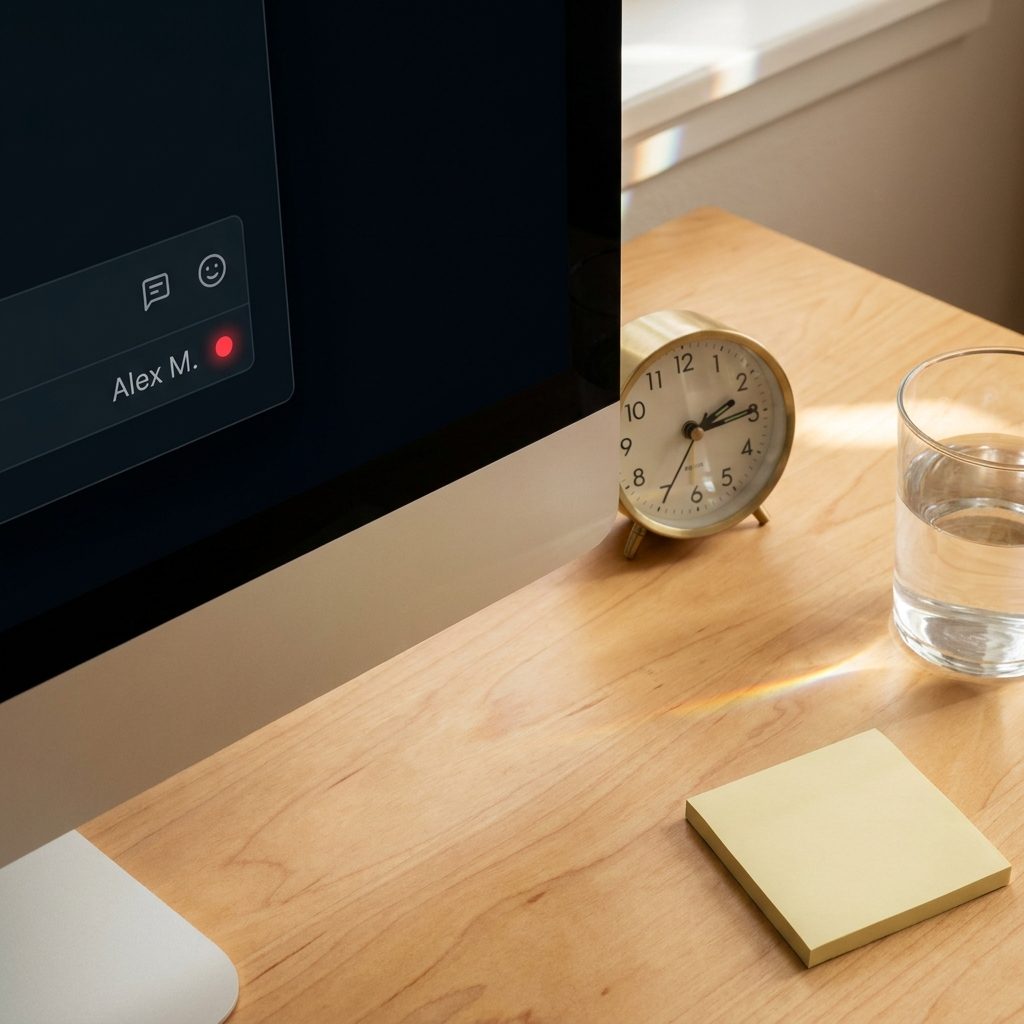
You set it to “Busy” because you need focus time. Completely reasonable. But when that red dot stays lit every single day, all day, for months? You’ve accidentally broadcast something you didn’t intend: Don’t come to me.
Managers route opportunities to people who seem approachable — not idle, but reachable. When a cross-functional project needs a volunteer, your manager isn’t tapping the person whose digital door has been bolted shut since March. They’ll gravitate toward someone whose green dot suggests a willingness to engage. Block focus time on your calendar instead, and set a custom status like “Deep work until 2 PM, open after.” Protects your concentration without building a fortress around your entire workday.
24. Solving Problems Quietly Instead of Sharing the Lessons Learned with Your Team

The Quiet Fixer Paradox
You spotted a process failure, diagnosed the root cause, implemented a fix on your own, and everything kept running smoothly. Nobody panicked. Nothing broke. Your reward? Absolutely nothing — because nobody knows it happened.
This one stings because the instinct is genuinely good. Fixing things without drama signals real competence. But competence nobody witnesses is competence nobody credits. And uncredited competence collects dust during promotion cycles.
Next time, write a brief “lessons learned” note and post it in your team channel or bring it up during standup. Frame it as useful for everyone: “Found a gap in our vendor onboarding flow that was generating duplicate entries — here’s what I changed and why.” One paragraph turns a silent repair into a moment people associate with your judgment.
23. Declining Travel Opportunities That Create Face-to-Face Exposure with Leadership

The conference invite hits your inbox and your first thought is logistics — the flight, the hotel, the disruption to your routine, the dog that needs watching. So you decline. Someone else goes. That someone else ends up having dinner with the VP of product, splitting a cab with a director from another division, or just being physically present when a hallway conversation reshapes a project’s direction.
I won’t pretend every business trip is career-changing. Most involve bad coffee and recycled slide decks. But the ones where senior leadership is present? Different animal entirely. A fifteen-minute face-to-face conversation builds more relational weight than months of polished Slack messages ever could. Say yes to at least a couple of these a year, even when the timing is terrible.
22. Waiting for Annual Reviews to Finally Discuss Your Career Ambitions

Annual reviews are backward-looking documents. They summarize what already happened. If the first time your manager hears “I want to lead a team” is during your December check-in, you’ve waited eleven months too long.
Promotions get decided in quiet rooms weeks before anyone announces them. Your manager needs runway to advocate for you, and advocacy requires knowing what you actually want. Have the conversation in January. February at the latest. Definitely before Q3 planning kicks off, because that’s when headcount and role changes get slotted in.
Keep it dead simple: “I’d like to be considered for a senior role in the next cycle. What would need to be true for that to happen?” One question. Gives your manager a framework and a timeline. Puts you on the list before the list exists.
21. Failing to Build Relationships with People Above Your Direct Manager

Your manager is not your only audience. I will die on this hill. The person green-lighting your promotion is often your manager’s manager, or a peer leader on a talent review committee who has never worked with you directly. When your entire professional identity flows through a single person inside the company, you’ve built a single point of failure. And single points of failure break.
None of this means going over your boss’s head. It means finding legitimate reasons to interact with senior people — volunteering for a cross-team initiative, asking your skip-level for a twenty-minute career conversation, commenting with substance on a VP’s internal post. These aren’t political maneuvers. They’re how organizations actually function. The people who get promoted are the ones whose names surface in rooms they aren’t in, spoken by people outside their direct reporting line.
20. Being Seen as Available for Tasks but Completely Unavailable for Leadership

Would you like to save this?
There’s a version of being helpful that quietly damages your trajectory. It looks like this: every time someone needs a deck reformatted, a spreadsheet tidied up, or meeting notes taken, your hand goes up. You’re the person who always says yes to the task. Over months, that becomes your identity — not “leader,” not “strategic thinker,” just… the reliable task-completer everyone leans on when the unglamorous work piles up.
The promotion paradox: the better you are at tasks nobody else wants, the harder it becomes to be seen as anything other than the person who does tasks nobody else wants.
Start selectively redirecting your energy toward projects with ambiguity — the ones where nobody has a checklist yet because the checklist needs to be invented. Those are leadership opportunities wearing the disguise of messy, undefined work. Volunteer for one of those instead of the next formatting request.
19. Turning Every Interaction into a Transaction Instead of an Actual Conversation

“Hey, quick question.” “Need the file.” “Can you update the tracker?” Every message stripped to pure function — no warmth, no curiosity about the other person, no conversational padding. You think you’re respecting everyone’s time. And you are. But you’re also grinding every relationship down to its mechanical skeleton.
Remote work already killed the hallway small talk, the coffee run invitations, the “how was your weekend” you half-listen to but that secretly deposits trust in some invisible relational account. If your digital communication scrubs out the last remaining traces of personality, you become interchangeable with a well-configured automation. Nobody goes to bat for an automation during talent reviews.
Before your next Slack message, add one human sentence. Not manufactured warmth — real warmth. “Hope the move went okay” if they mentioned relocating. “Your read on that vendor situation yesterday was really sharp” if it was. Four seconds of effort. Completely changes how people experience collaborating with you.
18. Never Mentoring Newer Employees Because You’re Too Buried in Your Own Workload

That junior hire who pinged you last month asking how to format the quarterly deck? You meant to respond. You really did. But your own deliverables were stacking up, so you sent a thumbs-up emoji and moved on. The quiet cost: leadership tracks who develops others, not just who delivers. Mentoring signals management readiness, and skipping it tells everyone you’re content staying put.
Block 30 minutes every other week for a standing check-in with one newer colleague. No formal program needed — just answer their questions, share a shortcut you’ve picked up, point them toward the right stakeholder. It costs almost nothing and registers in ways your task list never will.
17. Communicating Only Through Text When a Quick Video Call Would Build Rapport Faster

Slack messages don’t carry tone, warmth, or the micro-expressions that make a colleague think, “I trust this person.” I spent two years defaulting to chat for everything before realizing my manager had a stronger working relationship with someone who delivered less but hopped on camera twice a week. That stung.
The fix isn’t hour-long Zoom marathons. Once or twice a week, when a thread crosses five messages, flip it to a five-minute video call. Let people see your face. Laugh at a bad joke. Those tiny moments of real presence compound into something typed words never build: genuine rapport. And frankly, most of those long threads resolve faster on camera anyway.
16. Assuming Productivity Automatically Leads to Visibility

This one stings because it feels so unfair. You’re crushing your to-do list — every deadline met, every deliverable polished — and yet someone who does half the volume keeps getting mentioned in leadership meetings. What gives?
The Uncomfortable Truth About Remote Output
In an office, your work is partially visible by proximity. People walk past your desk, overhear your calls, see you grinding at 6 PM. Remote work strips all that ambient visibility away. Your output lives in a system somewhere, but nobody’s browsing Asana recreationally.
Productivity is necessary. Not sufficient. You need to pair execution with narration: a brief weekly update to your manager, a Slack post summarizing a win, a mention of your project’s impact during a team call. Not bragging — just making the invisible visible.
15. Treating Remote Work as an Escape from Office Politics Instead of Recognizing That Influence Still Matters

“At least I don’t have to deal with office politics anymore.” I’ve said this. You’ve probably said it too. Feels true for about six months — right up until someone you’ve never really spoken to gets promoted over you because they built the right relationships while you enjoyed the quiet.
Office politics isn’t a dirty phrase. It’s influence. Knowing who makes decisions, understanding what they value, making sure your work connects to their priorities. Going remote doesn’t eliminate that dynamic. It just hides the playing field, which is worse, because now you can lose without ever knowing you were in the running.
Start small. Identify two cross-functional stakeholders whose work touches yours and set up a 15-minute intro call. Ask what they’re focused on. You’re not scheming. You’re building the connective tissue that careers depend on.
14. Becoming So Comfortable at Home That You Stop Actively Managing Your Professional Reputation

Comfort is a sedative for ambition, and nobody warns you about it. The commute disappears, the dress code softens, the performative energy of being “on” fades into something quieter. Before long, you’re delivering good work in your cozy knit cardigan and sherpa-lined slippers, and that’s fine — genuinely. But you’ve also stopped updating your LinkedIn, stopped volunteering for visible projects, stopped thinking about what your name means inside the company.
Professional reputation decays without maintenance. Once a quarter, ask yourself: if my manager left tomorrow and a stranger took over, what would they learn about me from the record? If the answer is “not much,” you’ve got work to do beyond the deliverables.
13. Only Communicating When Work Is Complete Instead of Sharing Progress Along the Way

Perfectionists get bitten hardest here. You want to present the finished, polished thing — the complete analysis, the final draft. So you vanish for two weeks, surface with something excellent, and wonder why your manager seems vaguely anxious every time you go quiet.
From their seat, silence reads as uncertainty. They can’t see your screen. They don’t know if you’re stuck, coasting, or brilliantly focused. A quick Thursday message — “halfway through the analysis, early findings suggest X, full draft by Monday” — takes 30 seconds and does three things at once: it reassures, it creates a touchpoint, and it gives your boss something to relay upward. That last part matters more than you think.
12. Having a Spotless Task List but No Recognizable Personal Brand Inside the Company

Every task done. Every box checked. And if someone asked your VP what you’re specifically known for? They’d pause for an uncomfortably long time.
An internal personal brand isn’t about self-promotion theatrics. It’s about being known for something specific — maybe you’re the person who always catches data inconsistencies, or the one who writes the clearest project briefs, or the one who runs the tightest retrospectives. Whatever it is, name it, own it, and make sure it surfaces in your communication.
- Pick one professional strength that genuinely differentiates you.
- Reference it naturally in team settings: “I noticed something in the data that looked off — want me to dig in?”
- Let that consistency build recognition over six months.
Completion is baseline. What gets remembered is a different question entirely.
11. Letting Your Boss Become the Sole Narrator of Your Contributions

Your manager probably likes you. They probably mean well. They’re also juggling a dozen other direct reports, three cross-functional initiatives, and their own promotion anxieties. Expecting them to accurately and enthusiastically represent your work to their leadership? That’s like expecting a waiter to describe your grandmother’s recipe with the same love she would. Not going to happen.
I will die on this hill: you need to tell your own story. Not constantly. Not obnoxiously. But deliberately. Send a monthly highlights email to your boss. Copy relevant stakeholders when a project wraps. Volunteer to present your own work instead of letting your manager summarize it on a slide they cobbled together in five minutes. Your career story is too important to hand off entirely to someone with a hundred other things competing for their attention.
10. Avoiding Healthy Workplace Conflict and Becoming Known as ‘Easy to Overlook’

Would you like to save this?
Agreeableness feels safe behind a screen. Someone proposes a timeline you know is unrealistic? You type “sounds good” because pushing back over Slack feels awkward. A colleague takes your idea and rephrases it as their own in a meeting? You let it slide because you don’t want to be “that person.”
Here’s what happens after months of quiet compliance: you become furniture. Pleasant, reliable, and completely invisible when decisions get made about who’s ready for more. Leaders promote people who demonstrate judgment — and judgment sometimes looks like respectful disagreement. You don’t need to pick fights. Practice one sentence: “I see it differently, and here’s why.” Say it once a week in a meeting. Say it warmly. Say it with data. Watch what shifts.
9. Never Sharing Wins Because You Don’t Want to Sound Self-Promotional

Modesty is a virtue right up until it makes you invisible. In remote work, where nobody sees you close a deal, rescue a project, or handle a difficult client call with grace, modesty becomes a professional liability faster than you’d expect.
The people getting promoted aren’t louder than you. They’re just giving voice to what you’re keeping to yourself.
Flagging an accomplishment doesn’t require a trumpet fanfare. It looks like this: “Quick update — we closed the Henderson account this week, wanted to mention it since it ties to the Q3 revenue goal we discussed.” That’s connecting your output to organizational priorities. Leadership recognizes the difference between that and empty chest-thumping.
If the word “self-promotion” makes your skin crawl, reframe it as making your work useful to others. When you share a win, you’re giving your manager ammunition for their own reporting, giving your team a morale boost, and creating a paper trail that exists outside your own head. Keep it factual, keep it brief, and stop hiding the brushed gold trophy behind the book stack.
8. Being Present in Meetings but Absent from Informal Networks

You show up to every standup, nod at the right moments, maybe even ask a question or two — and then you close the laptop and disappear until the next calendar invite. Meanwhile, your coworkers are having the conversations that actually shape who gets tapped for new projects. Those five-minute Slack exchanges, the “hey, quick thought” DMs, the casual virtual coffee nobody forced them to schedule.
Managers notice who builds connective tissue across a team, not just who attends meetings. The fix? Send one unsolicited message per week to someone outside your immediate circle. React to a colleague’s idea in a channel. Respond to something that isn’t assigned to you. Visibility isn’t performing — it’s being part of the ambient awareness that decision-makers rely on when they’re mentally assembling their shortlist.
7. Solving Problems Alone That Could Have Showcased Your Collaboration Skills

The instinct to handle it yourself is the problem. You spotted the bug, fixed the bug, moved on. Nobody saw the fix. Nobody saw your thinking. And when your manager later asks the team who has experience with that kind of issue? Silence — because you never mentioned it.
Remote work rewards the visible collaborator, not the quiet hero. Next time you catch something, pause before fixing it solo and drop a message: “Found something interesting, want to loop in [name] since it touches their area.” You still do the work. But now two people witnessed your instinct, your generosity, and your judgment about who else should be involved. That gap — between being competent and being seen as leadership-ready — is where promotions live.
6. Never Developing Allies Outside Your Department

Your immediate team knows you’re great. That’s nice. Also insufficient. Promotions rarely happen inside a vacuum — they involve budget conversations with finance, headcount discussions with HR, strategic alignment with leadership across divisions. If nobody in those rooms has ever worked with you or even heard your name, your manager’s recommendation lands cold.
I got this wrong for years, honestly. Thought doing excellent work in my lane was the whole game. It isn’t.
Start small. Volunteer for one cross-functional project a quarter. Comment thoughtfully in company-wide channels. Ask someone from another department for a 20-minute virtual coffee to understand what they’re working on. You’re not networking in the gross, transactional sense — you’re making sure that when your name comes up in a room you’re not in, at least one person can say, “Oh yeah, I know them. Sharp.”
5. Giving Short Answers That End Conversations Instead of Expanding on Ideas

The “Sounds Good” Trap
“Sounds good.” “Done.” “Agreed.” Conversation closers, all of them — and in a remote environment where your words are often your only presence, they make you invisible. Every terse reply is a missed chance to show how you think.
Compare “Done” with “Done, and I noticed the data format changed from last quarter, so I adjusted the import script to handle both. Might be worth flagging for the team.” Same work. Completely different signal. The second version shows initiative, pattern recognition, and consideration for the people around you. Nobody’s asking you to write essays. But adding one sentence of context to your responses — even twice a day — reshapes how people perceive your engagement and your depth.
4. Making Yourself Indispensable to Your Current Role Rather Than Promotable to the Next One

This one stings because it looks like excellence. You’ve become the person who knows where everything lives, who can fix the workflow nobody else understands, who trained three new hires and documented every process. Your manager loves you exactly where you are. And that — exactly that — is the problem.
If promoting you would create a hole nobody can fill, you’ve accidentally built a cage out of competence. I will die on this hill: the single most counterproductive thing a remote worker can do is hoard institutional knowledge.
- Document your processes so someone else can run them.
- Train a backup for your critical functions, visibly and on the record.
- Start doing a fraction of your week’s work at the level above your current title — strategic thinking, cross-team coordination, mentoring.
You want your manager to see you as ready for what’s next. Not as a load-bearing wall they can’t afford to move.
3. Keeping Your LinkedIn Profile Dormant While Ambitious Coworkers Stay Visible

“I’m not looking for a job, so why bother?” Because your boss looks at LinkedIn. Your skip-level looks at LinkedIn. The people making promotion decisions scan profiles when they’re building a mental model of who’s ambitious, current, and externally credible — and a dormant profile with a headshot from 2017 and a bio still mentioning your previous company sends a message you don’t want sent.
You don’t need to become a content machine. Update your headline to reflect what you actually do now. Share one article a month with a brief, genuine comment. Engage with your company’s posts. That’s it. The bar is remarkably low, which makes the gap between you and the coworker who does this remarkably obvious.
2. Never Volunteering to Present Findings or Lead Discussions

Someone has to present the quarterly findings. Someone has to walk the stakeholders through the proposal. In a remote setting, the person who volunteers for that visibility gets an outsized share of credit — not because they did more work, but because they were the voice and face attached to the outcome.
Look, I get it. Presenting on Zoom feels awkward. Your cat will walk across the keyboard. Your internet will glitch at the worst possible moment. None of that matters as much as you think it does. What matters is that leadership saw you own a room, organize information clearly, and handle questions without crumbling. Volunteer once a quarter. Start with a low-stakes internal update if the thought of a client-facing presentation makes your stomach flip. The muscle builds fast. The reputation? Even faster.
1. Being Reliable but Forgettable

The quiet killer — and the one that sits underneath half the other mistakes on this list. You hit every deadline. Never cause problems. Your work is solid. Then the promotion conversation happens behind closed doors, and your manager says something like, “They’re great, really dependable,” and the room moves on to someone whose name sparks a story, an opinion, a remembered flash of initiative.
Dependability is the floor, not the ceiling. The ceiling is being the person someone thinks of when an interesting problem needs solving.
Reliability without distinctiveness is a trap, and remote work makes it worse because there’s no hallway presence, no overheard conversation, no body language filling in the gaps. You have to manufacture those signals on purpose. Have an opinion in a meeting and state it plainly. Send your manager a brief note about something you noticed that nobody asked you to notice. Pitch an improvement to a process that’s “fine.” Fine is forgettable. Specific, constructive, a little bold — that sticks.